



Baseball at 1xBet
Baseball rewards patience in a way few other sports do — a 162-game MLB season means a single bad week rarely reflects a team’s real quality, and the gap between a bettor who just picks a favorite and one who actually reads a pitcher’s underlying numbers is enormous. 1xBet covers baseball markets across MLB, NPB, KBO, and a long list of international tournaments, and this guide goes past the basic bet types to explain the actual statistics that separate an informed wager from a guess — plus an honest look at why some popular “betting systems” you’ll read elsewhere are worth avoiding entirely.
What Actually Moves Baseball Odds
Before looking at bet types, it helps to know what sportsbooks themselves weigh most heavily when setting a line, since that’s the same information a bettor needs to evaluate whether a price is fair:
- Starting pitcher matchup — in baseball, more than in almost any other team sport, a single player (the starting pitcher) can swing a game’s expected outcome more than the rest of the roster combined
- Bullpen depth and recent workload — a strong starter means little if the bullpen has been overused in the past few days and is running on tired arms
- Home/road and ballpark dimensions — some parks add runs, others suppress them (more on this below)
- Weather — wind direction and humidity affect how far fly balls travel, particularly in open-air stadiums
- Rest and travel — day games after night games, cross-country travel, and getaway-day fatigue are all measurable factors that show up in team performance splits
- Injuries and lineup changes — a missing cleanup hitter or a bullpen arm on the injured list changes the calculus even if it’s not reflected yet in the season-long numbers
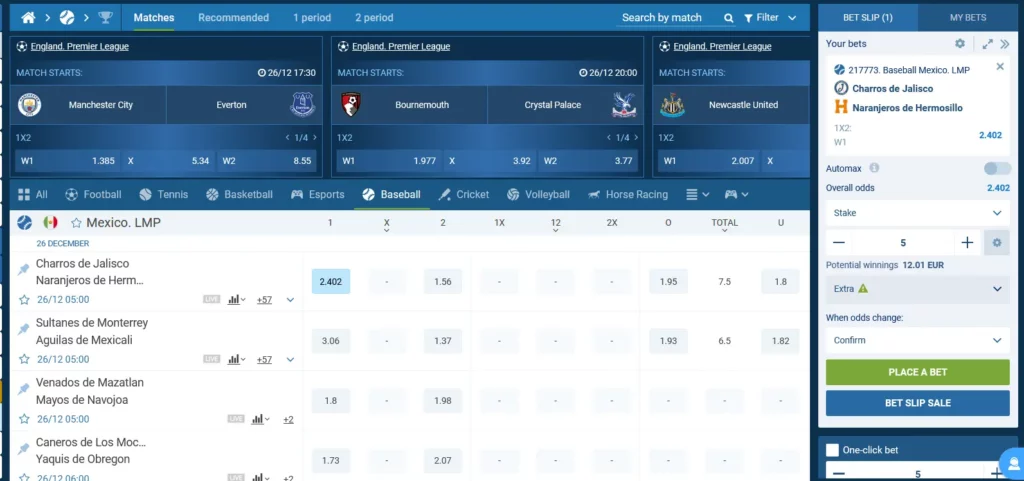
What you can bet on in baseball on 1xBet
Bet Types Available on Baseball
The core baseball markets on 1xBet break down into a few clear categories:
- Moneyline — picking the straight-up winner of the game
- Run line — baseball’s version of a point spread/handicap, almost always set at 1.5 runs
- Totals (Over/Under) — the combined number of runs scored by both teams
- Player props — strikeouts, hits, home runs, RBIs, and similar individual stat lines
- Innings betting — markets settled within a specific inning rather than the full game
- Futures — season-long or tournament-long bets on which team wins it all
Moneyline Bets: Picking the Winner
The moneyline is the simplest baseball bet — just the winner, with no points added or subtracted. Because baseball has no ties, this is a clean two-way market (barring the rare case of a suspended, uncompleted game).
What actually separates a good moneyline pick from a coin flip is starting pitcher quality more than team reputation. It’s common in baseball for a team with a losing overall record to be favored on a given night simply because their starter matches up well against the opposing lineup — team name recognition matters far less here than in sports like basketball or football, where a strong roster carries more weight game to game regardless of who’s on the mound.

Baseball at 1xBet
Run Line Betting (Handicap) Explained
The run line is baseball’s fixed-handicap market, almost universally set at 1.5 runs regardless of how mismatched the two teams look on paper. Betting the favorite at -1.5 means they need to win by 2 or more runs; betting the underdog at +1.5 means they win the bet either by winning outright or losing by exactly 1 run.
Example: In a game between the New York Yankees and the Baltimore Orioles, a bet on the Yankees at -1.5 only cashes if New York wins by 2 runs or more. A bet on the Orioles at +1.5 cashes if Baltimore wins outright, or loses the game by a single run (say, 4-3 or 5-4).
Because the handicap is fixed at 1.5 rather than adjusting to the matchup the way a football spread would, the odds — not the line — are what move to reflect how lopsided a game looks. A heavily favored team will carry a run line price with much shorter odds on the -1.5 side and correspondingly longer odds on the underdog’s +1.5, rather than the sportsbook moving to a -2.5 or -3.5 line.
Betting the Total (Over/Under)
The total combines both teams’ final run count, and in MLB it typically sits between 8.5 and 9.5 runs, adjusted up or down based on the specific pitching matchup, ballpark, and weather.
Example: In a Chicago Cubs–St. Louis Cardinals game set at 8.5, an Over bet needs 9 or more combined runs to win; an Under bet needs 8 or fewer.
The single biggest input into whether a total is fair is the pitching matchup — two strong starters with low walk rates typically point toward the Under, while a matchup involving a struggling bullpen or a hitter-friendly park points toward the Over. Weather compounds this: wind blowing out toward the outfield in an open stadium tends to add runs, while cold, heavy air suppresses fly-ball distance.
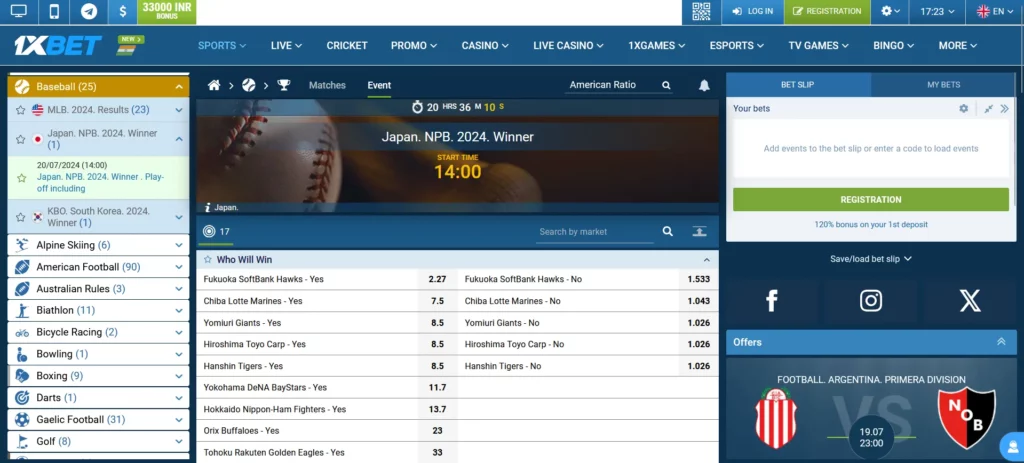
Baseball tournaments available for betting
Player Prop Bets
Player props let you bet on individual performance independent of who wins the game:
- Pitcher strikeouts — tied closely to a pitcher’s K/9 rate (strikeouts per nine innings) and the opposing lineup’s own strikeout tendency
- Batter hits and total bases — best evaluated against that specific pitcher’s platoon splits (how they perform against left-handed versus right-handed hitters)
- Home runs — heavily influenced by ballpark dimensions and a hitter’s recent barrel rate (how often they make optimal contact), not just their season home run total
- RBIs — depends as much on lineup position (hitters batting 3rd–5th get the most run-scoring chances) as on the player’s individual form
Props are where doing a bit of specific homework pays off most, since general team-level analysis (which side is favored, what the total is) doesn’t tell you much about how a specific batter matches up against a specific pitcher’s repertoire.
Inning and In-Game Betting
Innings markets let you bet on a smaller slice of the game rather than the full nine innings:
- First 5 innings (F5) — a common alternative to full-game totals and run lines, useful because it isolates the starting pitchers’ impact and removes bullpen variance from the equation entirely
- Individual inning winner — which team scores more in a specific inning, including the option that neither team scores
- Inning total — over/under on runs scored within one inning, usually set at 0.5 or 1.5
- Both teams to score — whether each side plates at least one run in that inning
- Exact inning score — a high-variance, high-payout market on the precise run count for both teams in that inning
First-5-innings markets deserve particular attention from bettors who like the pitching matchup but are less confident about a shaky bullpen — it’s a way to bet on the starter’s expected performance without the risk of a bullpen collapse affecting the result.
The Stats That Actually Matter: ERA, WHIP, FIP and Park Factors
This is the part most casual betting guides skip entirely, and it’s the difference between “look at the pitcher’s stats” as an empty phrase and actually knowing what to look for.
| Stat | What it measures | How to read it |
|---|---|---|
| ERA (Earned Run Average) | Earned runs allowed per 9 innings | League average sits around 3.90–4.50; under 3.00 is excellent, over 5.00 signals trouble |
| WHIP (Walks + Hits per Inning Pitched) | How many baserunners a pitcher allows per inning | League average is roughly 1.30–1.40; under 1.10 is elite |
| FIP (Fielding Independent Pitching) | A pitcher's performance based only on strikeouts, walks, and home runs — removing the defense behind them | Scaled like ERA; a large gap between ERA and FIP (more than roughly 0.7–1.0 runs) suggests the pitcher has been getting unusual luck or bad luck that may not continue |
| K/9 | Strikeouts per 9 innings | Higher is better for the pitcher; also useful for strikeout prop bets |
| OPS (On-base Plus Slugging) | A batter's ability to get on base and hit for power, combined into one number | League average is typically around .720–.750; anything over .850 is a strong hitter |
| Park Factor | How much a specific ballpark inflates or suppresses offense compared to a league-average park | A factor above 100 favors hitters (more runs, more home runs); below 100 favors pitchers |
The FIP-versus-ERA comparison is one of the most useful single checks a bettor can do: a pitcher whose ERA is significantly lower than their FIP has likely benefited from strong defense or favorable sequencing of hits — exactly the kind of pitcher whose next start is more likely to regress toward a higher run total than the market’s number implies.
Park factors matter more in baseball than in almost any other sport, because the physical dimensions of the field vary dramatically between stadiums. A hitter-friendly park with short fences and thin air tends to inflate both totals and home run props; a spacious, pitcher-friendly park with heavy sea-level air does the opposite. Checking whether a game is being played in a historically high-scoring or low-scoring venue is a five-minute step that meaningfully improves a total bet.
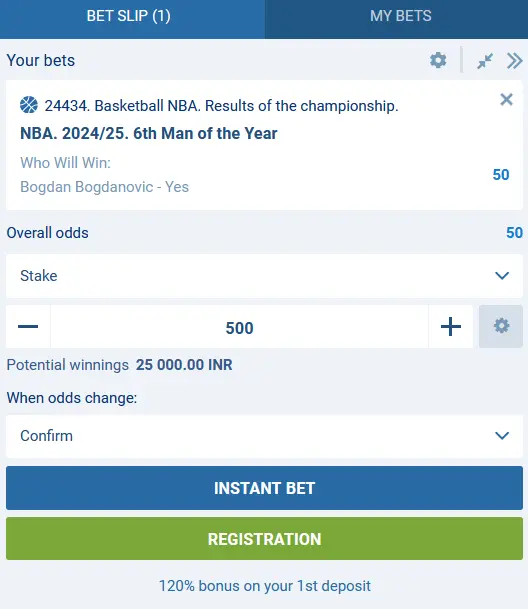
Types of baseball bets available at 1xBet
Tournaments and Leagues You Can Bet On
1xBet offers markets across the full spread of professional and international baseball:
- Major League Baseball (MLB) — 30 teams across the US and Canada, playing a 162-game regular season followed by a postseason bracket culminating in the World Series (best-of-seven)
- Nippon Professional Baseball (NPB) — Japan’s top league, 12 teams split into the Central and Pacific Leagues; playing styles emphasize contact hitting and precise pitching more than raw power, which tends to produce lower-scoring, tighter totals than MLB
- Korean Baseball Organization (KBO) — 10 teams, known for producing MLB-bound talent and for some of the highest-scoring environments among major leagues, partly due to smaller ballparks
- NCAA college baseball — deeper roster turnover and less publicly available scouting data than the pros makes markets here noticeably softer, but also less predictable
- Winter and regional leagues (Mexico, Cuba, the Dominican Republic, Venezuela, Nicaragua) — lower betting volume generally means less efficient pricing, which can work in an informed bettor’s favor
- International tournaments — the World Baseball Classic, the Baseball Americas Cup, and Olympic baseball when it’s on the program
A Smarter, Evidence-Based Approach to Baseball Betting
A lot of baseball betting content repeats advice that sounds intuitive but doesn’t hold up — the most common being the idea that a team “is due” to win after a losing streak, or that increasing a stake to chase back a previous loss is a sound strategy. It isn’t: each game is a new, independent event, and a losing streak has no bearing on the odds of the next result. Treating it as though it does is a well-documented cognitive bias, not an edge.
What actually helps over time:
- Compare FIP to ERA before trusting a pitcher’s season line, since a large gap in either direction flags a number that’s likely to shift
- Check the ballpark and weather for every total bet, not just the pitching matchup
- Track bullpen usage over the last 3–4 days, not just the starter — an overworked bullpen is a real, measurable risk factor
- Treat platoon splits as essential for player props, since a batter’s overall season average can mask a huge gap in performance against left-handed versus right-handed pitching
- Use live/in-game markets to react to information, such as an early exit by a starting pitcher, rather than to chase losses from an earlier bet
- Keep records of your own bets, including the reasoning behind each one — this is the only reliable way to find out whether a particular approach is actually working, rather than relying on memory of the wins and forgetting the losses
Which baseball tournaments you can bet on
A Note on Responsible Betting
Baseball’s long season and daily schedule make it easy to bet far more frequently than other sports — that volume is part of the appeal, but it’s worth setting a budget and sticking to it regardless of a hot or cold streak. No analysis, however detailed, changes the fact that each game carries genuine uncertainty, and betting more than planned to recover a loss tends to compound the problem rather than solve it.
Interesting Facts About Baseball
- The ball itself is built from a cork-and-rubber core, wound tightly in wool and cotton yarn, and finished with a cowhide cover — a single MLB game typically uses close to 100 balls, since any ball that touches the dirt is usually removed from play
- The spitball era — pitchers were legally allowed to apply substances to the ball to alter its movement until the practice was banned in 1920, after which “doctoring” the ball became an ejectable offense, forcing pitchers to rely purely on grip and arm angle for movement
- The World Series doesn’t have a fixed neutral venue — it rotates between the two finalists’ home stadiums, and the series is played best-of-seven, meaning a team needs four wins to be crowned champion
- The 3,000 Strikeout Club is one of pitching’s most exclusive milestones — a small group of pitchers in MLB history has recorded more than 3,000 career strikeouts, a mark that typically requires both longevity and sustained dominance
- Corporate sponsorship in Taiwan’s professional league has occasionally extended to team identity itself — one well-known franchise has carried a convenience-store chain’s branding directly in its team name
- Baseball’s global reach extends well beyond the US — it’s the most popular sport in Japan, Cuba, and the Dominican Republic, and a major sport in South Korea, Taiwan, and Venezuela, which is why 1xBet’s baseball coverage spans leagues on three continents rather than just MLB
 Aiden Brooks
