



Multi-account 1xBet
Not every case of “multi-accounting” on 1xBet is deliberate fraud — a surprising number of blocked accounts belong to people who simply shared a home Wi-Fi connection with a family member who also plays. This guide covers exactly what the one-account rule means, how detection actually works, what happens when it’s triggered, and — critically — how genuinely honest users can avoid getting flagged by accident.
The Core Rule: One Account Per Person, Household, and Payment Method
1xBet enforces a strict “one user — one account” policy, which is standard across the licensed betting and gambling industry. But the definition is broader than most players expect. In practice, an account is typically tied to one of the following, and duplication of any of them can trigger a review:
- One person
- One household or physical address
- One email address
- One phone number
- One payment card or e-wallet
- One IP address (in many cases)
This means the rule isn’t only about someone deliberately opening five accounts under fake names — it also covers situations like two family members registering separately from the same home network, or someone re-registering from the same device after losing access to an old account. Both scenarios can trigger the same automated review, even though only one of them is actual rule-breaking.
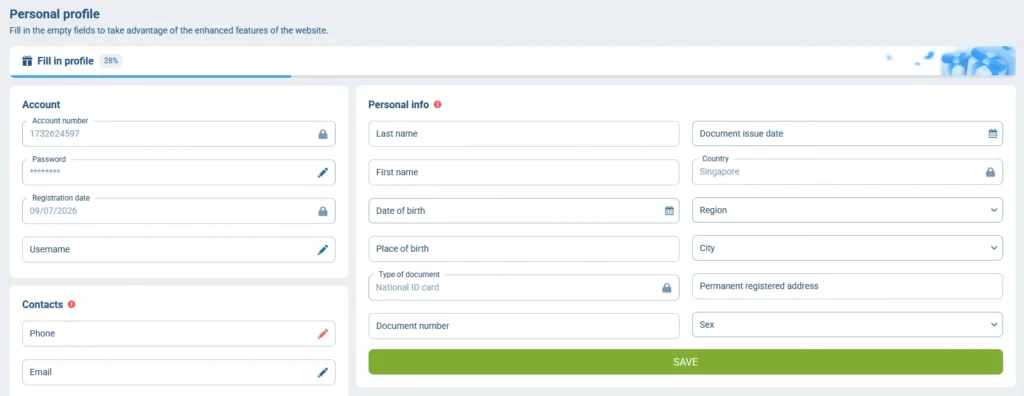
Personal Profile at 1xBet
Why the Policy Exists
- Bonus abuse prevention. Welcome bonuses and first-deposit offers are designed to be claimed once per person. Multiple accounts let the same individual collect the same promotion repeatedly, which distorts the economics of the offer for everyone else.
- Circumventing restrictions. A player limited or restricted on one account could otherwise open a fresh one to continue betting without those limits — multi-accounting is the primary way this gets attempted.
- Fraud and integrity. Betting with duplicate identities can be used to launder funds, obscure the source of a large win, or manipulate promotional systems at scale.
- Fair play. The policy exists to keep the playing field level — bonuses, odds, and limits are calculated on the assumption of one account per real person.
How 1xBet Detects Multiple Accounts
Detection isn’t based on a single signal — it’s a layered system that cross-references several data points at once:
| Signal | What It Reveals |
|---|---|
| IP address | Multiple accounts logging in from the same network address |
| Device fingerprinting | Hardware and browser configuration data that can link accounts even if the person used different names |
| Personal data matching | Overlapping names, phone numbers, or email patterns across profiles |
| Payment details | The same card or e-wallet used to fund more than one account |
| Betting history patterns | Similar staking behavior, market selections, or timing across accounts |
| Cookies and browser data | Stored identifiers that persist even after logging out |
| Geolocation | Sudden or implausible location jumps between sessions |
| Machine learning models | Pattern recognition across combinations of the above that aren't obvious individually |
Two details worth understanding here: first, disabling cookies or using a VPN to mask an IP address doesn’t make detection less likely — inconsistent or actively hidden data is itself treated as a risk signal, on top of whatever else the system finds. Second, none of these signals trigger a block in isolation; the system weighs several of them together, which is why a single shared IP address (like two people in the same house) doesn’t automatically equal a permanent ban, but does increase the chance of manual review.
If You Share a Household With Another 1xBet User
This is the situation most likely to catch an honest player off guard. If you live with a partner, roommate, or family member who also has (or wants) a 1xBet account, a few practical habits reduce the risk of an unintended flag:
- Keep accounts strictly on separate devices. Never log into a family member’s account from your own phone or laptop, even just to check a live score for them — this links the two profiles in the system.
- Use separate payment methods. Avoid funding both accounts from the same card, e-wallet, or bank account.
- Contact support proactively. If you know a household member is about to register their own account, reaching out to 1xBet support beforehand to flag the shared address or network can prevent an automatic review from escalating into a block.
- Expect that a shared home network alone is rarely disqualifying on its own — it’s the combination of shared IP plus shared device plus shared payment details that typically triggers action, not any single factor by itself.
None of this is a workaround for deliberate bonus abuse — attempting to register multiple accounts specifically to claim the same promotion twice remains a violation regardless of how carefully it’s disguised, and 1xBet’s layered detection is specifically designed to catch exactly that pattern over time.
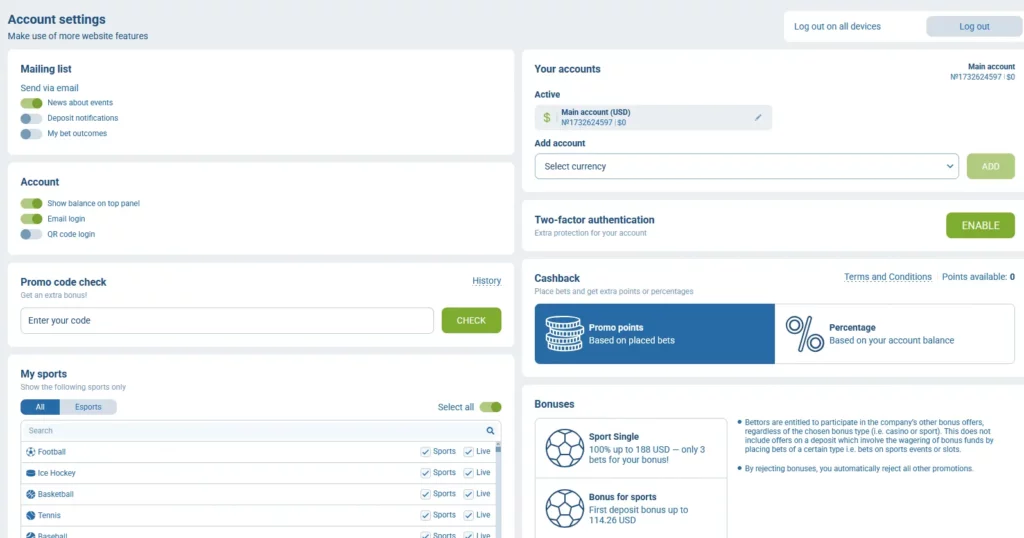
Account Settings at 1xBet
What Happens When Multi-Accounting Is Confirmed
Once 1xBet’s security team confirms a genuine violation (as opposed to a false positive later cleared through review), the consequences are serious:
- Immediate suspension of all accounts identified as connected
- Cancellation of any pending or settled bets and winnings tied to the violation
- Refusal to process any pending withdrawal requests tied to the flagged accounts
- Potential permanent blacklisting, affecting future account creation under the same identity
On the specific question of funds: based on 1xBet’s stated rules and how the company has responded in documented account disputes, the practical outcome is more nuanced than a blanket loss of everything. Winnings generated as a result of the violation are typically forfeited and not returned, but the original deposit amount has, in cases on record, been refunded rather than confiscated outright. This distinction matters — it’s not the same as losing your entire balance, and it’s worth confirming your specific situation directly with support rather than assuming the worst.
Similarly, “final” doesn’t mean 1xBet won’t communicate with you at all. Documented cases show the security team engaging with flagged users, requesting clarifying documents, and reviewing disputes — there’s no guarantee a confirmed violation gets reversed, but there is a real process to go through rather than silence. This is why proactively avoiding the situations that trigger a review remains the best protection, while also knowing that reaching out to support is a legitimate and sometimes productive next step if you believe a block was a mistake.
 Aiden Brooks
