



1xBet odds
A coefficient of 1.242 and a coefficient of 4.645 on the same match aren’t just “one number bigger than the other” — together they encode the bookmaker’s entire view of a match, including a built-in margin that most betting guides never actually show you how to find. 1xBet displays odds across every major format, and this guide uses real, live prices — pulled straight from the current board — to walk through exactly how odds are built, how to calculate a payout correctly, and how to spot the bookmaker’s margin sitting inside any set of numbers.
What Odds Actually Represent
An odds value is a bookmaker’s estimate of how likely an outcome is, expressed as a number rather than a percentage. The relationship is inverse and consistent across every sport: the higher the odds, the lower the implied likelihood of that outcome, and vice versa. A coefficient of 1.10 reflects an outcome the bookmaker considers highly likely; a coefficient of 15.00 reflects one they consider a long shot.
Odds are built from a mix of statistical and situational inputs — recent form, head-to-head history, team or player rankings, injury news, and, for outdoor events, conditions like weather and surface. None of these factors produce the number on their own; they feed into a probability estimate, which is then adjusted to include the bookmaker’s margin before it’s displayed as the final price.
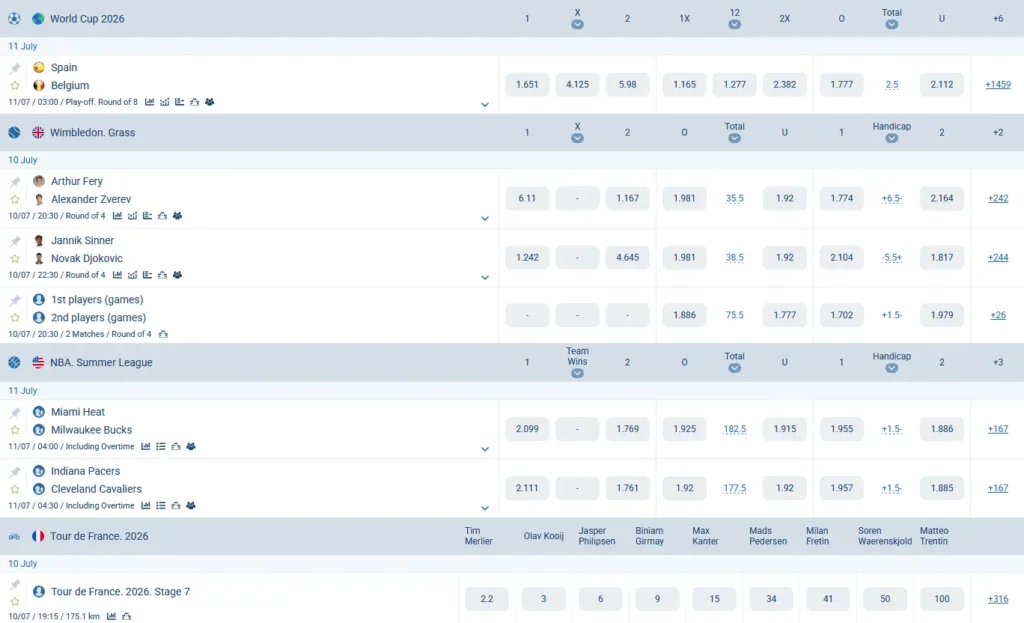
1xBet Odds
How to Calculate Payout and Profit — Correctly
There are two different numbers a bet produces, and mixing them up is one of the most common sources of confusion for new bettors:
- Payout — the total amount returned if the bet wins, including the original stake
- Profit — the amount actually gained, which is the payout minus the stake
Payout = Stake × Odds Profit = Payout − Stake
Worked example, using a real price from the current board — Jannik Sinner at odds of 1.242 to beat Novak Djokovic at Wimbledon:
A $50 stake on Sinner at 1.242 produces:
- Payout = $50 × 1.242 = $62.10
- Profit = $62.10 − $50 = $12.10
Compare that to backing the underdog in the same match — Djokovic at odds of 4.645:
A $50 stake on Djokovic produces:
- Payout = $50 × 4.645 = $232.25
- Profit = $232.25 − $50 = $182.25
The gap between these two outcomes is the clearest possible illustration of what odds communicate: a much smaller payout on the heavy favorite, a much larger one on the underdog, both derived directly from how likely the bookmaker considers each result.
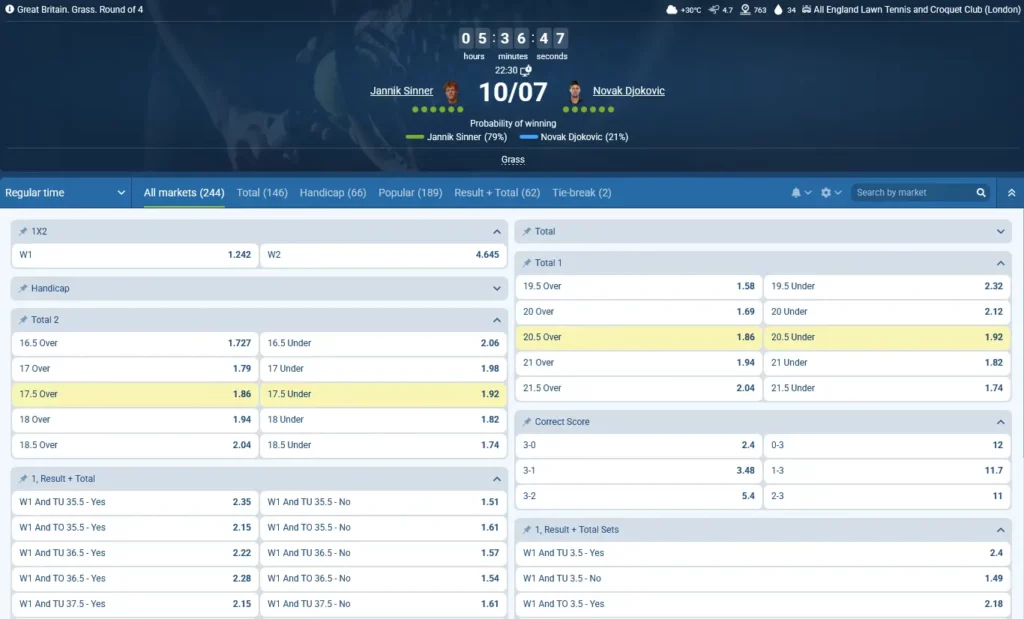
Tennis Odds at 1xBet
The Bookmaker’s Margin: What It Is and How to Calculate It
This is the part most odds explainers skip, and it’s the single most useful thing to understand if you want to judge whether a price is genuinely fair. Every set of odds on a match contains a built-in margin (also called the overround or vig) — the bookmaker’s edge, baked into the numbers rather than charged separately.
How to calculate it: convert each outcome’s odds into an implied probability (1 ÷ odds), add them together, and see how far the total exceeds 100%.
Real example — Sinner vs. Djokovic (1=1.242, 2=4.645):
| Outcome | Odds | Implied probability |
|---|---|---|
| Sinner to win | 1.242 | 1 ÷ 1.242 = 80.52% |
| Djokovic to win | 4.645 | 1 ÷ 4.645 = 21.53% |
| Total | 102.05% |
A “fair” book with no margin would sum to exactly 100%. Here it sums to 102.05% — so the built-in margin on this match is roughly 2%.
A second example makes the pattern clearer — Norway vs. England (World Cup 2026, 1=4.29, X=3.805, 2=1.924):
| Outcome | Odds | Implied probability |
|---|---|---|
| Norway to win | 4.29 | 23.31% |
| Draw | 3.805 | 26.28% |
| England to win | 1.924 | 51.98% |
| Total | 101.57% |
Margin here is even tighter — about 1.6% — which is typical for a marquee tournament match with heavy betting volume.
A third example shows why margin isn’t fixed — Grenada vs. Haiti (FIBA AmeriCup, 1=7.9, 2=1.04):
| Outcome | Odds | Implied probability |
|---|---|---|
| Grenada to win | 7.9 | 12.66% |
| Haiti to win | 1.04 | 96.15% |
| Total | 108.81% |
The margin here is nearly 9% — more than five times higher than the World Cup match. This isn’t inconsistency; it reflects lower betting volume and a heavily lopsided matchup, both of which push bookmakers to widen their edge on lower-liquidity events.
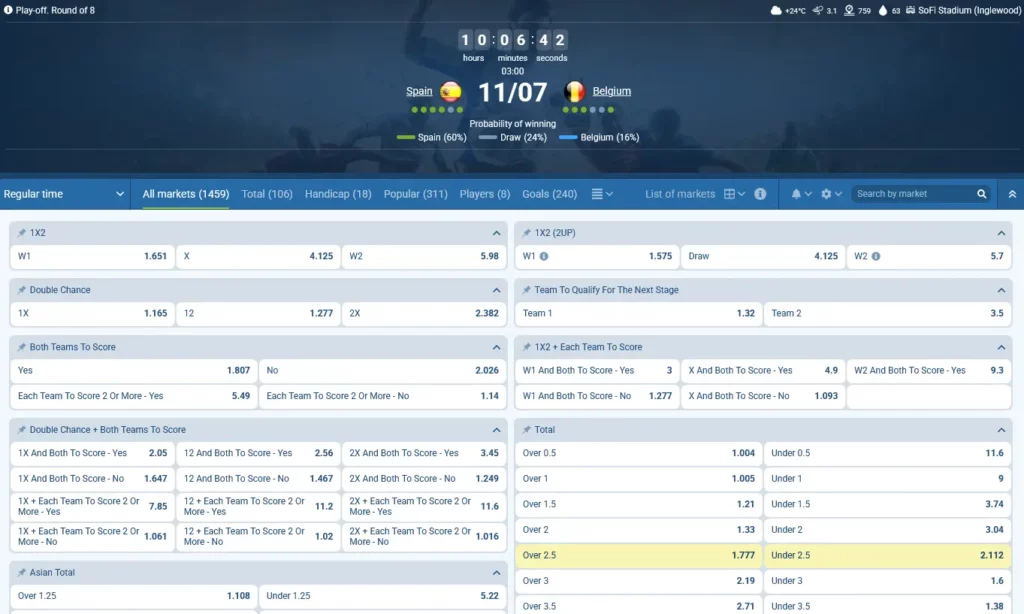
Football Odds at 1xBet
Implied Probability: Reading What the Odds Really Say
Once you can calculate implied probability, you can read a set of odds the way an experienced bettor does — as a probability estimate, not just a payout multiplier. The formula is simple:
Implied probability = (1 ÷ Odds) × 100
Because the raw implied probabilities always sum to slightly more than 100% (that’s the margin from the section above), removing the margin gives a more accurate picture of the bookmaker’s true estimate. To do that, divide each outcome’s raw implied probability by the total, then multiply by 100.
Using the Sinner–Djokovic match again: the raw implied probabilities are 80.52% and 21.53%, summing to 102.05%. Removing the margin:
- Sinner’s true estimated probability: 80.52 ÷ 102.05 × 100 ≈ 78.9%
- Djokovic’s true estimated probability: 21.53 ÷ 102.05 × 100 ≈ 21.1%
This margin-free number is the closest thing to the bookmaker’s actual view of the match, separate from their commercial edge — and it’s the number worth comparing against your own assessment of a matchup, not the raw odds themselves.
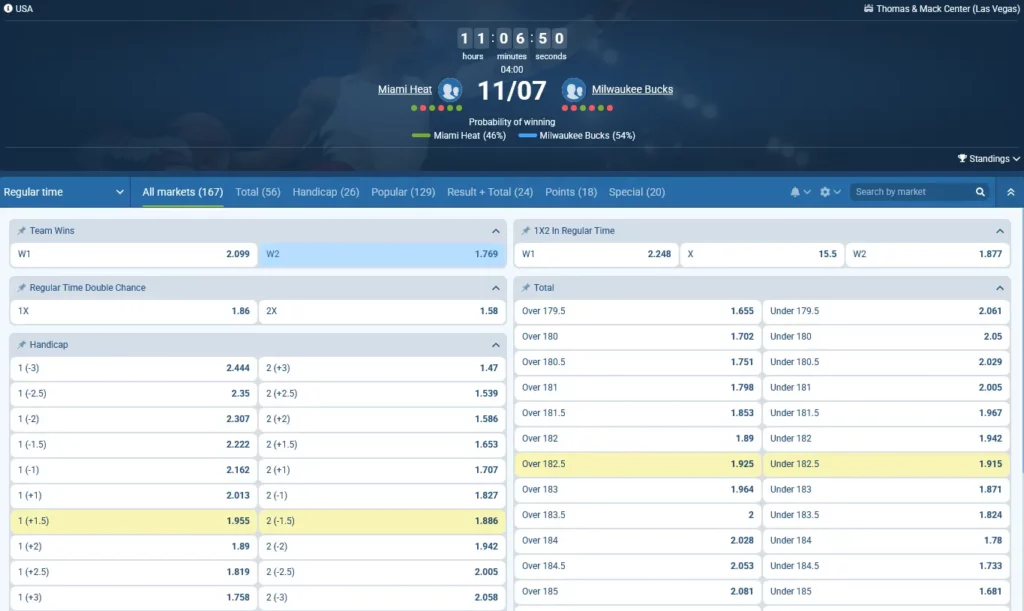
Basketball Odds at 1xBet
Odds Formats Explained — With Real Conversions
1xBet supports five odds display formats, switchable from the site or app settings. Rather than just defining them, here’s the same real match — Sinner (favorite) vs. Djokovic (underdog) — converted across every format so the differences are concrete:
| Format | Sinner (favorite) | Djokovic (underdog) |
|---|---|---|
| Decimal (European) | 1.242 | 4.645 |
| American | −413 | +364 |
| Fractional (British) | ≈ 6/25 | ≈ 29/8 |
| Hong Kong | 0.242 | 3.645 |
| Malay/Malaysian | −4.13 | 3.65 |
A few things worth knowing about how these convert:
- Decimal → American: for favorites (decimal below 2.00), American odds = −100 ÷ (decimal − 1). For underdogs (decimal 2.00 or above), American odds = (decimal − 1) × 100.
- Decimal → Hong Kong: simply decimal minus 1 — Hong Kong odds show potential profit per unit staked, without including the stake in the number the way decimal odds do.
- Decimal → Malay: mirrors Hong Kong odds for underdogs, but flips to a negative value for favorites, similar in spirit to American odds but scaled differently.
- Decimal → Fractional: these are always approximations — bookmakers round to the nearest common fraction rather than displaying an exact decimal-to-fraction conversion, so a fractional price is a close equivalent rather than a mathematically exact one.
Decimal is generally the easiest format to do quick mental math with, since payout is a single multiplication — which is likely why it’s the default across most of Europe and most online sportsbooks, 1xBet included.
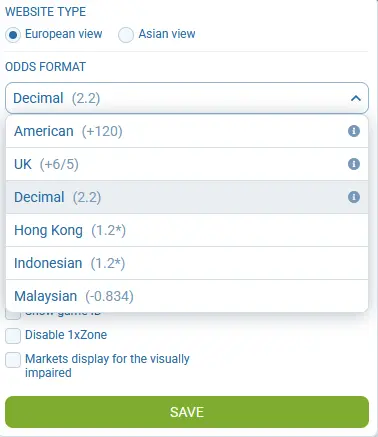
Odds Settings at 1xBet
Reading a Real Match Board: Two Worked Examples
A tight, high-liquidity market — Argentina vs. Switzerland (World Cup 2026): 1=1.737, X=3.7, 2=5.89. The gap between Argentina’s price and Switzerland’s tells you the bookmaker sees this as a clear but not overwhelming favorite situation — Argentina’s implied probability sits around 57.6%, versus roughly 17% for Switzerland and the rest split across the draw. The combined margin here works out to about 1.6%, consistent with a heavily traded, high-profile fixture.
A lopsided, lower-liquidity market — NBA Summer League, Miami Heat vs. Milwaukee Bucks: 1=2.099, 2=1.769. Despite being a closer numerical matchup than the World Cup example, the margin here is roughly 4.2% — more than double the World Cup match — because Summer League games carry far less betting volume than a marquee international fixture, and bookmakers widen margins where liquidity is thinner.
The practical takeaway: the size of the gap between two prices tells you about the perceived mismatch, but the combined margin tells you about market depth — and the two are independent of each other. A close-looking match can still carry a wide margin if it’s a lower-profile event.
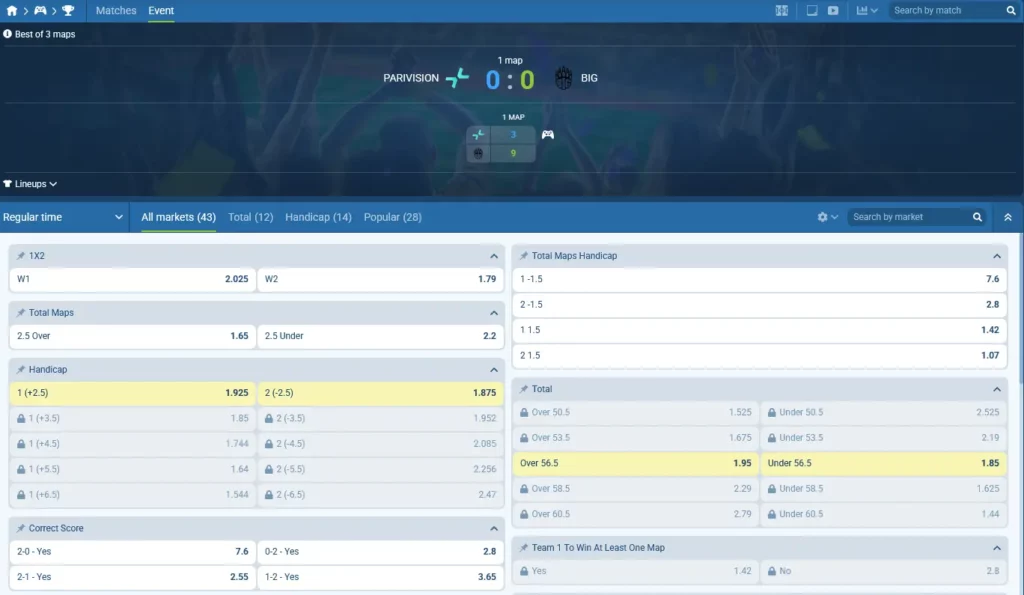
Cybersport Live Betiing at 1xBet
 Aiden Brooks
