
Betting on a shooter, a MOBA, and a real-time strategy game are three genuinely different skills wearing the same interface — the map veto that decides a CS2 series has almost nothing in common with the hero draft that decides a Dota 2 one, and treating them as interchangeable is the fastest way to miss what actually moves a result. 1xBet covers 14 esports disciplines with markets built around each game’s real mechanics, and this guide breaks down what to actually look at per genre, using live boards straight from the current lineup.
Esports Disciplines Available Right Now
The current lineup spans 14 titles, with CS 2, Valorant, and Rainbow Six currently carrying the deepest match counts:
- CS 2 — 11 active tournaments
- Valorant — 13 active tournaments
- Rainbow Six — 7 active tournaments, split across regional leagues (APAC Asia, APAC North, APAC Oceania, North America, South America, CN League, Europe/MENA)
- Dota 2 — 4 active tournaments
- League of Legends — 4 active tournaments
- Honor of Kings, Call of Duty, Call of Duty: Mobile, PUBG — 2 active tournaments each
- Mobile Legends, Arena of Valor, WarCraft III, Apex Legends, Crossfire — 1 active tournament each at present
Alongside real-match betting (the Real tab), the Esports section also runs two separate formats worth understanding on their own terms, since they’re built on fundamentally different mechanics from traditional esports tournaments.
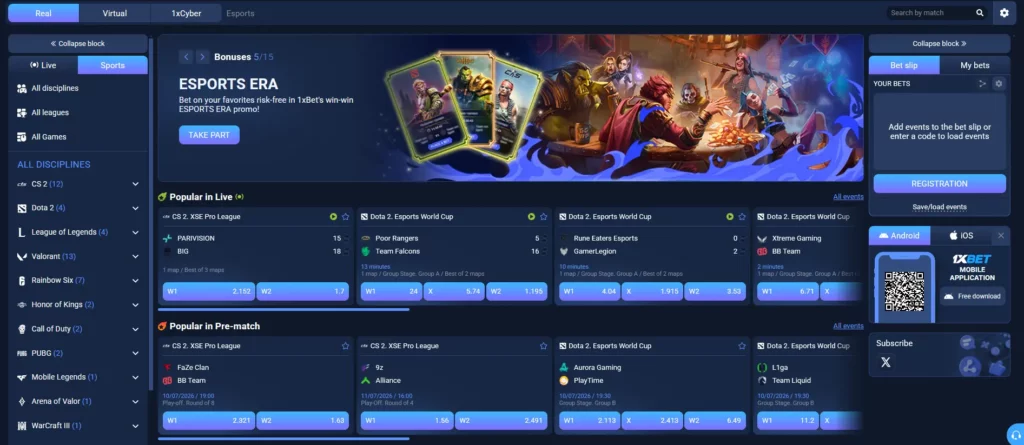
Esports at 1xBet
How to Place an Esports Bet
- Open the Esports section from the main menu and select Real to see actual scheduled and live tournament matches
- Pick a discipline from the sidebar (CS 2, Dota 2, League of Legends, Valorant, and so on), then a specific tournament and match
- Review the market board — most matches offer dozens of markets beyond the simple winner, broken down by map and by objective
- Click a price to add it to your bet slip, enter your stake, and confirm
Markets update continuously once a match goes live, and many matches offer map-specific and objective-specific in-play markets in addition to the standard pre-match board.
1xCyber and Virtual: Two Different Non-Traditional Formats
Beyond the Real tab covering actual CS2, Dota 2, League of Legends and similar tournaments, the Esports section runs two genuinely different alternative formats — and mixing them up leads to the wrong expectations about what you’re actually betting on.
1xCyber features real human players competing in fast-format simulated sports games — think FIFA-style football (branded as Esoccer), tennis, basketball, and other sports played under gamer tags rather than real team names. Matches run continuously, back to back, with very short halves — a typical Esoccer match runs two halves of just 3 or 4 minutes each, meaning a full match resolves in well under 10 minutes. Competitions include formats like Esoccer Battle Volta, Esoccer GG League, and licensed-style tournaments such as FC 26 Esports World Cup and FC 26 eSports Battle (running Champions League and La Liga-branded brackets). Because a real person is at the controls, results carry genuine skill variance — a strong Esoccer player has a real, repeatable edge, similar to any competitive video game — but the sheer speed and volume of matches (often several running live at once, back to back all day) makes this a fundamentally different rhythm from a traditional Bo3 CS2 series that takes an hour or more.
Virtual sports, by contrast, are entirely computer-generated — no human player is involved in the outcome, and the result is produced by a fixed algorithm rather than by skill or a live performance. This makes Virtual closer in spirit to a continuously running RNG casino game than to esports in the competitive sense, and it’s worth treating it that way when deciding how much analysis is actually useful to do beforehand — with no human input, prior form and player research simply don’t apply.
The disciplines covered on the 1xCyber side currently include Football (9 leagues), Basketball (3), Ice Hockey (1), Tennis (1), Cricket (1), and Kabaddi (1) — a noticeably different spread from the Real esports lineup, reflecting that 1xCyber format-adapts traditional sports rather than covering PC/console esports titles.
CS2 Betting: What Actually Matters
CS2 betting boards are unusually rich — a single Best-of-3 match on 1xBet can carry 1X2, total maps, total maps handicap, and full correct-score markets, plus separate boards for each individual map once the veto is known. The map pool itself is the single most important pre-match factor: professional CS2 map win rates vary enormously by team, and 1xBet’s own match pages display this directly. In one current fixture (FaZe Clan vs. BB Team), FaZe’s map win rate over the last three months ranges from 86% on Mirage down to 33% on Dust2, while BB Team’s numbers run almost the exact opposite — 38% on Mirage against 73% on Dust2. That gap matters more than either team’s overall record, because the map veto process determines which of those numbers is actually in play once the series starts.
Beyond map pool, the factors worth tracking are:
- Side economy — round-by-round buy patterns (full buy, force buy, eco round) shift win probability within a map far more than overall team strength does
- Pistol rounds — winning the opening pistol round of a half creates a strong follow-up advantage due to the economic snowball it enables
- Roster and role stability — CS2 team lineups (in-game leader, entry fragger, AWPer, support roles) change often enough between tournaments that checking the current active roster, not just the team name, is essential
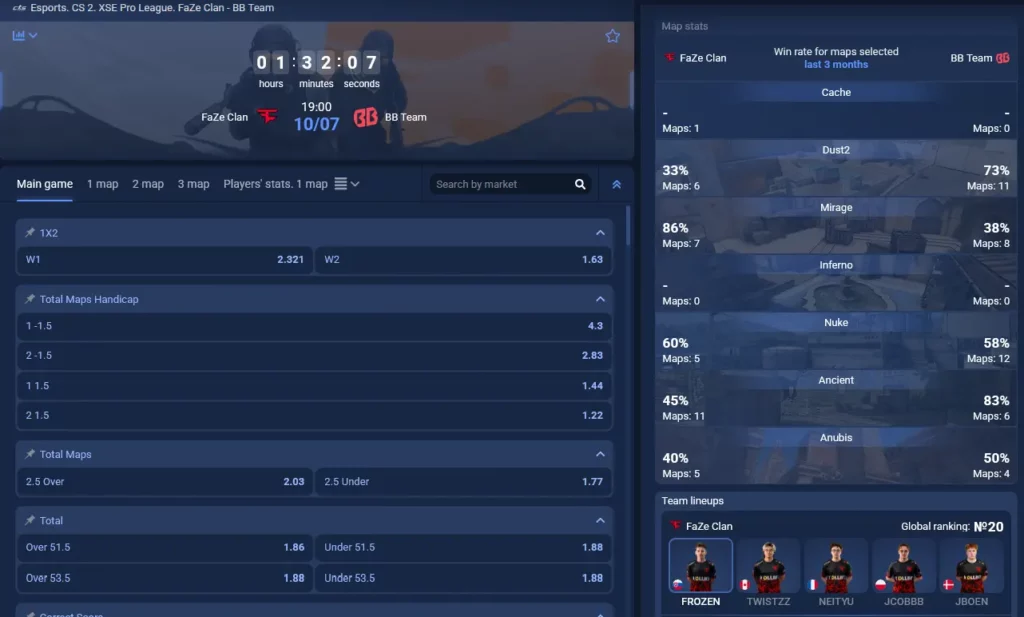
CS 2 at 1xBet
Dota 2 Betting: Why the Draft Matters More Than the Roster
Dota 2 markets on 1xBet include 1X2, correct score, total maps handicap, and frags handicap — but the single biggest driver of any individual game’s outcome happens before the first hit lands: the hero draft. Pick/ban decisions establish each team’s win condition for that specific game, which means recent results are only meaningful in the context of what patch and meta they were played under.
Match history is genuinely useful here when read correctly — 1xBet’s match pages show recent head-to-head results directly. In one current example, Aurora Gaming enters a match with 3 recent wins, including two clean 2-0 sweeps and one narrower 2-1 series, against a mix of opponents across different tournaments. That kind of recent-form data is far more informative than a season-long win rate, precisely because Dota 2’s competitive meta shifts with every patch — a team’s draft strength six months ago may not reflect their current pick/ban priorities at all.
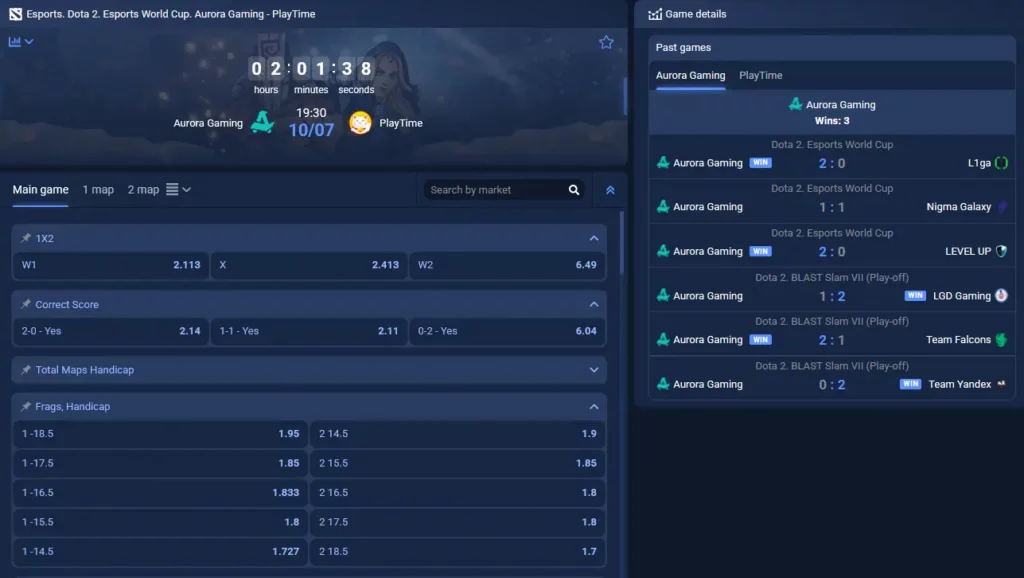
Dota 2 at 1xBet
League of Legends Betting: Objectives Over Kills
This is the discipline where genre-specific markets matter most, and it’s also where 1xBet’s board goes deepest. Beyond the standard match winner, a single map in a League of Legends match can carry markets on first blood, team to take the next Nashor (Baron), total dragons beaten, total towers destroyed, first team to destroy an inhibitor, and map duration — every one of which reflects the game’s actual win condition better than kill count alone.
The reason this matters: League of Legends is won through objective control, not raw kill totals. A team can lose the kill count and still win the game by controlling dragon stacks and taking Baron at the right moment to force a decisive late-game fight. Markets like “team to take the next Nashor” and “total dragons beaten” are betting directly on macro-strategy execution — which team plays for objectives versus which plays for kills — rather than on skirmish outcomes that don’t always translate into map wins.
A current example illustrates how lopsided these prices can get: in a Gen.G vs. Karmine Corp Esports World Cup match, Gen.G is priced at 1.1 to win the full match against 6.52 for Karmine Corp — a heavy-favorite situation where individual map objective markets (first blood, first tower, dragon control) often carry more genuinely competitive pricing than the overall match winner.
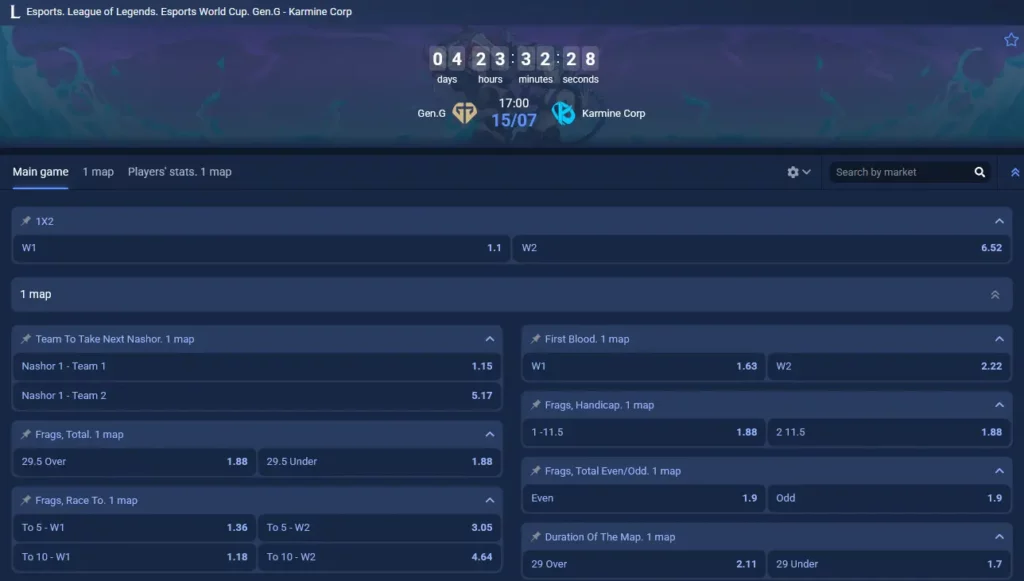
League of Legends at 1xBet
Valorant and Rainbow Six: Map Pool and Side Discipline
Valorant currently carries the widest match count on 1xBet’s board (13 active tournaments), and like CS2, agent composition and map pool are the pre-match factors that matter most — a team’s agent pool on Ascent tells you very little about how they’ll perform on Icebox, since utility usage and rotations differ significantly between maps.
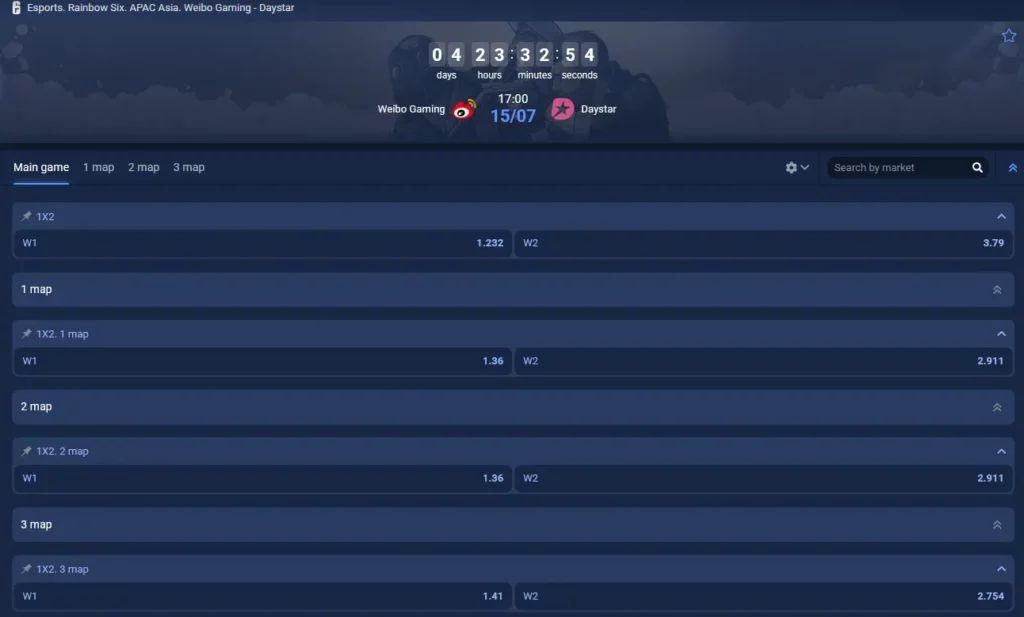
Rainbow Six matches are structured and priced per map from the outset — a current Weibo Gaming vs. Daystar fixture prices the overall match at 1.232 / 3.79, with separate 1X2 markets for map 1, map 2, and map 3 individually, each carrying its own distinct price. This map-by-map structure exists because Rainbow Six’s operator bans and site-attack dynamics can swing dramatically between maps depending on which operators are available — a team dominant on defense on one map can be significantly weaker on another with a different site layout.
Rainbow Six at 1xBet
Mobile Esports: A Faster, Different Rhythm
Honor of Kings, Mobile Legends, and Arena of Valor run on shorter game clocks and faster patch cycles than their PC counterparts, which changes what’s worth tracking: recent-form data decays faster (a team’s play style from two patches ago may already be outdated), and match duration markets tend to carry tighter, more predictable ranges than PC MOBA equivalents because mobile game design generally paces games toward a narrower time window.
Reading a Real Esports Match Board
Esports odds compress a lot of information into a small set of numbers, and reading them the same way you’d read traditional sports odds applies directly here — implied probability and bookmaker margin work identically regardless of discipline. A few live examples show the range:
| Match | Discipline | W1 | W2 (or X/W2) |
|---|---|---|---|
| FaZe Clan vs. BB Team | CS2 | 2.321 | 1.63 |
| Aurora Gaming vs. PlayTime | Dota 2 | 2.113 (X: 2.413) | 6.49 |
| Gen.G vs. Karmine Corp | League of Legends | 1.1 | 6.52 |
| Weibo Gaming vs. Daystar | Rainbow Six | 1.232 | 3.79 |
The spread here is instructive: CS2’s FaZe/BB Team price (2.321/1.63) reflects a genuinely competitive matchup, while the League of Legends price (1.1/6.52) reflects a heavy mismatch — and in both cases, checking the map-specific and objective-specific markets often reveals better relative value than the overall match winner alone, since those sub-markets are priced around narrower, more specific outcomes.
1xBet’s Esports Partnerships
1xBet’s esports involvement extends beyond taking bets — the operator maintains partnerships and sponsorships with organizations including Riot Games, Sangal, Aurora, Mongolz, Mirror, and PGL, spanning tournament organizers and competitive teams across multiple regions and titles. This kind of direct involvement in the competitive ecosystem is also why 1xBet’s esports coverage runs unusually deep on regional and lower-tier tournaments, not just the headline events.