
A single number pays 35 to 1 on a wheel where you actually only have a 1-in-37 chance of hitting it — that gap between the payout and the real odds is the house edge, and it’s the one number that matters more than any betting system ever will. 1xBet carries one of the largest roulette catalogs in the industry, spanning RNG tables, live-dealer studios, TV-game formats, and specialty variants with built-in multipliers, and this guide covers all of it — plus the math behind betting systems that most roulette content either skips or gets wrong.
Roulette Basics: How the Wheel and Bets Work
The mechanic is the same across every version: a ball is spun around a wheel divided into numbered pockets, and players bet on where it will land — a single number, a color, a range, or a defined group. Bet types fall into two broad categories:
- Inside bets — single numbers or small groups (splits, corners, streets), which pay out at higher odds because they’re less likely to hit
- Outside bets — larger groupings like red/black, odd/even, or 1-18/19-36, which pay even money (1:1) because they cover roughly half the wheel
A straight bet on a single number pays 35 to 1 if it hits. That payout ratio is fixed regardless of which roulette variant you’re playing — what changes between variants is how many numbers are actually on the wheel, and that’s where the house edge comes from.
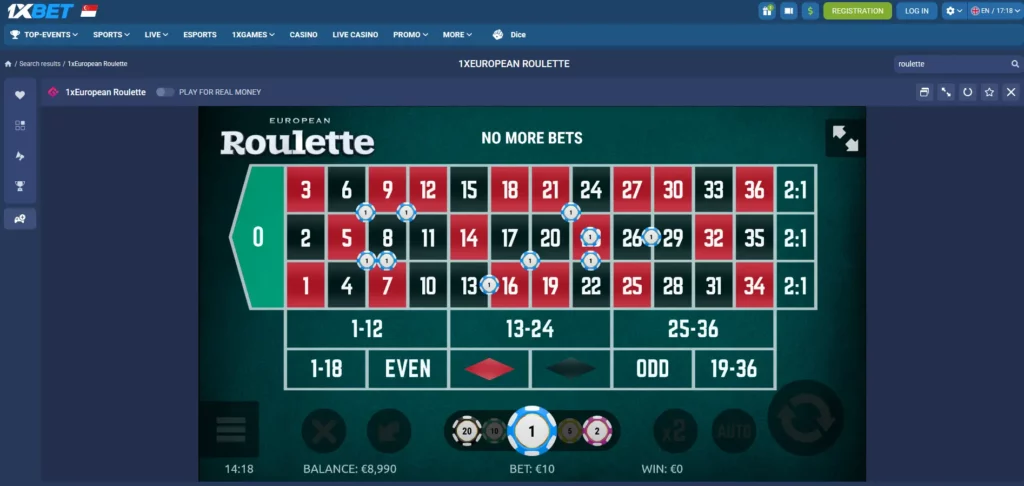
1xBet Roulette
European, American and French Roulette: The Math That Actually Matters
European roulette has 37 pockets (1-36 plus a single “0”). Because the payout for a single number stays at 35:1 while your real odds of hitting it are 1 in 37, the math works out to a house edge of exactly 2.70% on every bet type on the wheel:
Expected value per $1 staked = (1/37 × 35) − (36/37 × 1) = −2.70%
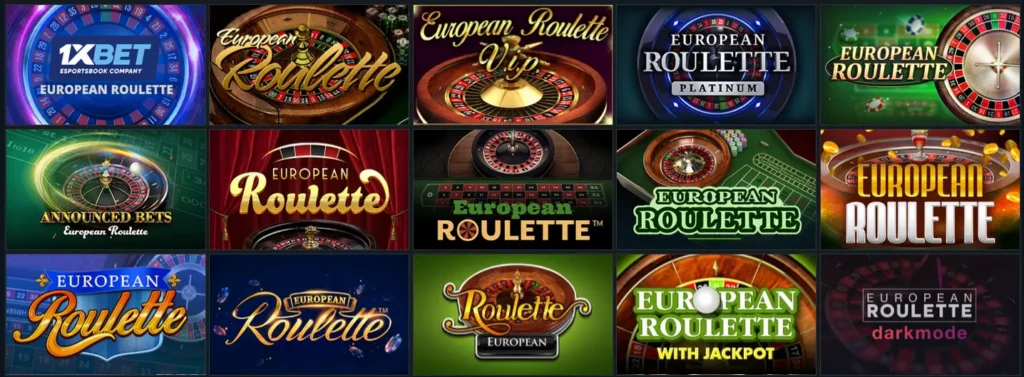
European roulette
American roulette adds a second green pocket (“00”), bringing the total to 38. The payout stays the same, but your odds of hitting any single number drop, pushing the house edge to 5.26% — almost double the European version:
Expected value per $1 staked = (1/38 × 35) − (37/38 × 1) = −5.26%
American roulette does offer one bet not available on the European wheel: the “top line” (0, 00, 1, 2, 3), paying 6:1. It sounds like a reasonable-looking bet, but the math is actually the worst on the table — a house edge of 7.89%, well above every other bet at an American table. It’s worth knowing this specifically because it’s often marketed as a distinctive, exciting bet, when mathematically it’s the one to avoid if house edge matters to you.
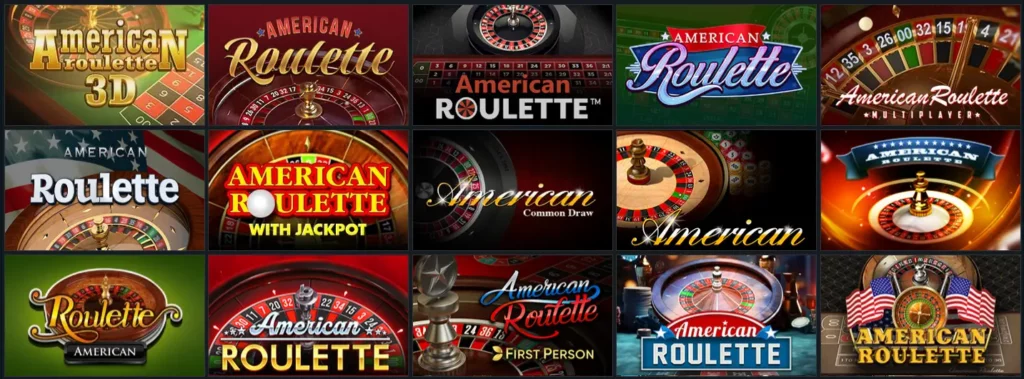
American roulette
French roulette uses the same 37-pocket wheel as the European version, but adds two rules that materially change the math on even-money bets (red/black, odd/even, 1-18/19-36):
- La Partage — if the ball lands on zero, half your even-money stake is returned automatically
- En Prison — instead of losing half, your stake is “imprisoned” for one more spin; if it wins that spin, you get it back in full
With La Partage active, the house edge on even-money bets is cut roughly in half, down to about 1.35% — the best price available on any standard roulette bet across all three variants.
This is the single most useful piece of practical information in this entire guide for anyone who bets on colors or odd/even: if French roulette with La Partage is available, it’s mathematically the strongest version of that specific bet type you’ll find.

French roulette
Where to Find Roulette on 1xBet
Roulette on 1xBet spans four distinct formats, each suited to a different way of playing:
RNG (computer-generated) tables — instant rounds with no dealer, available any time. The catalog includes standard European, American 3D, and French variants (1xEuropean Roulette, European Roulette Platinum, American Roulette 3D, Roulette Classic), alongside themed and high-volatility versions like Virtual Eye of Ra Roulette 2000x and Western Roulette.
Live-dealer tables — real croupiers streamed in real time, with stake ranges to suit almost any bankroll. Evolution’s studio alone runs several distinct formats here, including Immersive Roulette (multi-angle camera work for a closer view of the wheel), Lightning Roulette and its regional variants Turkish Lightning Roulette and XXXtreme Lightning Roulette (random multiplier numbers added each round), plus licensed-theme tables like Monopoly Roulette and World Cup Roulette. Other studios contribute their own takes, including Ezugi’s Speed Roulette and Spanish Roulette, and Winfinity’s Cabaret Roulette, with stakes ranging from roughly $0.10 up to $100,000 depending on the table.
TV-game roulette — a hybrid format broadcast game-show style, typically with simpler interfaces and features like Roulette x500 and CandyBall Roulette, which blends roulette mechanics with a bingo-style number draw.
Bingo-style roulette variants — titles like Roulette Lotto, Black Roulette, and Red Roulette apply a roulette wheel to a lottery-style draw format rather than a traditional table layout, appealing to players who prefer a faster, simplified round structure.
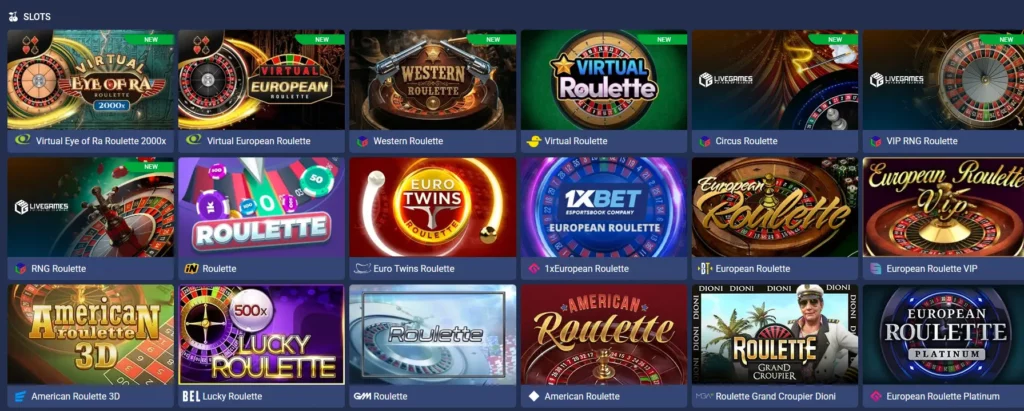
Roulette Slots at 1xBet
Specialty and High-Multiplier Variants
A few variants worth understanding on their own terms, since their mechanics genuinely differ from standard roulette rather than just re-skinning the same math:
- Multiplier formats (Lightning Roulette and similar) — before each round, the game randomly assigns multipliers (up to several hundred times the payout) to a handful of numbers. If the ball lands on a boosted number, straight-up bets on it pay far more than the standard 35:1. This changes the payout structure and variance significantly, but it’s worth knowing that games with lucky-number multiplier mechanics typically carry a higher built-in house edge than standard roulette specifically to fund those bigger occasional payouts — the multipliers add excitement and variance, not better underlying odds.
- Mini Roulette — a smaller wheel, typically 13 pockets (1-12 plus zero) instead of 37. Smaller wheels generally mean smaller payouts on inside bets to compensate, so this isn’t simply “easier to win” — the house edge on a well-designed mini wheel is usually kept comparable to standard roulette, just distributed differently across fewer numbers.
- Multi-wheel roulette — betting the same numbers across several wheels spinning simultaneously doesn’t change the house edge on any individual wheel; it multiplies your exposure (and your stake) rather than improving your odds. It increases the number of outcomes you’re exposed to per round, not the probability of any one of them.
- Double-ball roulette — using two balls instead of one changes which combination bets are available and how outside bets resolve (since two balls can land on different colors), which meaningfully increases variance, but it does not change the fundamental house edge built into the wheel’s pocket count.

Roulette TV Games at 1xBet
Betting Systems: What They Actually Change (and What They Don’t)
This is worth being direct about, because most roulette content either skips it or gets it wrong: no betting system changes the house edge. The 2.70% (European) or 5.26% (American) edge calculated above applies to every individual spin, regardless of how much you’re staking or what happened on the previous spin. Roulette has no memory — the wheel doesn’t know or care whether the last five spins landed on black.
What betting systems actually do is change the shape of your risk — how wins and losses are distributed — without changing the underlying expected value, which stays negative over any extended session. Here’s what each popular system actually does mathematically:
- Martingale — doubling the bet after every loss on an even-money wager. If you eventually win, you recover all previous losses plus one unit of profit. The catch: this requires an unbroken bankroll and no table limit, neither of which exists in practice. A string of even 6-7 consecutive losses (which happens more often than intuition suggests) can require a bet 64-128 times your original stake, hitting the table maximum or your own bankroll limit before the system can “correct” — turning a sequence of small losses into one large one.
- Reverse Martingale (Paroli) — increasing the bet after a win instead of a loss, resetting after any loss. This caps your downside per losing streak to a single unit, but it means a big winning streak is required to produce a meaningful profit, and one loss at the top of a streak erases several rounds of gains at once.
- D’Alembert — a gentler version of Martingale: bet size increases by one unit after a loss and decreases by one unit after a win. The swings are smaller and slower, which reduces the risk of hitting a table limit, but it doesn’t change the underlying math — it just spreads the same negative expected value over more, smaller bets.
- Fibonacci — bet sizes follow the Fibonacci sequence (1, 1, 2, 3, 5, 8…), increasing after a loss and stepping back two places after a win. Like Martingale, it’s a loss-progression system, just with slower-growing bet sizes — the same structural risk exists, just delayed further into a losing streak.
- James Bond system — a flat-betting approach that covers a wide spread of numbers in a single round (typically high numbers, a six-line, and zero) to guarantee a partial win on most spins. It doesn’t touch the house edge either — it just redistributes the same expected loss across a wider set of outcomes per round, trading fewer total losses for smaller wins most of the time.
None of these systems, individually or combined, turn a negative expected value into a positive one. What they genuinely can do is help structure a session — making bet sizing more predictable and less impulsive than betting an arbitrary amount each spin. That’s a legitimate reason to use one if you enjoy having a system, but it’s a organizational tool, not a mathematical edge.

Roulette at Live Casino 1xBet
A Note on Bankroll and Limits
Because house edge applies per spin regardless of strategy, the only variable actually within a player’s control is how much is staked and for how long. Setting a session budget before playing — and treating any progression system as a way to structure that budget rather than a way to guarantee a win — keeps roulette what it’s meant to be: a game of chance with a known, fixed edge, not a puzzle with a solution. 1xBet’s demo mode is available for most roulette titles and is a genuinely useful way to test how any of the systems above actually feel across a long session, without staking real money to find out.