








Counter-Strike 2 at 1xBet
The Counter-Strike 2 esports scene has become one of the busiest corners of competitive gaming, with dozens of matches running every week across leagues, qualifiers, and Valve-sanctioned events. 1xBet covers this activity closely, offering pre-match and live odds on everything from smaller regional leagues to the biggest tournaments on the calendar, so bettors who follow Counter-Strike 2 have a genuinely deep market to work with rather than a handful of headline fixtures. Getting started only takes a quick registration, after which the same account gives access to the full esports book as well as the casino section if you want to explore other games.
1xBet’s Role in the Counter-Strike 2 Esports Scene
1xBet has built one of the more visible sponsorship portfolios in Counter-Strike 2, backing organizations such as The MongolZ, Aurora Gaming, and MIBR. The MongolZ partnership goes back to the team’s 2023 relaunch from the IHC Esports roster, and it has paid off: the Mongolian squad reached No. 1 in Valve’s Regional Standings in September 2025 and briefly topped the HLTV World Ranking that same month, prompting 1xBet to introduce custom championship rings for partner teams that reach the top of the Valve standings.
At the event level, 1xBet has served as a betting sponsor for tournaments including IEM Cologne and BLAST.tv Major events, putting its odds directly into official broadcasts. The brand is also listed as a partner of HLTV.org, the sport’s main statistics and news outlet, alongside organizations like ESL and CCT.
Why this matters for bettors: sponsorship activity is a reasonable signal of how seriously an operator treats a discipline. A bookmaker embedded in team and tournament partnerships tends to run deeper markets and faster live-odds updates than one that treats esports as an afterthought — which shows up directly in the market depth covered below.
CS2 Odds
Counter-Strike 2 Betting Basics
Counter-Strike 2 pits two five-player teams against each other — Terrorists, who try to plant and detonate a bomb (or hold hostages, on select maps), and Counter-Terrorists, who try to stop them or rescue hostages before time runs out. Matches are played across a best-of series (most commonly Bo1, Bo3, or Bo5), with each individual game called a map.
A few mechanics matter specifically for betting analysis:
- Round economy. Teams buy weapons and equipment each round based on money earned from kills, objectives, and losses. A team on a poor economy will often play an “eco” round with minimal gear, which shifts round-win probability sharply.
- Map veto. Before a series starts, teams alternate banning and picking maps from the active map pool. The final map (in a Bo1) or map order (in a Bo3/Bo5) can favor one side heavily depending on their map win rates.
- Side switch. Regulation halves split 12 rounds per side (the current MR12 format), so a team strong on one side but weak on the other can see momentum swing hard at halftime.
Understanding these basics is what separates a bet based on team names alone from one grounded in how a specific series is actually likely to play out — and it’s also the foundation for the calculations below.
From Odds to Probability: Reading the Market Before You Bet
Every decimal odd 1xBet posts implicitly states a probability. The formula is simple:
Implied probability = 1 ÷ decimal odds
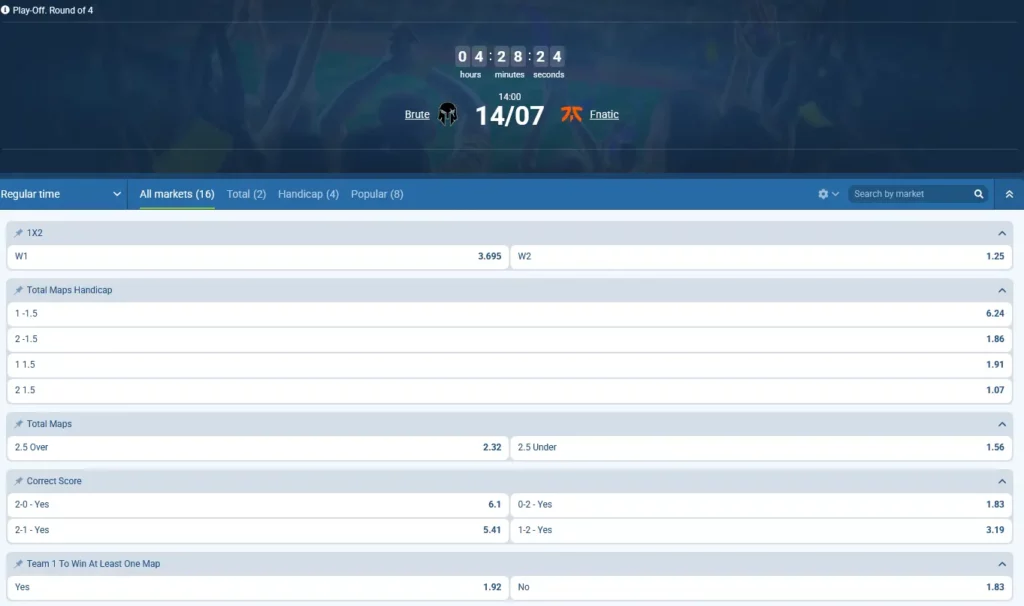
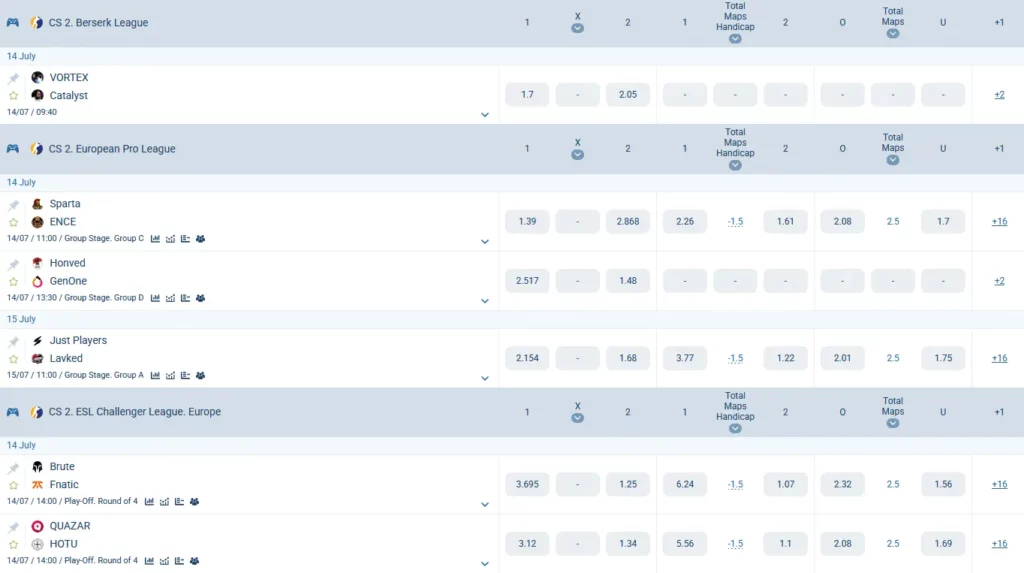
Take a real Round of 4 fixture between Brute and Fnatic, where 1xBet priced the match winner market at Brute 3.695 and Fnatic 1.25:
| Outcome | Odds | Implied probability |
|---|---|---|
| Brute to win | 3.695 | 1 ÷ 3.695 = 27.06% |
| Fnatic to win | 1.25 | 1 ÷ 1.25 = 80.00% |
Add those two figures together and you get 107.06%, not 100%. That extra 7.06% is the bookmaker’s margin (overround) — the built-in edge that makes 1xBet profitable across many bets regardless of who wins any single match. Every market carries some version of this margin, and calculating it is the first step before deciding whether a price is actually worth betting.
The same math applies to the Team 1 to Win at Least One Map market from that same fixture, priced Yes 1.92 / No 1.83: implied probabilities of 52.08% and 54.64% sum to 106.72% — a 6.72% margin, slightly tighter than the outright winner market.
Counter-Strike betting basics
Calculating Expected Value (EV) on a Real Bet
Implied probability tells you what the bookmaker thinks. Expected value tells you whether your own estimate makes the bet worth placing. The formula for a $100 stake is:
EV = (your estimated win probability × odds × stake) − stake
Suppose you’ve watched Fnatic’s recent LAN results and believe their real win probability against Brute is closer to 85%, not the 80% implied by the 1.25 odds:
EV = (0.85 × 1.25 × $100) − $100 = $106.25 − $100 = +$6.25
That’s a positive expected value of 6.25% per $100 staked — in theory, a bet worth making if your 85% estimate is sound. Now compare that to betting the underdog, Brute at 3.695, if your own analysis actually puts their real win chance at just 20% (below the market’s implied 27.06%):
EV = (0.20 × 3.695 × $100) − $100 = $73.90 − $100 = −$26.10
A negative EV of over 26%. Long odds on an underdog look tempting, but they’re only worth betting when your estimate of that team’s chances is higher than the market’s — not simply because the payout looks large.
Total Maps and Map Handicap: Worked Examples
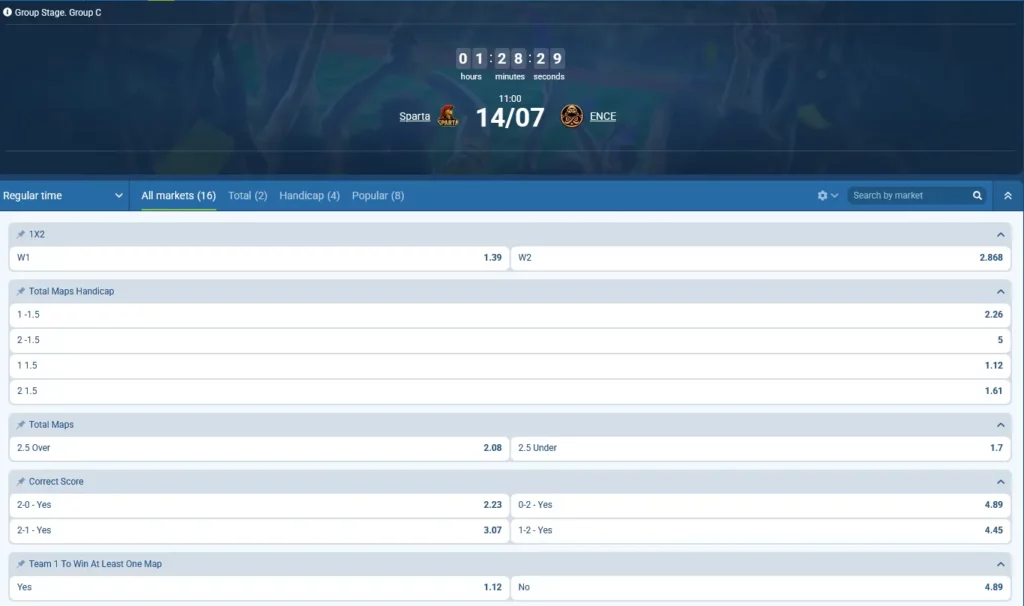
Total Maps Handicap gives one team a virtual head start or deficit in the map count. In a Group Stage fixture between Sparta and ENCE, 1xBet listed Sparta at -1.5 maps (Sparta must win the series 2-0 for the bet to land) at odds of 2.26, while ENCE at +1.5 (ENCE can lose 0-2 and this bet still loses only on that exact clean sweep) was priced at 1.61.
Implied probabilities: 1 ÷ 2.26 = 44.25% for Sparta -1.5, and 1 ÷ 1.61 = 62.11% for ENCE +1.5. Sum: 106.36% margin.
A simple way to sanity-check that Sparta price is to build your own estimate from recent map win rates. If Sparta has been winning roughly 65% of individual maps against comparable opposition, and you treat the two maps in a clean 2-0 as broadly independent events, a rough estimate of Sparta winning both is:
0.65 × 0.65 = 42.25%
That’s close to the market’s 44.25% implied figure — suggesting this particular price is close to fair value rather than offering a clear edge either way. This kind of back-of-envelope check is far more useful than betting on reputation alone.
Total Maps works similarly but without picking a side. In that same Sparta vs. ENCE match, Over 2.5 maps sat at 2.08 (implied 48.08%) and Under 2.5 at 1.70 (implied 58.82%), a 106.90% margin — the market leaning toward a straightforward 2-0 finish rather than a full three-map decider.
CS 2 Live Betting
Correct Score: Payout Math and When It Pays Off
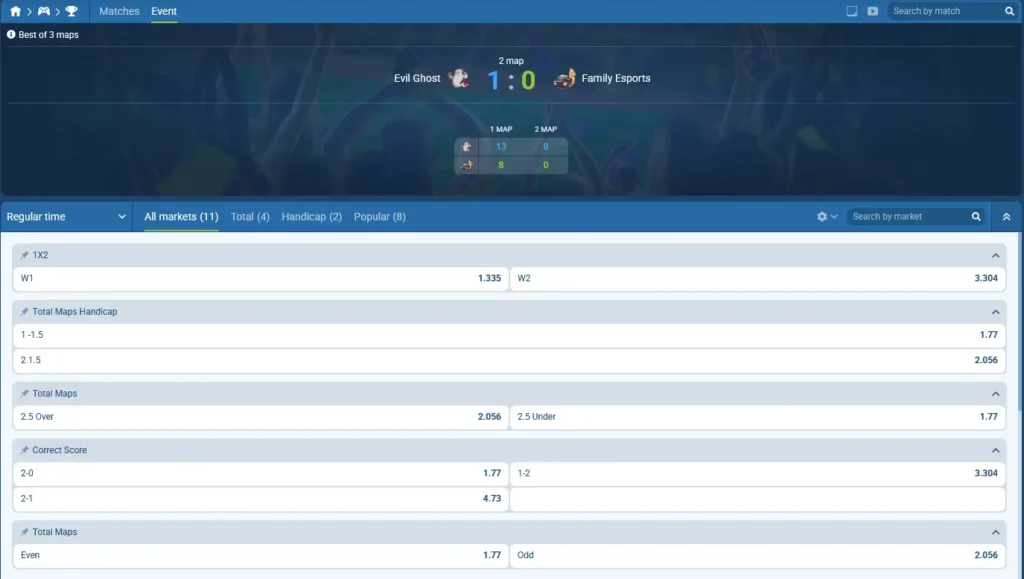
Correct Score asks bettors to call the exact map result. In a live Bo3 between Evil Ghost and Family Esports, with Evil Ghost already 1-0 up, 1xBet’s in-play Correct Score market priced a 2-0 finish at 1.77 and a 1-2 reversal (Family Esports winning the next two maps) at 3.304.
On a $50 stake at 1.77, the payout math is straightforward:
Return = $50 × 1.77 = $88.50 (profit of $38.50)
Return on the 1-2 outcome at 3.304 = $50 × 3.304 = $165.20 (profit of $115.20)
Correct Score is a higher-variance market than 1X2 or Total Maps, since the outcome has to land exactly rather than within a range. It becomes more attractive when one team clearly controls the remaining maps in the veto — for example, if Family Esports picked the second map specifically because it’s their strongest map, the “reversal” price may be more generous than their true chances warrant, which is exactly the kind of gap value bettors look for.
Live Betting: How Round Economy Swings the Numbers
Live markets move fastest around economy shifts. A simplified example: a team that loses a pistol round typically enters the following round on a poor economy and is forced into an “eco” round (minimal-buy) rather than a full-armor, full-rifle buy. If a team’s round win rate on a full buy against an opponent’s full buy sits around 50%, that same team’s win rate on an eco round against a full-buy opponent commonly drops to somewhere in the 15-25% range, depending on map and side.
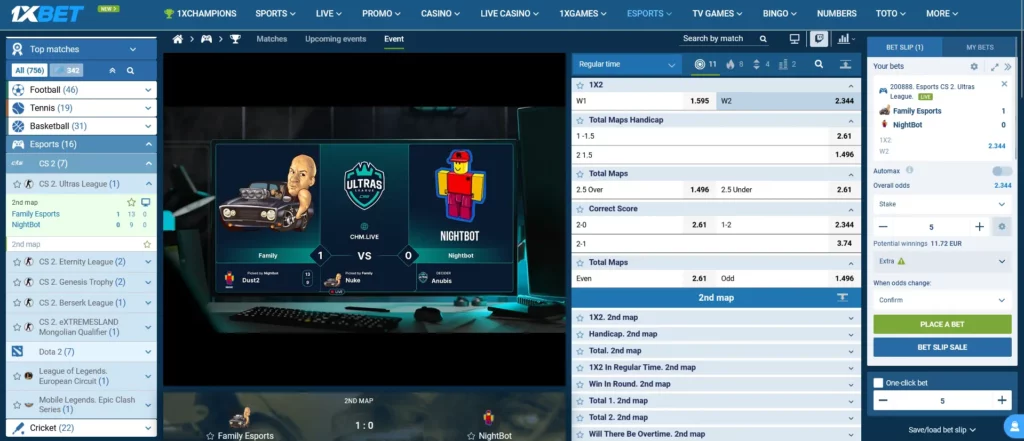
That’s the kind of swing that moves in-play odds within seconds of a pistol round ending — which is why the same Evil Ghost vs. Family Esports match, at 1-0 on maps and 13-8 up on rounds within the second map, still carried 11 live markets (1X2, Total Maps Handicap, Total Maps, Correct Score, Odd/Even Total Maps, among others) updating continuously as the round score moved. Following a match through 1xBet’s live interface — via the Android app or iOS app — gets you meaningfully different prices than betting before the series starts, precisely because economy states like this aren’t visible in a pre-match line.
CS2 Tournaments You Can Bet On
1xBet’s CS2 coverage spans several tiers of competition. Regional and mid-tier leagues, such as CS2 Berserk League, CS2 European Pro League, and CS2 ESL Challenger League Europe, run continuously with group stages and playoff brackets, giving bettors a steady stream of fixtures between developing and semi-professional rosters.
Top-tier events, including IEM Cologne, BLAST.tv Major tournaments, and PGL Majors, sit at the top of the competitive calendar and draw the strongest teams in the world. Since 2025, invitations to these events are determined by Valve’s Regional Standings — an official ranking Valve introduced during the CS2 transition and made mandatory for all tournament organizers, replacing the older system of discretionary invites and franchise slots. A team’s seeding and invite chances are now tied directly to measurable recent results rather than event-organizer partnerships.
As of the most recent HLTV World Ranking, the top of the standings reads Falcons, Vitality, Spirit, FURIA, and Natus Vincere, with Aurora — one of 1xBet’s partner teams — also inside the top six. Rankings shift weekly, so checking the current standings before betting on a tournament favorite is worth the extra minute, since a two-week-old ranking snapshot can already be stale.
CS2 Betting at 1xBet
Staking: Fixed Units vs. the Kelly Criterion
Two approaches cover most of how disciplined bettors size their stakes.
Fixed unit staking simply assigns a flat percentage of bankroll per bet, regardless of confidence level:
| Bankroll | Standard stake (1-2%) | High-confidence stake (3-5%) |
|---|---|---|
| $200 | $2-$4 | $6-$10 |
| $500 | $5-$10 | $15-$25 |
| $1,000 | $10-$20 | $30-$50 |
The Kelly Criterion goes a step further by sizing the stake to your actual edge. The formula is:
f = (bp − q) ÷ b
where b is the decimal odds minus 1, p is your estimated win probability, and q is 1 − p. Using the earlier Fnatic example (odds 1.25, so b = 0.25; estimated p = 0.85; q = 0.15):
f = (0.25 × 0.85 − 0.15) ÷ 0.25 = (0.2125 − 0.15) ÷ 0.25 = 0.25, or 25% of bankroll.
Full Kelly stakes like this are aggressive by design and assume your probability estimate is exactly right — a risky assumption in a game as variance-heavy as CS2. Most disciplined bettors use fractional Kelly (commonly a quarter or half of the full figure) instead. A quarter-Kelly stake on a $1,000 bankroll here would be:
$1,000 × (0.25 ÷ 4) = $62.50
— a stake that still reflects the size of your estimated edge without risking a quarter of the bankroll on one series result.
How to Bet Smarter on CS2
A few habits separate consistent CS2 bettors from those betting on team names alone:
- Check the map pool split, not just the overall record. A team can have a strong series win rate while being genuinely weak on one specific map — which matters enormously once the veto is public.
- Watch for roster changes. A single player swap, especially an in-game leader or a primary AWPer, can shift a team’s form for several events before results catch up with the new lineup.
- Separate LAN form from online form. Both HLTV’s and Valve’s ranking systems weight LAN results more heavily, and for good reason — some teams perform very differently on a big stage than in online qualifiers.
- Track the veto process itself, not just final maps. Which map a team is willing to ban first often reveals more about their confidence level than their pick.
- Treat pistol rounds as leading indicators, not guarantees. Winning both pistol rounds correlates strongly with winning the half, but the 15-25% eco-round win rate above shows it isn’t decisive on its own — factor it into live bets rather than building a whole strategy around it.
CS2 at 1xBet
Interesting Facts About Counter-Strike 2
- Counter-Strike 2 replaced Counter-Strike: Global Offensive on September 27, 2023, rebuilding the game on Valve’s Source 2 engine while keeping the same core objective-based gameplay.
- Dust2 remains one of the most recognizable maps in the franchise’s history, tracing back to the original Counter-Strike and still appearing in the current competitive map pool in updated form.
- ZywOo of Team Vitality became the first player to win HLTV’s Player of the Year award four times, a record that reflects Vitality’s sustained dominance through 2025.
- The Valve Regional Standings, not HLTV’s community ranking, now officially decide tournament invites — a structural change from the CS:GO era, when organizers often relied on partnership deals and franchise slots instead of pure performance.
- Some of the rarest weapon skins in the game, such as the AWP Dragon Lore in Factory New condition, can trade for tens of thousands of dollars, making the in-game economy a notable side industry of its own.
 Aiden Brooks
