
A single World Cup match on 1xBet can carry over 1,400 individual markets — and buried in that number is a small widget most bettors scroll past that actually tells you the bookmaker’s real, margin-free view of the game, if you know how to read it. 1xBet covers football more deeply than any other sport on the site, and this guide uses live match boards — including a real World Cup 2026 fixture and an in-play Chinese Super League game — to show what the numbers actually mean, not just what they’re called.
Reading a Real Match Board: 1,400+ Markets in One Game
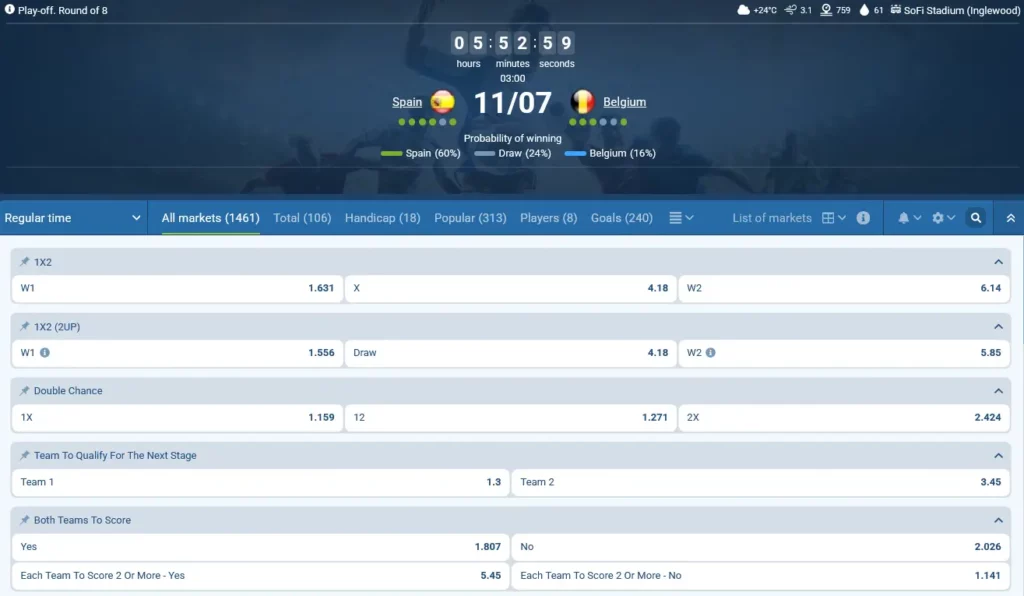
Take a real example — Spain vs. Belgium, World Cup 2026 Play-off Round of 8. The match page breaks its 1,461 total markets into filtered tabs: Total (106 markets), Handicap (18), Popular (313), Players (8), Goals (240), among others. The core groups worth understanding:
- 1X2 — match winner (W1=1.631, X=4.18, W2=6.14 here)
- 1X2 (2UP) — a variant where a two-goal lead effectively settles the bet early, priced slightly differently from standard 1X2 (W1=1.556, Draw=4.18, W2=5.85) to account for that added protection
- Double Chance — covering two of the three outcomes at once (1X=1.159, 12=1.271, 2X=2.424)
- Team to Qualify for the Next Stage — relevant specifically for knockout football, since a draw doesn’t exist as a final outcome here (Team 1=1.3, Team 2=3.45)
- Both Teams to Score — Yes=1.807, No=2.026
- Combination markets — 1X2 combined with Both Teams to Score, offering a single price for two conditions being true together (for example, “W1 and Both to Score – Yes” at 3.0)
The sheer depth here — Players and Goals tabs alone breaking out into hundreds of individual markets — reflects how much more granular football coverage is compared to most other sports on the site, largely because football’s low-scoring nature makes markets around specific events (a corner, a card, a substitution’s effect) genuinely bettable in a way high-scoring sports rarely support.
Football at 1xBet
What “Probability of Winning” Really Shows
This is worth understanding because it’s a shortcut to work most bettors do manually. Above the market board, 1xBet displays a Probability of Winning bar directly — for Spain vs. Belgium, it reads Spain 60%, Draw 24%, Belgium 16%.
Checking the math confirms exactly what this number is: converting the raw 1X2 odds (1.631 / 4.18 / 6.14) into implied probability gives 61.3% / 23.9% / 16.3%, summing to 101.5% — the extra 1.5% is the bookmaker’s margin. Removing that margin (dividing each figure by the total and rescaling to 100%) gives 60.4% / 23.6% / 16.0% — matching the displayed widget almost exactly. In other words, the Probability of Winning bar is the margin-free implied probability, already calculated for you — it’s worth checking directly against your own read of the match rather than treating the raw 1X2 price as the “real” estimate, since the raw price always includes the built-in margin.
Expected Goals (xG): The Metric That Actually Predicts Outcomes
This is the single biggest gap in most football betting content, and it’s worth fixing directly with a real example. A live match — Shandong Taishan vs. Yunnan Yukun, China Super League, 73 minutes into the second half — shows a scoreline of 4-1, but the underlying xG reads 2.11 to 1.24.
That gap matters: Shandong Taishan has scored nearly double their expected-goals total, while the scoreline suggests a much more one-sided game than the underlying chances actually were. Expected goals measures the quality of chances created (based on shot location, type, and situation), independent of whether they were actually converted — so a team significantly outscoring their xG has, to some extent, been finishing above what the chance quality alone would predict, which is a real signal that the scoreline is overstating one team’s control of the game.
The same match illustrates this further: despite trailing 4-1, Yunnan Yukun actually leads in attacks (97 to 66), dangerous attacks (52 to 27), and ball possession (57% to 43%) — every underlying process metric points toward Yunnan controlling large stretches of play, while the scoreline tells the opposite story.
This is exactly the kind of gap worth knowing how to read: the scoreline reflects finishing, not balance of play, and a team trailing while dominating the underlying numbers is a genuinely different situation from a team trailing while also being outplayed — even though both look identical on the scoreboard alone.
Football Winner Bets at 1xBet
Handicap and Totals: Reading Real Numbers
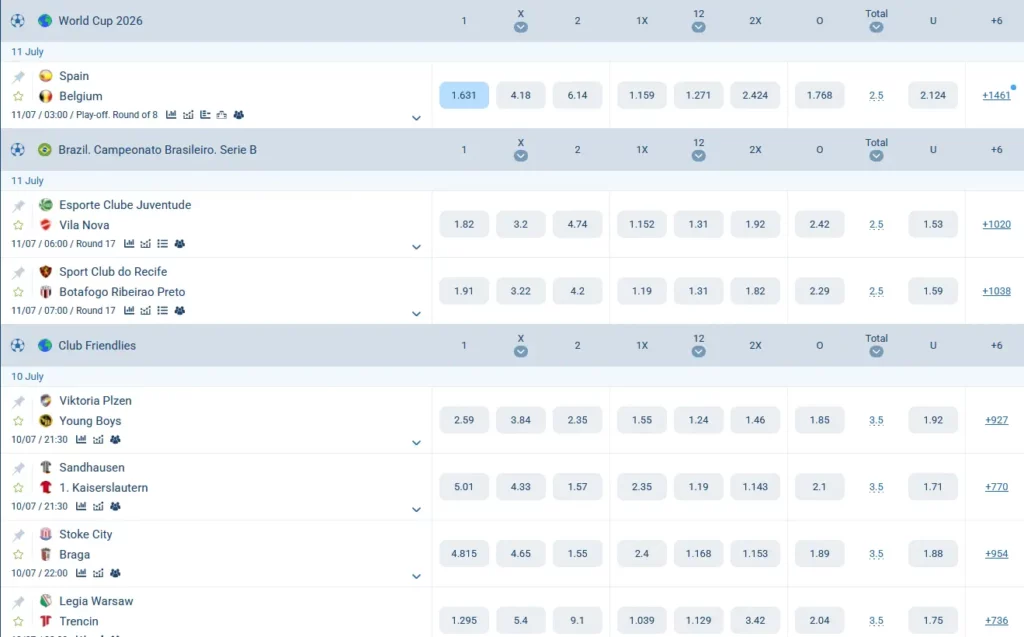
Using the same Spain vs. Belgium match, the Total is set at 2.5, with Over priced at 1.768 and Under at 2.124 — the Over being favored here reflects both teams’ attacking record and the expectation of an open, high-tempo knockout match. Handicap markets work the same way as in most sports: a -1.5 handicap on the favorite requires a two-goal margin of victory to pay out, while +1.5 on the underdog pays out on a win, a draw, or a one-goal loss.
The “Team to Qualify” market (1.3 / 3.45) is worth flagging specifically because it’s easy to confuse with the standard match-winner price — in a knockout fixture, this market accounts for the possibility of the tie going to extra time or penalties, so its price reflects total progression probability, not just 90-minute result, and will differ meaningfully from the 1X2 price on the same page.
Football Express at 1xBet
Both Teams to Score and Combination Markets
Both Teams to Score (BTTS) is priced independently of the match winner — in the Spain-Belgium example, Yes sits at 1.807 against 2.026 for No, reflecting that both sides are expected to find the net at least once. Combination markets stack BTTS with the match result for a single price: “W1 and Both Teams to Score – Yes” at 3.0 is a stricter condition than either market alone (Spain must both win and concede), which is why its price sits higher than the standalone Spain win price of 1.631 — it’s effectively two conditions priced as one, and worth comparing against calculating the two prices separately to see whether the combined market offers genuinely better or worse value than betting both legs individually.
Live Football Betting: Reading the Real Match State
The Shandong Taishan match above doubles as a useful live-betting example. With the score at 4-1 and 17 minutes remaining, the live 1X2 board reads W1=1.008, X=29, W2=67 — a price that’s moved to reflect near-certainty for the leading team, exactly as you’d expect this late with a three-goal cushion. The Double Chance line (1X=1.001, 12=1.007, 2X=26) confirms the same read from a different angle: 1X and 12 are both priced at essentially 1.00, meaning the market considers anything other than a Yunnan comeback all but settled.
What this match demonstrates well for live betting generally: the in-play price reacts to the scoreline far faster than it reacts to the underlying run of play — the price here has fully adjusted to the 4-1 scoreline, even though Yunnan’s superior attack and possession numbers (detailed above) suggest they’re still generating real chances. For a bettor watching the actual run of play rather than just the scoreboard, that gap between “what the price assumes is settled” and “what the match stats say is still happening” is precisely where live betting can offer more informed decisions than reacting to the score alone.
Football Bets at 1xBet
A Grounded Approach to Football Betting
A few habits separate research-backed betting from guesswork, based on what the data above actually shows:
- Check xG alongside the scoreline, especially for a team on a hot or cold scoring streak — a team significantly outperforming their xG over several matches is more likely to see that finishing rate regress than to sustain it indefinitely
- Use the Probability of Winning widget as a starting comparison point, not a final answer — it’s the bookmaker’s margin-free estimate, worth checking against your own read of team news, form, and matchup specifics
- Distinguish “Team to Qualify” from match-winner markets in knockout fixtures specifically, since they answer genuinely different questions
- Track process stats (attacks, dangerous attacks, possession) during live matches, not just the score, since a lopsided scoreline can mask a genuinely competitive run of play
- Treat combination markets as two priced conditions, not a shortcut — it’s worth checking whether pricing both legs separately offers better value than the packaged price
None of this replaces genuine uncertainty — football remains a low-scoring sport where variance plays a real role in any single match — but grounding decisions in xG, process stats, and the market’s own margin-free probability estimate is a meaningfully more informed starting point than reacting to team reputation or the scoreline alone.
Getting access to the full market board shown throughout this guide — including the Probability of Winning widget, live xG stats, and combination markets — starts with completing registration. The same boards carry over directly to the Android and iOS apps, which matters in particular for live betting, where reacting to a run of play like the Shandong Taishan example above is a lot easier from a phone than waiting to get back to a desktop.