



UFC at 1xBet
A fight card can list a “draw” price of 50.00 right next to a fighter at 1.017 — and understanding why those two numbers coexist on the same board tells you more about how MMA odds actually work than any list of bet types. 1xBet carries deep UFC coverage, from marquee numbered events down to full Fight Night cards and dozens of specialty props per event, and this guide uses the current fight lineup to explain how to actually read that board.
How to Read a UFC Match Board
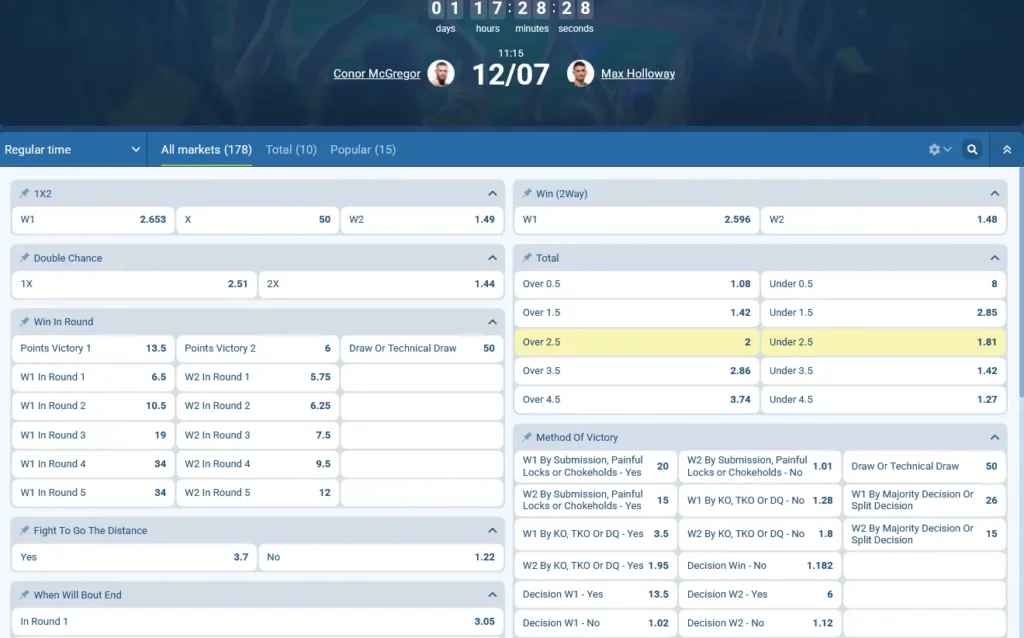
A single UFC fight on 1xBet typically carries far more than a simple winner market. Take the current Conor McGregor vs. Max Holloway headliner as an example: alongside the standard 1 (McGregor), X (draw), and 2 (Holloway) prices — 2.653 / 50 / 1.49 — the same board offers 1X and 2X double-chance prices, an Over/Under on total rounds (set at 2.5 here), and dozens of additional markets accessible from the same match page.
The draw price is worth understanding on its own: a 50.00 coefficient on “X” reflects an implied probability of roughly 2% — and even that’s generous, since a scored draw in a judged MMA bout is genuinely rare (most fights end in a clear decision, or before the judges are needed at all). Because the draw is priced as a near-impossibility, the real contest on the board is between the two fighters, and the effective bookmaker margin — once the draw’s negligible weight is set aside — runs a bit higher on MMA moneylines (commonly 5-8%, sometimes more on lower-profile cards) than on a comparable two-way football or tennis market, reflecting both the format and generally lower betting volume outside marquee cards.
UFC at 1xBet
Method of Victory and Round Betting
Beyond the match winner, the two most common ways to bet on how a fight plays out are:
- Method of victory — knockout/TKO, submission, or judges’ decision. Pricing here tracks each fighter’s actual finishing statistics: a fighter with a strong submission win rate will carry shorter odds on “win by submission” specifically, independent of their overall win probability.
- Round betting — picking the specific round in which the fight ends, or betting Over/Under on a total rounds line (typically set at 1.5 or 2.5 depending on whether it’s a 3- or 5-round fight). Fighters known for early finishes push the odds on the first round or two lower; fighters who tend to go the distance push later-round and Over prices lower instead.
One correction worth making explicitly, since it’s a commonly repeated but imprecise claim: Conor McGregor’s 13-second finish of José Aldo (UFC 194, 2015) is the fastest finish in UFC title-fight history specifically — not the fastest knockout in UFC history overall. Several non-title UFC finishes have been faster (some under 10 seconds), so the “title fight” qualifier matters for the claim to be accurate.
How Judges Score a Decision: The 10-Point Must System
Roughly a third of UFC fights go to the judges’ scorecards, which makes understanding how those scorecards actually work directly useful for method-of-victory and moneyline betting alike — not just background trivia.
Judges use the 10-point must system: the round winner is awarded 10 points, and the loser gets 9 or fewer, based on effective striking, grappling control, and aggression, weighted in that rough order for most judging bodies. A dominant round (a near-finish, one-sided damage) can be scored 10-8, which matters because it means a fighter can lose two rounds clearly but still win a fight on points if they won one round decisively enough.
The resulting decision types affect how “close” a fight actually was:
- Unanimous decision — all three judges score the same way; the cleaner result
- Split decision — two judges favor one fighter, one favors the other; a genuinely close fight where reasonable scoring could have gone either way
- Majority decision — two judges favor one fighter, the third scores an even round
Split decisions are the clearest signal that a fight was genuinely competitive — worth noting specifically when researching a rematch or a fighter’s recent form, since a “win” by split decision reflects a much closer outcome than the win/loss record alone suggests.
UFC Odds at 1xBet
UFC Special Bets: Card-Wide and Multi-Fighter Props
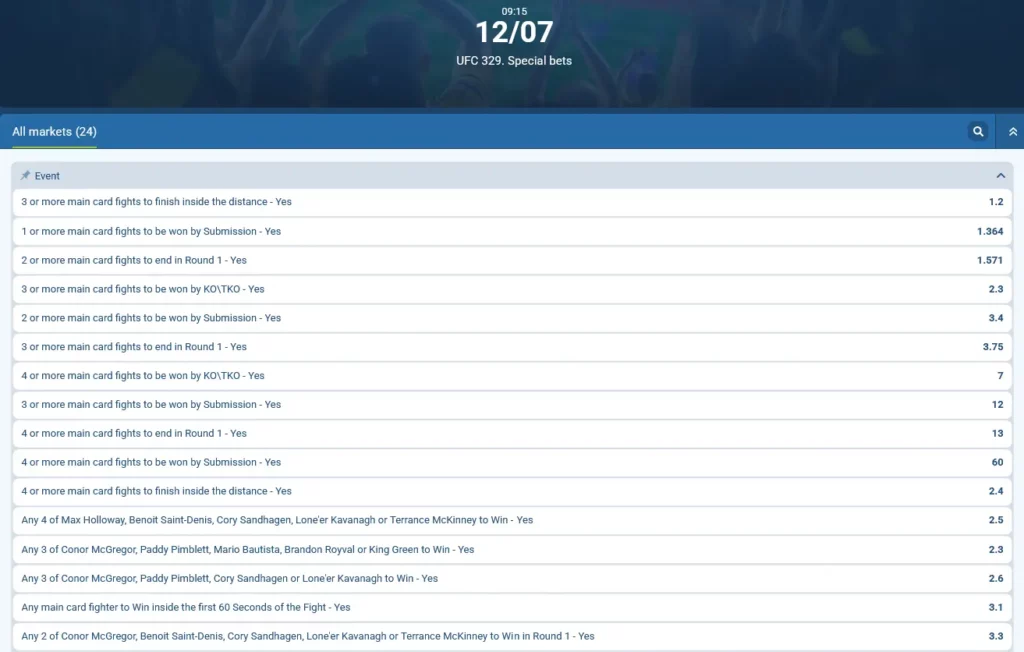
This is where UFC betting genuinely diverges from most other sports, and it’s worth knowing this market group exists — 1xBet runs a dedicated Special Bets board per numbered event, often with 20+ markets covering the entire card rather than a single fight. The current UFC 329 Special Bets board illustrates the range:
| Market | Price |
|---|---|
| 3+ main card fights to finish inside the distance | 1.2 |
| 1+ main card fight won by submission | 1.364 |
| 2+ main card fights to end in Round 1 | 1.571 |
| 3+ main card fights won by KO/TKO | 2.3 |
| 4+ main card fights to finish inside the distance | 2.4 |
| Any main card fighter to win inside the first 60 seconds | 3.1 |
| 3+ main card fights to end in Round 1 | 3.75 |
| 4+ main card fights won by KO/TKO | 7 |
| 3+ main card fights won by submission | 12 |
| 4+ main card fights to end in Round 1 | 13 |
| 4+ main card fights won by submission | 60 |
These are essentially card-wide totals — betting on the aggregate finishing pattern of an entire main card rather than one fight’s outcome, which rewards a different kind of preparation: instead of studying one matchup deeply, it rewards a broad read across every fighter on the card (how many of them are finishers versus decision fighters).
The same board also runs multi-fighter combination bets — for example, “Any 3 of Conor McGregor, Paddy Pimblett, Mario Bautista, Brandon Royval or King Green to win” at 2.3, or “Any 2 of [five named fighters] to win in Round 1” at 3.3. These function like a mini-parlay built into a single price: correctly picking which of several favorites will actually win (or finish early) across a card, without needing to construct the accumulator yourself.
UFC Special bets at 1xBet
Fight Length: 3 Rounds vs. 5 Rounds, and What It Means for Totals
Most UFC bouts run 3 rounds of 5 minutes. Two categories run longer, at 5 rounds: title fights, and most main-event bouts even when no belt is on the line. This directly explains why the total-rounds line varies between fights on the same card — the current McGregor vs. Holloway headliner carries a Total set at 2.5 rounds, consistent with a 3-round non-title bout, while a genuine title fight (such as the upcoming UFC 330 Women’s Minimumweight Championship bout) would carry a total closer to 4.5, reflecting the extra two rounds available. Checking whether a fight is scheduled for 3 or 5 rounds before looking at the Over/Under line isn’t optional — it’s the single biggest determinant of where that line should sit in the first place.
Reading a Real Fight Card
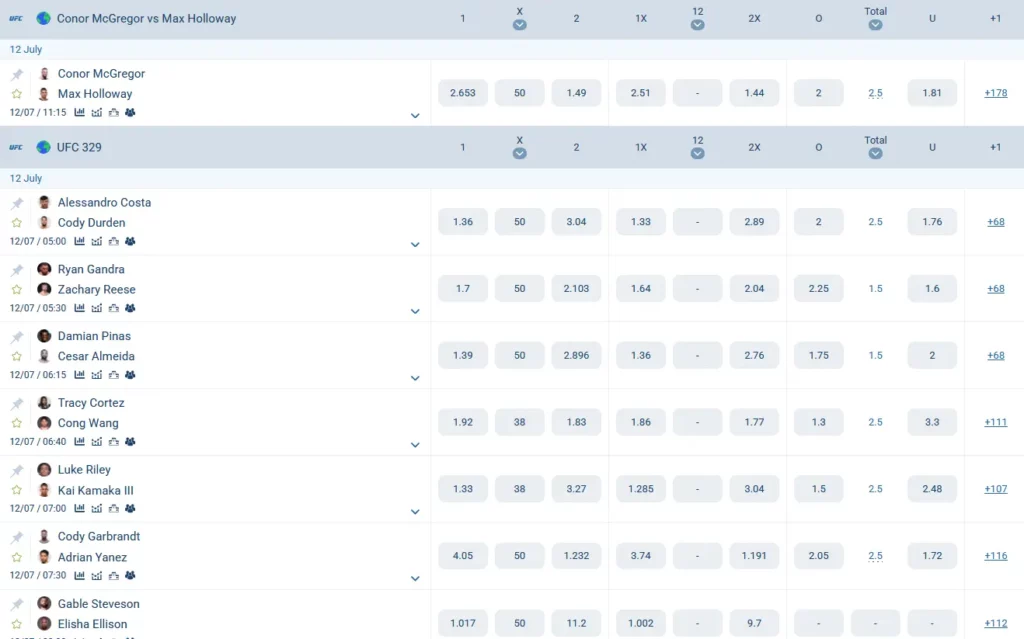
The current UFC 329 card shows the range of pricing across a single event clearly:
| Fight | 1 | X | 2 |
|---|---|---|---|
| Alessandro Costa vs. Cody Durden | 1.36 | 50 | 3.04 |
| Ryan Gandra vs. Zachary Reese | 1.7 | 50 | 2.103 |
| Cody Garbrandt vs. Adrian Yanez | 4.05 | 50 | 1.232 |
| Gable Steveson vs. Elisha Ellison | 1.017 | 50 | 11.2 |
The Steveson–Ellison price (1.017 / 11.2) is a useful extreme example: a coefficient of 1.017 implies roughly a 98% probability, about as close to a “sure thing” as MMA pricing gets, reserved for genuinely lopsided profile mismatches. Compare that to Costa–Durden (1.36 / 3.04), a clearly favored but genuinely competitive matchup.
A pattern worth checking rather than assuming: it’s tempting to assume marquee numbered events like UFC 329 always carry tighter, more efficient pricing than a weekly Fight Night card — but that isn’t consistently true fight-by-fight. Calculating the actual two-way margin (1÷odds for each fighter, summed) across the current UFC Fight Night card shows a strikingly consistent margin of roughly 104% across nearly every bout on the card — Austin Bashi vs. Jose Delgado, Seok Hyun Ko vs. Jean-Paul Lebosnoyani, and six other matchups all cluster in the 103.9-104.5% range. Several undercard fights on the numbered UFC 329 event, by contrast, run margins closer to 106-107% — higher than the Fight Night card, not lower. The practical lesson: event prestige doesn’t reliably predict pricing efficiency at the individual-fight level — it’s worth calculating the actual margin on the specific fight you’re betting rather than assuming a numbered event’s undercard is automatically sharper-priced than a Fight Night main card.
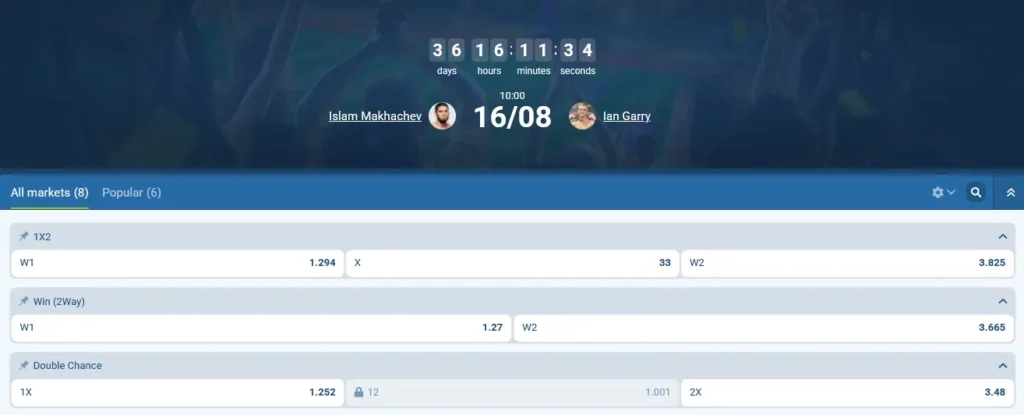
On both cards, note that the draw price sits at a flat 50 (UFC 329) or 33 (Fight Night) across nearly every fight regardless of the actual matchup — further confirmation that the draw market is priced as a formality rather than a genuine probability estimate in MMA, unlike in a sport such as football where the draw price moves meaningfully with the matchup.
What to Actually Check Before Betting
Beyond studying “how a fighter usually fights” in general terms, a few specific, checkable factors separate an informed bet from a guess:
- Weight cut history — a fighter who struggles to make weight and rehydrates late is at real risk of fading in later rounds; this is checkable via weigh-in reports and is one of the more reliable in-advance signals available.
- Finish rate by method — publicly available fight statistics (UFC’s own official stats site, among others) break down win rate by knockout, submission, and decision specifically, which is far more useful for method-of-victory bets than a general sense of a fighter’s reputation.
- Recent opposition level — a win streak against lower-tier opponents doesn’t translate directly into performance against a ranked opponent; checking who a fighter has actually beaten matters more than the raw record.
- Style matchups — a strong wrestler with good takedown offense often has a real structural advantage against a striker with weak takedown defense, independent of either fighter’s overall record; this is a genuinely predictive factor worth weighing specifically, not just background context.
1xBet UFC Odds
Types of UFC Events
1xBet’s UFC coverage spans three distinct event tiers, each with a different betting profile:
- Numbered events (e.g., UFC 329, UFC 330) — the highest-profile cards, often headlined by title fights, and the only events currently carrying a full Special Bets board with card-wide and multi-fighter props. Betting volume here is highest, but as the margin comparison above shows, that doesn’t automatically mean every fight on the card is more efficiently priced than a Fight Night bout — main event pricing tends to be sharpest, while lower undercard fights can carry wider margins due to thinner individual betting interest.
- Fight Night events (e.g., UFC Fight Night 19.07.26) — weekly or near-weekly cards featuring a mix of prospects and mid-tier veterans. These don’t carry the Special Bets board, but individual fight margins are often tightly and consistently priced across the whole card, as shown above — worth treating as seriously as a numbered event’s undercard, not dismissing as automatically softer.
- Prospective fights — a separate listing of confirmed but not-yet-fully-carded matchups, useful for tracking upcoming fights before the full market board goes live.
 Aiden Brooks
