



Boxing at 1xBet
1xBet carries a full boxing card — from small-hall four-round bouts to IBF world title fights — and the actual value in betting on it comes down to reading the market screen correctly: knowing which numbers are genuinely comparable, which look similar but aren’t, and how much margin is quietly built into each type of bet. This guide works through real 1xBet match screens exactly as they appeared, with the calculations a bettor should run before placing money, not just the terminology.
Reading a Full Match Screen: Anthony Joshua vs. Kristian Prenga
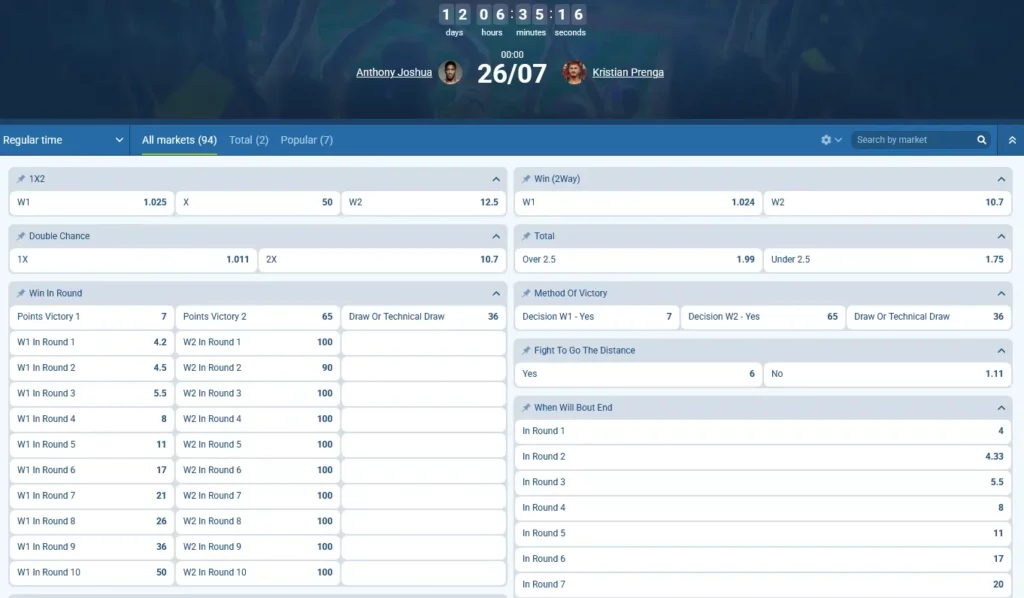
A single fight page can carry dozens of separate markets. The Anthony Joshua vs. Kristian Prenga screen (26/07) lists 94 total markets, and the six visible at a glance already show how differently the same fight gets priced depending on exactly what’s being asked:
| Market | Selections | Odds |
|---|---|---|
| 1X2 | W1 / X / W2 | 1.025 / 50 / 12.5 |
| Win (2Way) | W1 / W2 | 1.024 / 10.7 |
| Double Chance | 1X / 2X | 1.011 / 10.7 |
| Total | Over 2.5 / Under 2.5 | 1.99 / 1.75 |
| Fight To Go The Distance | Yes / No | 6 / 1.11 |
| Points Victory | W1 / W2 / Draw or Technical Draw | 7 / 65 / 36 |
Even before any calculation, the spread tells the story: Joshua is priced at 1.025 to win outright (implying roughly 97.6%), while the draw sits at 50 — a market almost nobody is expected to back, but one that still has to be priced and still carries its own margin.
Boxing at 1xBet
How Rare Is a Draw, Really? Reading the Locked “12” Market
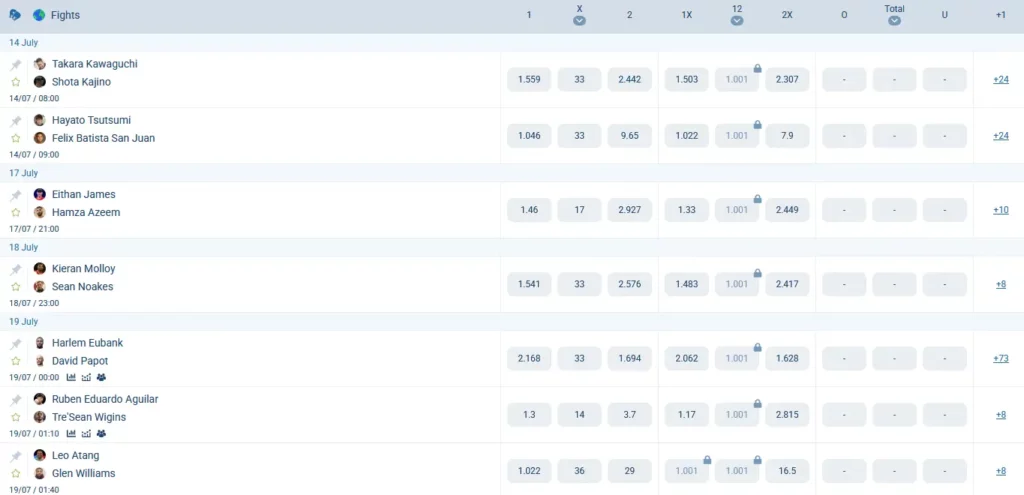
Across the full fight list for mid-July — Kawaguchi vs. Kajino, Tsutsumi vs. Batista San Juan, James vs. Azeem, Molloy vs. Noakes, Eubank vs. Papot, Aguilar vs. Wigins, Atang vs. Williams — one column is identical on every single row: “12” (Double Chance, either boxer wins, no draw) is priced at 1.001 and shown with a padlock icon, regardless of how close or lopsided the actual matchup is.
That’s not a coincidence or an oversight — it’s the market openly stating that a boxing match ending in a draw is close to a non-event. An odds of 1.001 implies a 99.9% probability that one fighter or the other wins outright, and the padlock indicates the stake on this near-certain outcome is capped, since there’s essentially no risk for the operator to price around. It’s the boxing equivalent of a market that technically exists but that the operator has no real interest in taking meaningful action on.
One detail worth being precise about: the draw isn’t priced identically across different markets that nominally describe the same outcome. On the Joshua vs. Prenga card, the 1X2 draw is quoted at 50 (implying 2.00%), while the separate “Draw or Technical Draw” line inside the Method of Victory market is quoted at 36 (implying 2.78%). Same real-world outcome, different market, different implied probability — a reminder that market labels that sound equivalent aren’t automatically the same liquidity pool.
Calculating the Bookmaker’s Margin Across Real Fights
The same method used on any sport applies here: implied probability = 1 ÷ decimal odds, and anything the three 1X2 outcomes add up to above 100% is the built-in margin. Running that across the full mid-July card:
| Match | Odds (1 / X / 2) | Total margin |
|---|---|---|
| Atang vs. Williams | 1.022 / 36 / 29 | 4.07% |
| Molloy vs. Noakes | 1.541 / 33 / 2.576 | 6.74% |
| Kelly vs. Agyarko | 1.232 / 33 / 4.49 | 6.47% |
| Joshua vs. Prenga | 1.025 / 50 / 12.5 | 7.56% |
| Eubank vs. Papot | 2.168 / 33 / 1.694 | 8.19% |
| Kawaguchi vs. Kajino | 1.559 / 33 / 2.442 | 8.12% |
| James vs. Azeem | 1.46 / 17 / 2.927 | 8.54% |
| Tsutsumi vs. Batista San Juan | 1.046 / 33 / 9.65 | 9.00% |
| Aguilar vs. Wigins | 1.3 / 14 / 3.7 | 11.09% |
Unlike a market where margin sits in a tight, predictable band regardless of matchup, boxing’s 1X2 margin here spans a real range — from 4.07% up to 11.09%, roughly a 7-point spread across the same card on the same day. There’s no clean rule tying margin size to how lopsided a fight looks (Atang vs. Williams is the most one-sided pairing on the list and also carries the thinnest margin, while Aguilar vs. Wigins, a much closer-looking matchup on paper, carries the thickest) — which means margin has to be checked fight-by-fight rather than assumed from the shape of the odds alone.
Boxing Betting at 1xBet
1X2 vs. Win (2Way): Does Dropping the Draw Change the Price?
It’s tempting to assume that removing the draw from a boxing market should mechanically shrink the margin, since there’s one fewer outcome to price around. Checking it directly across three fights where both markets are shown side by side says otherwise:
| Match | 1X2 margin | Win (2Way) margin | Difference |
|---|---|---|---|
| Joshua vs. Prenga | 7.56% | 7.01% | −0.55pp |
| James vs. Azeem | 8.54% | 9.32% | +0.78pp |
| Kelly vs. Agyarko | 6.47% | 6.04% | −0.43pp |
Two of the three fights show the two-way market carrying less margin than 1X2, one shows the opposite. There’s no consistent direction — each market is quoted independently, and assuming one is automatically “cheaper” than the other without checking is a real way to leave value on the table.
Method of Victory and Win In Round: Why the Granular Markets Cost So Much More
The Joshua vs. Prenga screen breaks “how will this fight end” down to the most detailed level available: a separate price for Joshua winning by stoppage in each of rounds 1 through 10, a separate price for Prenga doing the same, plus points-decision and draw prices. Adding up every single way Joshua could win — points victory (odds of 7) plus all ten individual stoppage-round prices (4.2, 4.5, 5.5, 8, 11, 17, 21, 26, 36, 50) — gives a striking result:
- Points Victory 1 (7): 14.29% implied
- Sum of all ten “W1 In Round” prices: 105.07% implied
- Combined total: 119.36%
That’s nearly 22 percentage points higher than Joshua’s actual win probability from the plain 1X2 line (97.56%) or the Win (2Way) line (97.66%). Slicing one outcome into eleven separate priced pieces doesn’t just redistribute the same probability across more lines — it adds a large amount of extra margin on top, far more than the roughly 7.5% margin sitting in the plain match-winner market.
Running the same check on Prenga’s side tells a smaller version of the same story:
- Points Victory 2 (65): 1.54% implied
- Sum of all ten “W2 In Round” prices (mostly priced at 100, one at 90): 10.11% implied
- Combined total: 11.65%, versus his plain win probability of 8.00% (1X2) or 9.35% (Win 2Way) — a gap of roughly 2.3 to 3.65 percentage points.
The favorite’s granular breakdown carries dramatically more excess margin (≈22pp) than the underdog’s (≈2.3–3.65pp). Part of that comes down to how short odds round: a price like 4.2 rounds far more coarsely relative to its true value than a price like 100 does, and with eleven separate short-priced lines stacked on Joshua’s side, those small roundings compound fast. The practical takeaway: the more finely a “how will it end” market is sliced, the more that slicing costs — and it costs the heavy favorite’s side of the card far more than the underdog’s.
IBF at 1xBet
Fight To Go The Distance and When Will Bout End
Fight To Go The Distance is a simple two-way market: will the fight reach the final bell, or not. On the Joshua card: Yes at 6 (16.67% implied), No at 1.11 (90.09% implied), totaling 106.76% — a 6.76% margin, close to the middle of the range already seen in the plain match-winner markets above.
When Will Bout End is a different, more granular market covering every round in which the fight could conclude by any method, for either fighter. Only the first seven rounds are visible on the Joshua screen (4, 4.33, 5.5, 8, 11, 17, 20), and those seven alone already sum to a 98.75% implied probability — before accounting for the remaining rounds still to come on the full list. That’s consistent with the same pattern found in the round-by-round win markets above: the more rounds a market has to price individually, the more the cumulative margin stacks up.
Specified Round Markets: A Real Example
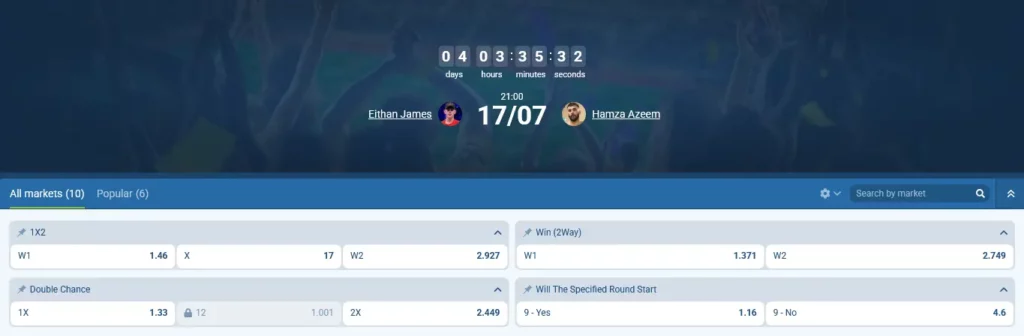
A less commonly explained market type shows up on the Eithan James vs. Hamza Azeem screen (17/07): “Will The Specified Round Start” — in this case, round 9. Yes is priced at 1.16 (86.21% implied), No at 4.6 (21.74% implied), totaling 107.95% — a 7.95% margin.
This market answers a narrower question than “will the fight go the distance”: it’s asking specifically whether the fight reaches a particular round, which matters most in fights where a stoppage is considered likely well before the final bell — a scheduled 10 or 12-round fight where the market clearly doesn’t expect round 9 to be reached with much certainty is a very different betting proposition than one priced close to even money on that same question.
Title Fights and Sanctioning Bodies: A Real Example
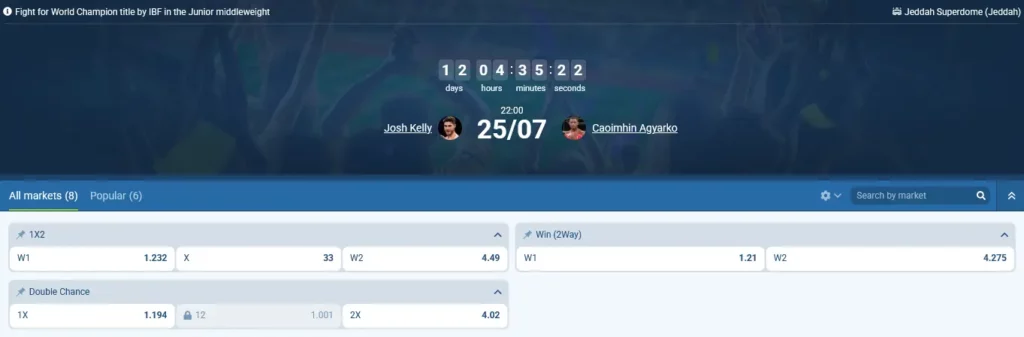
Not every fight on the card carries a championship belt, and the difference matters for market depth and public interest. Josh Kelly vs. Caoimhin Agyarko (25/07, Jeddah Superdome) is explicitly billed as a fight for the World Champion title by IBF in the Junior Middleweight division — clearly marked on the match screen itself, alongside the venue. The market screen for this fight — 1X2 at 1.232 / 33 / 4.49, Win (2Way) at 1.21 / 4.275, Double Chance at 1.194 / (12 locked) / 4.02 — carries a 6.47% margin on the plain 1X2 line, in the lower half of the range seen across the card.
Title fights like this typically draw markets from all four major sanctioning bodies — WBC, WBA, IBF, and WBO — and the same fighter can hold, defend, or contest a title recognized by one, several, or occasionally none of them depending on how fragmented the division is at the time. Checking which specific title is on the line (as this screen does explicitly) matters more than assuming “world title fight” means undisputed champion status.
Reading a Fight Card for Where the Value Actually Sits
Scanning the full mid-July list side by side surfaces useful signals before opening a single match screen:
- A very short favorite with a very long draw price (Atang vs. Williams: 1.022 / 36 / 29) signals the market expects total domination — the draw and underdog prices exist mostly as formalities.
- A tight 1X2 spread with a shorter draw price (Eubank vs. Papot: 2.168 / 33 / 1.694, or Kelly vs. Agyarko style closeness) usually reflects a genuinely competitive matchup rather than a mismatch on paper.
- The small number in the corner of each row (+24, +10, +8, +73, and so on) indicates how many additional markets exist beyond the compact list view — a much higher number, like the +73 shown for Eubank vs. Papot, generally means richer live and derivative markets are available on that specific fight once it’s opened.
Boxing odds at 1xBet
A Realistic Approach to Analysis
None of the shortcuts sometimes repeated as boxing betting “systems” hold up against how carefully these markets are actually priced. Useful analysis instead comes down to a short list of genuinely checkable factors:
- Recent stoppage rate, not just win-loss record — a fighter who’s won every recent fight by decision behaves very differently in “method of victory” and “when will bout end” markets than one stopping opponents early and often
- Activity and ring rust — a boxer returning from a long layoff carries different risk in round-specific markets than one coming off a recent, active schedule
- Weight-class history — a fighter moving up or down in weight for a specific bout changes stamina and power assumptions that plain win/loss records don’t capture
- Which specific market carries the least excess margin for the read being made — as shown above, plain match-winner markets and Fight To Go The Distance sit in a moderate margin band, while granular round-by-round and method-of-victory markets carry substantially more built-in margin, especially on the favorite’s side of a lopsided card
Getting Started
Registration takes a few minutes, and once an account is active, full fight cards — including every market shown throughout this guide — are available through the Android and iOS apps as well as the desktop site, with live odds updating on the same screens covered above.
 Aiden Brooks
