
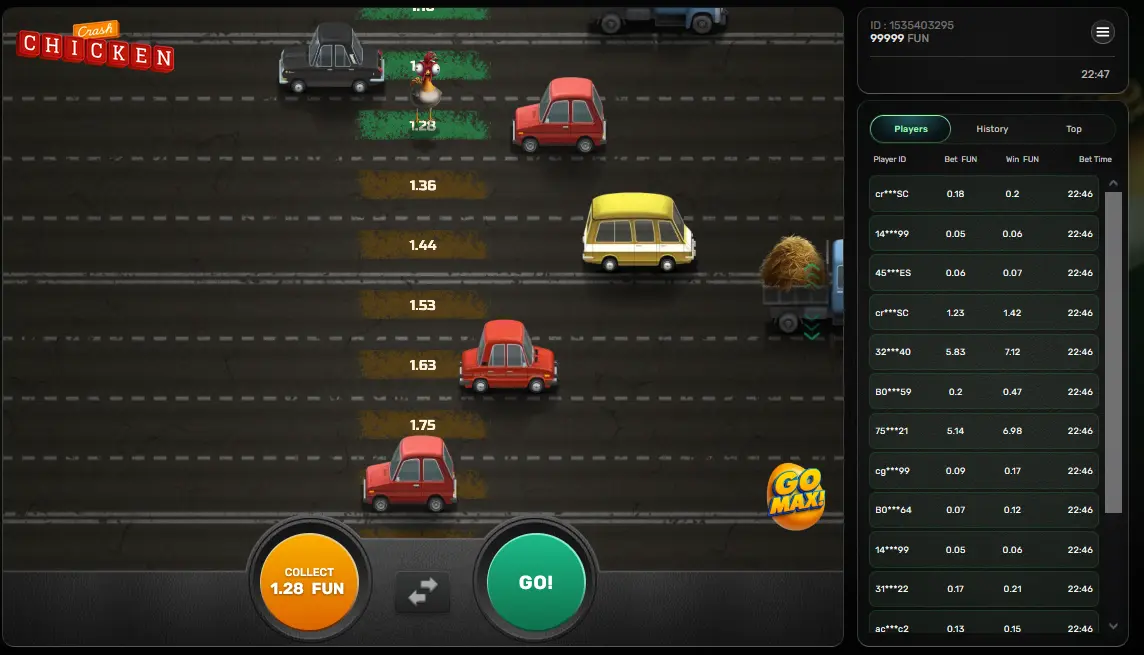
A chicken standing on a crosswalk isn’t the metaphor you’d expect for a casino game’s math, but it’s exactly how Chicken Crash works: every line on the road carries its own fixed odds, and the chicken’s progress across it is the entire game. 1xBet carries Chicken Crash by Galaxsys, and this guide sticks strictly to what the game’s own official rules confirm — bet limits, RTP range, and what actually happens if your connection drops mid-round — rather than the vague “pattern” talk that circulates around most crash-style games.
How Chicken Crash Actually Works
The premise is simple: guide a chicken across a busy road by choosing where it should stop. Each crosswalk line further down the road carries its own fixed winning odds, and those odds scale with how far the chicken has to travel — the further the line, the higher the payout multiplier, and the higher the risk that a car gets there first.
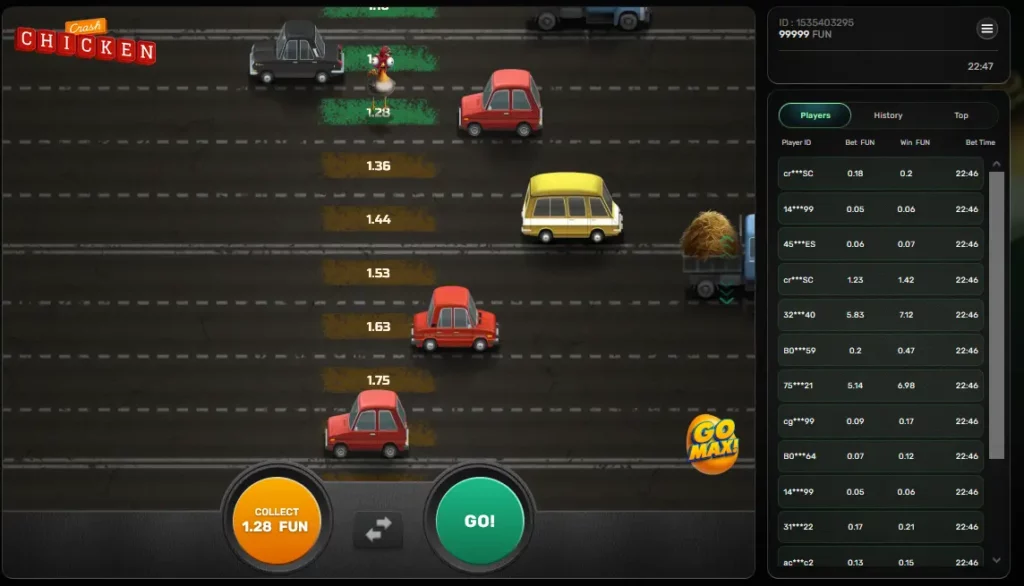
Chicken Crash Interface
There are two outcomes on any given attempt:
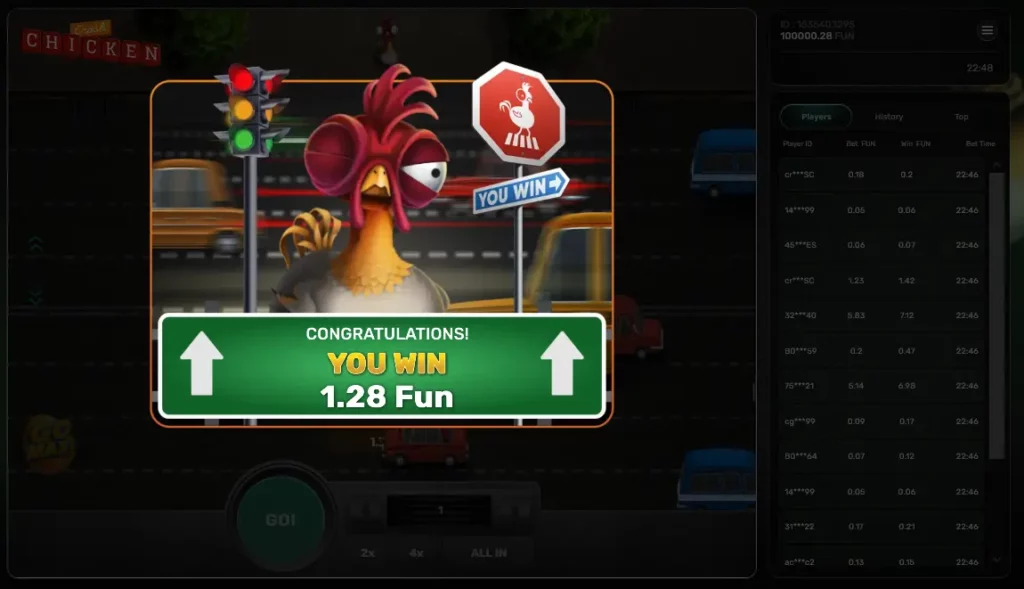
- The chicken reaches the selected line successfully — the bet amount is multiplied by that line’s specific odds, and the win is credited
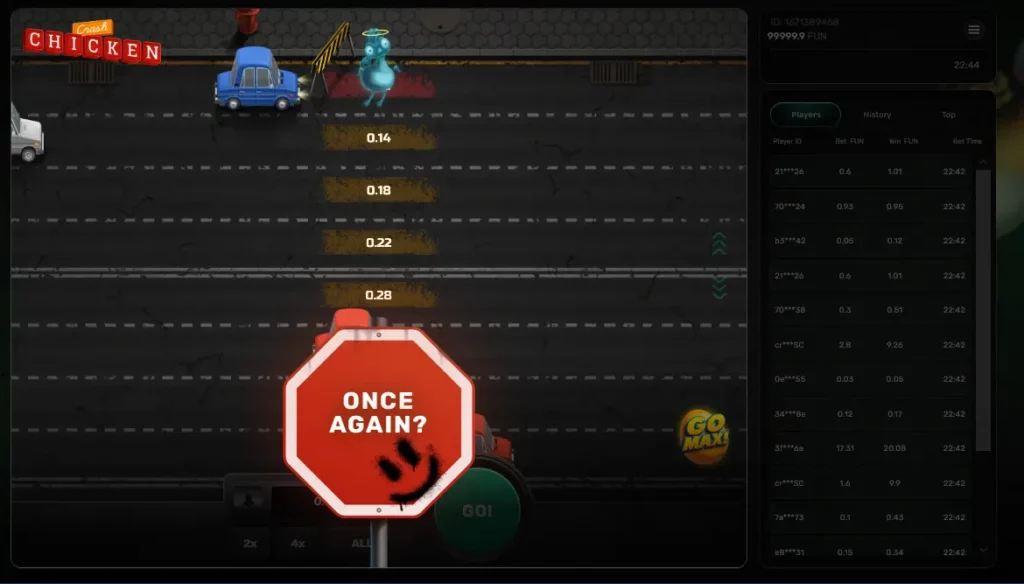
- The chicken is hit by a car before reaching the selected line — the placed bet is lost in full
Once the chicken successfully reaches a line, there’s no obligation to stop: the player can cash out immediately, or continue further down the road by selecting another line or pressing Go again. One structural rule worth knowing regardless of strategy: the chicken can never move backwards — every decision only extends the run forward, for better or worse.
Two Ways to Move: Selecting a Line vs. Pressing Go
This is a genuine mechanical distinction worth understanding before playing, since it changes how a round unfolds. After setting a stake, there are two ways to progress:
- Tap directly on a specific crosswalk line — the chicken moves straight to that spot, skipping every line in between. This lets a player commit to a specific risk/reward point in one action rather than advancing step by step.
- Press the “Go” button — the chicken takes exactly one step forward at a time, letting a player reassess after every single line rather than committing to a distant target upfront.
Neither approach is inherently better — jumping straight to a line suits a player who already knows their target multiplier, while stepping through one line at a time suits a player who wants the option to cash out at any point along the way without having pre-committed to a distant line.
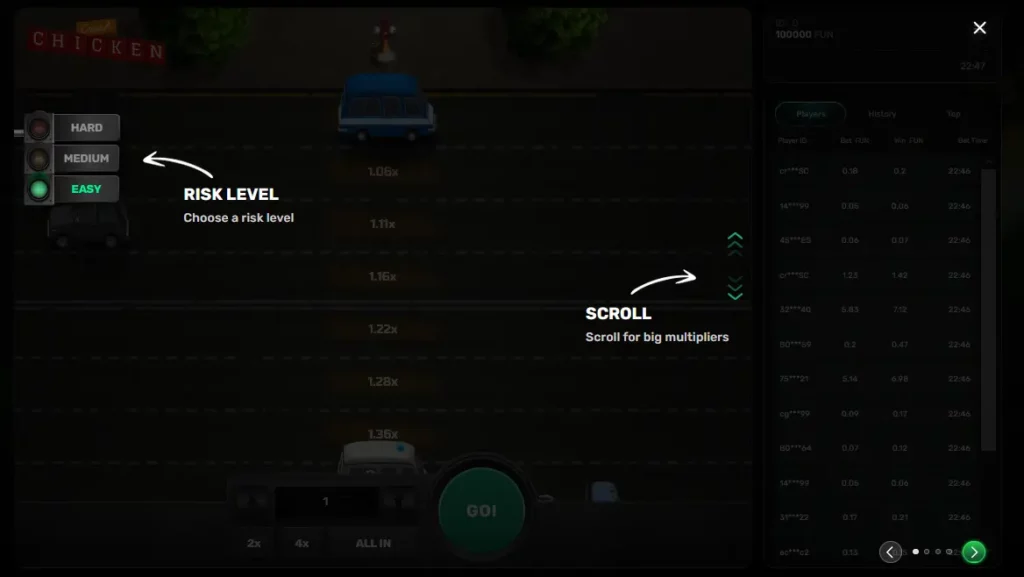
Chicken Crash Tutorial
Difficulty Levels and Real Bet Limits
Chicken Crash runs three difficulty levels — Easy, Medium, and Hard — and each carries genuinely different betting limits, not just a cosmetic risk label:
| Difficulty | Min Bet | Max Bet | Max Win |
|---|---|---|---|
| Easy | 0.1 | 1,000 | 10,000 |
| Medium | 0.1 | 200 | 10,000 |
| Hard | 0.1 | 100 | 10,000 |
The pattern here is worth noticing on its own: the maximum bet allowed actually shrinks as difficulty increases — Easy permits stakes up to 10 times higher than Hard mode. This is a deliberate volatility control built into the game’s own limits, not just a difference in crosswalk odds: since Hard mode’s odds escalate more aggressively per line, the game caps how much can be staked on that higher-variance structure, while the maximum possible win (10,000 units) stays identical across all three levels regardless of difficulty chosen.
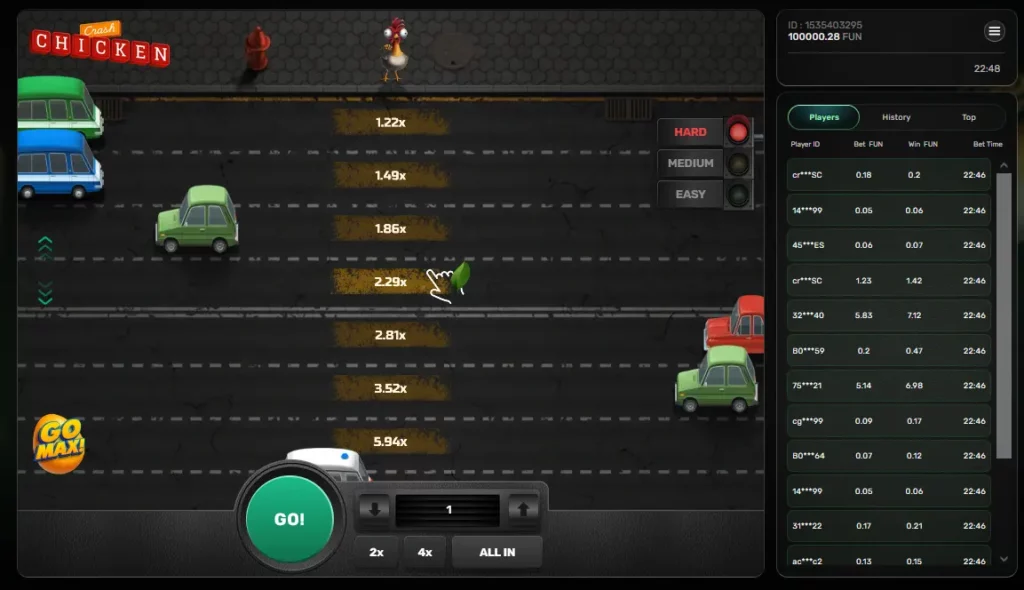
Chicken Crash Hard Mode
RTP: Why It’s a Range, Not a Single Number
Chicken Crash’s official return-to-player figure is stated as 91.88%–98%, not a single fixed percentage. This range reflects the fact that RTP in a line-based crash format isn’t uniform across every possible decision — the specific line chosen, and by extension the specific odds attached to it, sits somewhere within that published range depending on how far along the road that line is. This is a meaningfully more honest way to describe the game’s math than quoting a single flat number: a game with dozens of possible cashout points across three difficulty levels doesn’t reduce cleanly to one RTP figure, and any source that quotes a single flat percentage without the range is simplifying past what the game’s own published figures actually say.
Win at Chicken Crash
What Happens If Your Connection Drops
This is genuinely useful information that most game guides skip entirely. According to the game’s own rules, poor internet connection or device performance can delay how game states, animations, or results are displayed — but the actual outcome of a round is always determined server-side, independent of what a player’s screen shows or when it shows it.
Specifically: if a disconnection happens during an active round after the bet has already been accepted by the server, any winning that round produces is automatically credited to the player’s balance once connection is restored — regardless of the interruption. In practice, this means a lost connection at a critical moment doesn’t cost a winning round, since the server-side result stands independent of what the player was able to see in real time. It’s a meaningfully reassuring detail for a fast-paced game where connection timing genuinely matters to the player experience.
Defeat in Chicken Crash
A Grounded Approach to Playing
Since round outcomes are determined server-side and each round is independent, a few honest points are worth keeping in mind rather than the “track recent patterns” advice that circulates around crash-style games generally:
- Past rounds don’t predict the next one. A recent run of low-multiplier crashes doesn’t make a longer run more or less likely on the next attempt — treating a history of outcomes as a signal for what’s “due” is a common misconception, not a real edge.
- Choosing a specific line versus stepping with Go is a preference about control, not a strategy that beats the game’s built-in math. Both approaches are subject to the same underlying odds structure.
- The difficulty level’s bet cap is a real constraint worth planning around, particularly in Hard mode, where the maximum stake is a tenth of what Easy mode allows — worth checking before assuming a planned stake will be accepted.
- Deciding on a cashout point before starting a run, rather than during it, removes in-the-moment pressure from a game explicitly designed around a ticking sense of risk.
None of this changes the fundamental uncertainty of a crash-format game — the published RTP range confirms the house edge is real and roughly consistent with other titles in the genre — but grounding decisions in the game’s actual published limits and mechanics is a more honest starting point than treating recent outcomes as predictive of what comes next.