



Group B at the 2026 World Cup
1xBet has Group B priced as one of the most open and unpredictable pools of the entire 2026 World Cup. No single powerhouse dominates — instead, four teams with wildly different footballing histories share two spots in the round of 16.
Group B Overview
Group B may be the most democratic draw of the tournament. A host nation without a single World Cup point in their history. An unexpected giant-killer from the Balkans who sent Italy home. A Swiss side forever knocking on the door of a true breakthrough. And a Gulf state for whom simply arriving here represents the culmination of a decades-long project. Four stories. Two places.
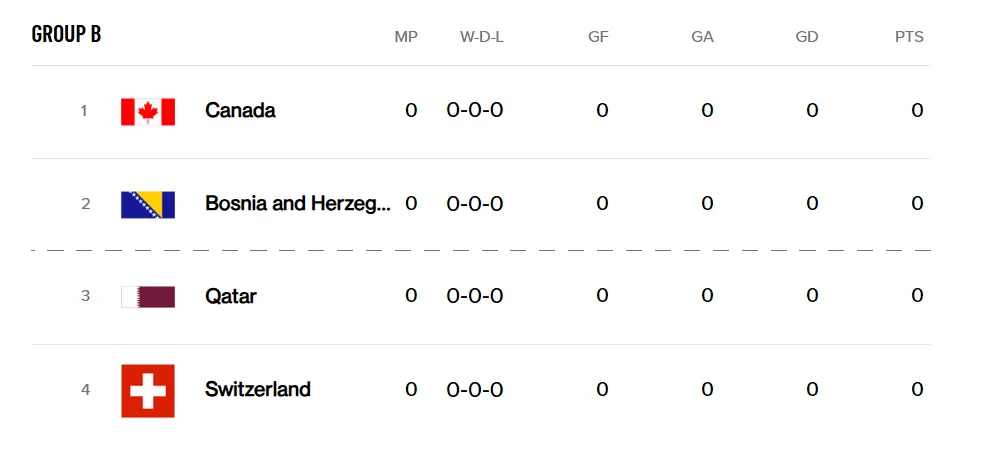
World Cup 2026 Group B
Canada
A hockey nation in search of a football identity
In Canada, sport has historically meant one thing: ice hockey. Football existed on the fringes — just three Canadian clubs in MLS for years, no independent domestic league until 2019. And yet it was football that gave Canada their first major international gold: at the 1904 Olympics in St. Louis, a team from the club Galt won both games with a combined score of 11-0.
On the global stage, Canada’s record has been far more modest. Their first qualification campaign ended in heartbreak and a two-tournament boycott. Only from 1970 did they begin qualifying regularly, energised by the creation of the North American Soccer League — the competition that brought Pele, Eusebio and Gerd Muller to the continent.
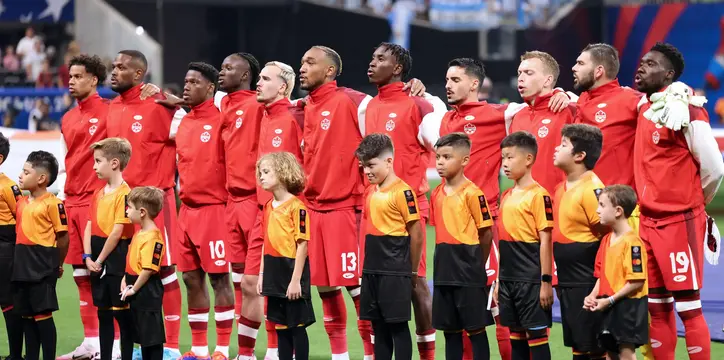
World Cup 2026. Canada
The 1986 World Cup: a frozen stadium between a cemetery and a prison
Canada’s first World Cup place was secured through sheer ingenuity. The decisive qualifier against Honduras was staged on the island of Newfoundland in autumn — temperatures around -10°C, biting wind, bone-chilling humidity. The stadium sat between two cemeteries and a prison. The Hondurans were broken before kick-off. Canada won, travelled to Mexico — and lost all three matches without scoring a single goal.
Football then virtually vanished in Canada. Top players drifted to Scandinavia and the lower reaches of English football. Some Canadian-born players switched allegiances entirely — Yassine Bounou, born in Quebec, went on to represent Morocco.
The Herdman revolution
Everything changed in 2018 with the appointment of John Herdman. When he declared he would take Canada to the World Cup, the reaction ranged from scepticism to outright mockery. But Herdman had a plan. Drawing on MLS academies and a government programme called Canada Soccer’s Pathway, he reshaped the national team’s culture from within. Within four years, he had moved Canada dozens of places up the FIFA rankings and delivered a World Cup place for 2022.
In Qatar, Canada lost all three games — to Morocco (1-2), Croatia (1-4) and Belgium (0-1) — but left a vivid impression: young, quick and fearless. No points, but clear evidence the project was working.
Playing style and key players
Canada play direct, vertical, high-intensity football — pressing hard without the ball and transitioning quickly when they win it. Head coach Jesse Marsh, a graduate of the Red Bull coaching system, has added structure and organisation to the squad’s raw athleticism.
- Jonathan David (Juventus) — the all-time leading scorer in Canadian football history, 39 goals in 75 appearances. Born in New York, raised in Canada, he could have represented the United States but chose the red maple leaf.
- Alphonso Davies (Bayern Munich) — the most recognisable face of Canadian football, and also the most fragile. His fitness is the defining question ahead of the tournament; without him, Canada lose significant attacking threat.
- Steven Eustaquio (on loan at LA Galaxy) — the quarterback of the midfield, giving Marsh the freedom to shift between 4-4-2, 4-3-3 and 4-2-3-1 without losing structure. Named Canada’s best player in 2023.
- Jesse Marsh (52) — former head coach of New York Red Bulls, Red Bull Salzburg and Leeds United. The principles absorbed in the Red Bull system have transferred seamlessly to this squad.
Switzerland
A century of almost
If football was born in Britain, its first home on the continent was Switzerland. English students founded the country’s first club in 1860; the federation followed in 1895; Switzerland became one of FIFA’s founding members in 1904. Their first official match ended in a 0-1 defeat to France in 1905.
The Red Crusaders have appeared at 13 World Cups. Their best results came in 1934, 1938 and 1954 — the 1954 quarter-final, a 5-7 defeat to Austria played on home soil in Lausanne, remains the highest-scoring match in World Cup history. A prolonged crisis in the second half of the 20th century stemmed from an unusual source: the country’s French- and German-speaking players followed incompatible footballing philosophies, and no coach could unite them. The breakthrough came under Roy Hodgson, who brought the squad together for the 1994 World Cup. Since then, Switzerland have qualified for every tournament except 2010.
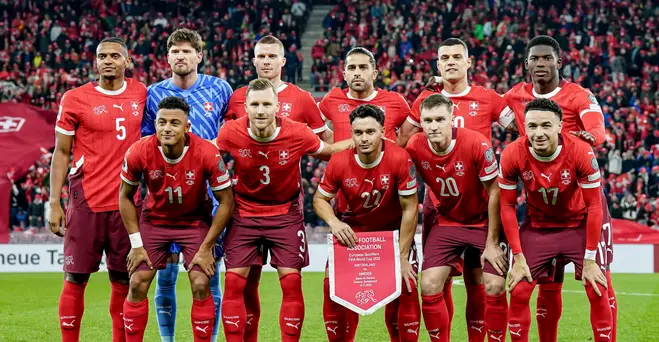
World Cup 2026. Switzerland
Flawless qualification
Switzerland navigated their qualifying group — alongside Sweden, Slovenia and Kosovo — without a single defeat. Six matches, two draws, just two goals conceded. Sweden, theoretically their main rivals, imploded and finished last. The Red Crusaders were comfortable throughout.
Playing style and key players
Head coach Murat Yakin favours a 4-3-3 built around explosive wide play and an intricate, interchangeable midfield trio. The system is dynamic: when one midfielder pushes forward, the others cover; when the full-backs overlap, the midfield shifts accordingly. Switzerland are genuinely difficult to pin down.
- Manuel Akanji (Manchester City) — the intellectual anchor of the defence. Pep Guardiola has spoken admiringly of his football intelligence; he reads the game several moves ahead and was dominant throughout qualifying.
- Granit Xhaka (Sunderland) — captain and record appearance holder with 143 caps. His leadership, set-piece delivery and steel in midfield are the team’s emotional core.
- Gregor Kobel (Borussia Dortmund) — the goalkeeper and the squad’s most valuable player. He only broke into the national team in 2021 but is now indispensable.
- Murat Yakin — familiar to Russian football fans from a difficult stint at Spartak Moscow in 2014-15. He found his calling with the Swiss national side, guiding them to Euro 2024 where they eliminated Italy in the last 16.
Bosnia and Herzegovina
Heirs to the European Brazilians
Bosnian footballers were a significant presence in Yugoslavian football long before Bosnia and Herzegovina had an independent national team. Yugoslavia were known as the European Brazilians — technically gifted, twice European Championship finalists, twice World Cup semi-finalists, and four-time Olympic medallists including gold in Rome in 1960. Bosnian players were always central to that story.
The independent team’s journey began in turbulent circumstances. Civil war meant no official matches during the country’s earliest years as a footballing nation. Their first official game was a 0-2 defeat to Albania in 1995. Progress was slow and uneven — in World Cup qualifying for 2002, they lost to everyone except Liechtenstein.
The turning point came in 2007, when 13 players staged a protest demanding reform of the football federation. The shake-up that followed brought through a young generation including Edin Dzeko and Miralem Pjanic. Their first World Cup came in Brazil 2014 — defeats to Argentina (1-2) and Nigeria (0-1), then a consolation win over Iran (3-1).
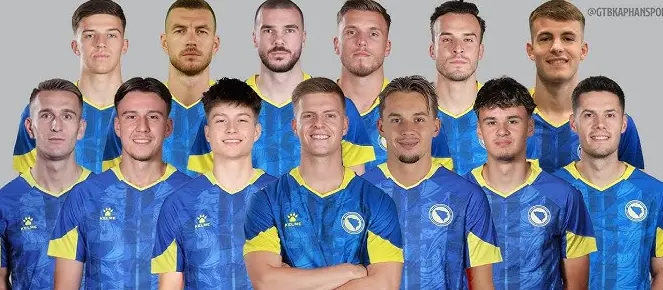
World Cup 2026. Bosnia
The night Italy went to hell in Zenica
Qualifying for 2026 was turbulent. In a group with Austria, Romania, Cyprus and San Marino, Bosnia led early before dropping points to Cyprus (2-2, conceding a 96th-minute penalty) and drawing the final group game against Austria (1-1). Into the play-offs they went.
First came Wales — Bosnia trailed on aggregate but Edin Dzeko equalised before the shootout, where a missed penalty from Brennan Johnson and a decisive save settled it. Then Italy. When footage circulated of Azzurri players celebrating the Bosnia draw, Pjanic publicly promised them hell in Zenica. He delivered. The stadium roared for 120 minutes. A red card for Italy, an equaliser 11 minutes from the end of extra time, then the shootout — Esposito and Cristante both cracked. Bosnia are going to the World Cup.
Playing style and key players
Head coach Sergej Barbarez — himself a former Bundesliga striker — has built a team in his own image: relentless, physical and utterly committed. The 4-4-2 is pressed with extraordinary intensity; full-backs push into the opposition half and somehow the team always recovers to defend.
- Edin Dzeko (40, Schalke) — the legend who refuses to retire. 73 international goals — the national all-time record. The second-highest scorer in the current squad has four. The rest of the team are playing in a different statistical universe.
- Esmir Bajraktarevic (PSV) — the dribbling engine of the squad. Made eight successful dribbles in the historic win over Italy and held his nerve for the decisive penalty in the same game. His qualifying goal against Romania drew immediate comparisons to a young Messi.
- Nikola Vasilj (St. Pauli, Bundesliga) — the goalkeeper, currently among the top three in the Bundesliga for saves and goals prevented per 90 minutes. His play-off heroics showcased a mentality built for the biggest moments.
Qatar
An academy project meets the world stage
Qatar built its football from scratch. Through the 1970s and 80s, the national team tried naturalisation — recruiting players from Pakistan, India and Latin America. The experiment failed. The answer was the Aspire Academy, established in 2004 with a mandate to develop Qatari talent by scouting over 17 million boys across Africa. The Belgian club Eupen and Spain’s Cultural Leonesa were purchased as development pathways for graduates.
The results eventually arrived: an Asian Cup triumph in 2019 with 10 Aspire graduates in the squad, and a second continental title in 2023 — this time without conceding in the group stage, beating Iran in the semi-final and Jordan in the final. But the 2022 World Cup, played on home soil, was a humbling experience: bottom of the group, zero points, three defeats each by a two-goal margin.
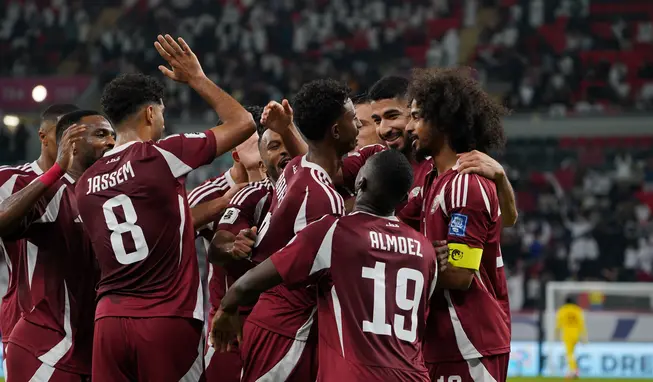
World Cup 2026. Qatar
Qualification through turbulence
The road to 2026 was far from smooth. Heavy defeats to the UAE (0-3 and 1-5), Uzbekistan (0-3) and Kyrgyzstan (1-3) in the third round of Asian qualifying exposed a significant gap between regional competition and international standards. Only a 1-0 win over Iran kept them in contention. In the decisive fourth-round matches, a goalless draw with Oman and a 2-1 win over the UAE — with the clinching goal scored by naturalised Portuguese defender Pedro Miguel — secured their place.
Playing style and key players
Head coach Julen Lopetegui — best known internationally for being sacked by Spain on the eve of the 2018 World Cup after agreeing to join Real Madrid — has arranged the squad in a 4-2-3-1 with an emphasis on attacking players. The defensive midfield pairing lack the positional intelligence to cover effectively, a weakness that stronger sides will look to exploit.
- Akram Afif (Al-Sadd) — the most recognisable product of the Aspire Academy. Versatile across both flanks and primarily a creator, he provided two assists in the decisive win over the UAE.
- Almoez Ali (Al-Duhail) — the all-time leading scorer with over 50 goals in 188 appearances. His goals at the 2019 Asian Cup — including a hat-trick against North Korea — established him as the team’s central attacking figure.
- Boualem Khoukhi (35) — the defensive rock. Rarely misses a game through injury and brings an authority to the backline that no other squad member can replicate.
- Julen Lopetegui — after difficult spells at Wolverhampton Wanderers and West Ham United, the Spaniard has found a setting where his pragmatic approach has at least produced results at the qualification stage.
Who Advances from Group B
| Team | 1xBet |
|---|---|
| Switzerland | 1.09 |
| Canada | 1.24 |
| Bosnia and Herzegovina | 1.29 |
| Qatar | 2.43 |
Switzerland at 1.09 is not really a betting market — it is closer to a formality. The Red Crusaders have the squad, the coaching and the tournament experience to navigate this group with authority. Canada and Bosnia are priced almost identically, and that tells its own story. The hosts bring the weight of home expectation and the energy of 50,000 supporters; Bosnia carry the memory of Italy and the fury of Zenica. Their opening game against each other is the defining fixture of the group. Qatar (2.43) — the odds are more generous than the football warrants, a reflection of the expanded format rather than genuine optimism.

Group B. World Cup 2026. Odds at 1xBet
Who Wins Group B
| Team | 1xBet |
|---|---|
| Switzerland | 1.81 |
| Canada | 3.62 |
| Bosnia and Herzegovina | 4.50 |
| Qatar | 30.00 |
Switzerland (1.81) are clear favourites to top the group, and first place matters — the bracket from second leads to the Netherlands or Brazil by the round of 16. Yakin’s side will be highly motivated to win every game. Canada (3.62) are genuine contenders for top spot if Davies is fit and David is sharp. Bosnia (4.50) — the wide odds reflect real uncertainty about how to assess them after the Italy result. If they beat Canada in the opener, the equation shifts entirely. Qatar (30.00) — for the most committed optimists only.
Our Predictions
Switzerland advance — the only question is first or second. First place is strongly preferred: the easier bracket in the knockout stage is a meaningful advantage. Canada will record their first-ever World Cup victory in this group, ending a 40-year wait for three points on football’s biggest stage. The second spot will be settled by the Canada-Bosnia opener — the most important match in the group and one of the most compelling games of the entire first round.
Bosnia finish third with their heads held high. Qatar finish fourth and depart without a point — though the country has long since learned to measure its football progress in decades rather than results.
Other Groups WC-2026 at 1xBet
 Aiden Brooks
