



Group C at the 2026 World Cup
1xBet has Group C as one of the clearest pools at the top — and one of the most emotionally charged at the bottom. Five-time world champions. The finest African side of the last decade. A Scottish generation ending 28 years of exile. And Haiti — a country whose national stadium is run by armed gangs, whose coach has never set foot on the island, and who got here on sheer willpower alone.
Group C Overview
Group C is built on layered expectations. Brazil chase a sixth world title under their first foreign coach in living memory. Morocco are back to prove Qatar was no fluke. Scotland return to the World Cup stage for the first time since 1998, ending nearly three decades of near-misses. And Haiti carry a story that cinema could not improve upon. Three teams with ambitions. One with something far greater.
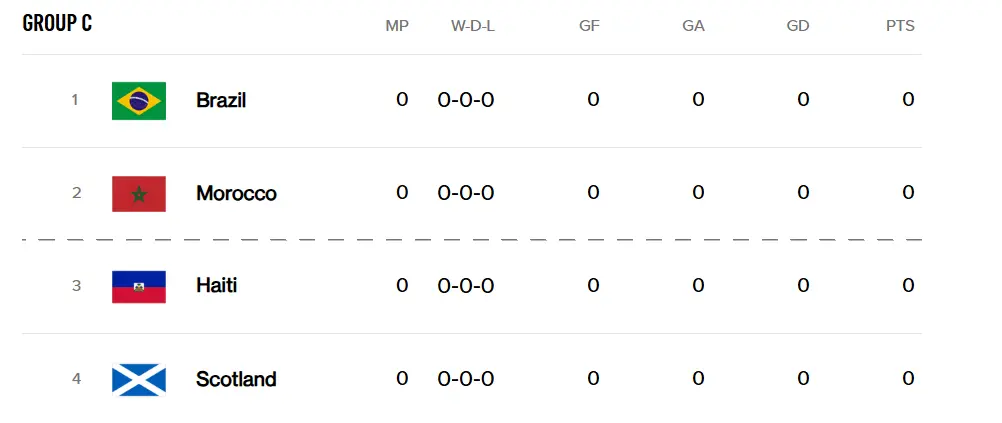
World Cup 2026 Group C
Brazil
The only team that has always been there
Brazil are the only nation to have appeared at every single World Cup — all 23 editions. Their five titles (1958, 1962, 1970, 1994, 2002) remain an absolute record. The 2022 tournament ended in a quarter-final penalty shootout defeat to Croatia — a result that still stings. Now, under their first foreign head coach in decades, the Selecao return with a squad worthy of the name Pentacampeoes, chasing a sixth title.
Qualification for 2026 was uncharacteristically rocky. Brazil finished fifth in the South American standings, and head coach Carlo Ancelotti — appointed after leaving Real Madrid — marked his competitive debut with a 0-0 draw against Ecuador. The decisive win came in game two: a 1-0 victory over Paraguay, settled by a Vinicius Junior goal on 44 minutes. Brazil became the first team to qualify for all 23 World Cups.
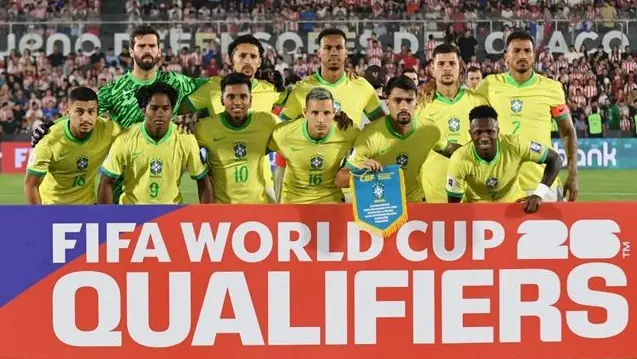
World Cup 2026. Brazil
Ancelotti’s 4-2-4 and a squad full of stars
Ancelotti has expressed a preference for a 4-2-4 — a formation that echoes the great Brazilian sides of the past. In goal: Alisson (Liverpool), Ederson (Fenerbahce) and Bento (Al-Nassr). The defensive unit features Marquinhos (PSG), Gabriel Magalhaes (Arsenal) and Eder Militao (Real Madrid) at centre-back, with Wesley (Roma) and Douglas Santos (Zenit) at full-back. The midfield is anchored by Casemiro (Manchester United) and Bruno Guimaraes (Newcastle), with Fabinho, Andrey Santos and Danilo Santos providing depth. In attack: Vinicius, Raphinha, Matheus Cunha and Joao Pedro, with Estevao and Luis Enrique on the flanks.
The Neymar question remains unresolved — his inclusion can no longer be taken for granted even by the coaching staff.
- Vinicius Junior (Real Madrid) — the team’s brightest star and one of the best players in the world. Scored the goal that sealed Brazil’s qualification.
- Raphinha (Barcelona) — versatile, creative and capable of playing wide or centrally. One of the most complete attackers in the squad.
- Bruno Guimaraes (Newcastle) — the heartbeat of the midfield press and transition game. Underrated globally, essential to how this Brazil actually functions.
- Carlo Ancelotti — a four-time Champions League winner as a manager and one of the most celebrated coaches in the history of the sport. His appointment as the first foreign boss of the Selecao in many decades was the biggest coaching story of the past year.
Morocco
From outsiders to fourth in the world
Morocco’s run at the 2022 World Cup was one of the great stories in the tournament’s history. The first African semi-finalists ever, the Atlas Lions eliminated Spain and Portugal and came within touching distance of the final — only France (0-2) stopped them. It was not just a result; it was a cultural moment felt across an entire continent.
For 2026, Morocco qualified with a perfect record: six wins from six in Group E of African qualifying, including a 5-0 demolition of Niger. They were the first African side to secure their place at the tournament.
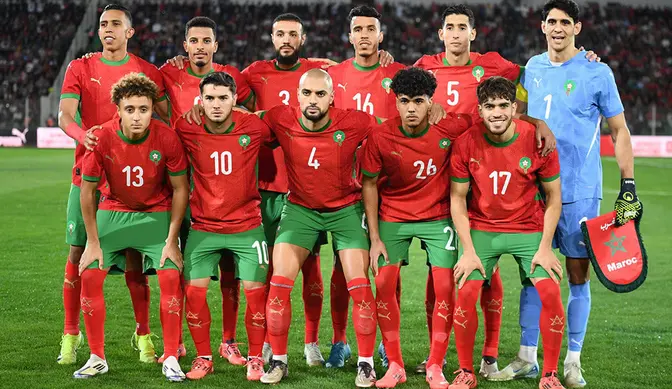
World Cup 2026. Morocco
Playing style and key players
Morocco are built on defensive discipline and collective organisation. They are not a side that opens up easily — their strength lies in compact shape, rapid transitions and a genuine set-piece threat. Their squad is rich in players from the top five European leagues.
- Yassine Bounou (Bono) — one of the world’s elite goalkeepers, born in Quebec but the cornerstone of Moroccan football. His performances in Qatar, including the penalty shootout against Spain, are already the stuff of legend.
- Achraf Hakimi (PSG) — arguably the finest attacking full-back in world football. His combination of pace, technique and positioning makes him a constant threat from right-back.
- Hakim Ziyech — experience and creativity on the right wing, capable of producing individual moments that change matches entirely.
- Brahim Diaz (Real Madrid) — the attacking wildcard. Quick, direct and comfortable in tight spaces; one of the harder players in this group to plan for defensively.
- Noussair Mazraoui (Bayern Munich) — adds European experience and defensive solidity on the left side of a back line that has rarely been breached.
Scotland
Twenty-eight years, three near-misses and a curse
Scotland gave international football to the world — the first-ever match between national teams took place in Glasgow in 1872, a 0-0 draw against England. But World Cups have been unkind to the Tartan Army. Between 1974 and 1982, they were eliminated three times in a row on goal difference — each time finishing level on points with the side that progressed. One extra goal would have changed three different tournaments.
After missing three consecutive World Cups — beaten by Belgium, Croatia, England and Denmark in successive qualifying campaigns — Scotland finally broke through. In a group with Denmark, Greece and Belarus, everything came down to the final match in Glasgow against the Danes. With a draw in sight and early exit looming, Scotland scored twice in stoppage time to win 4-2. They are back at a World Cup for the first time in 28 years.
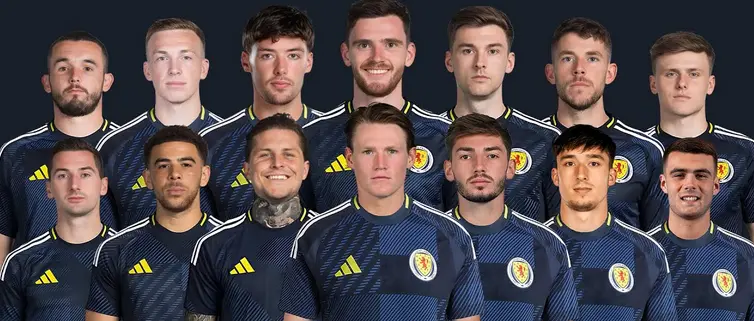
World Cup 2026. Scotland
Playing style and key players
Steve Clarke has built a side around high pressing, vertical play and raw character. Scotland can shift from daring to pragmatic within the same game, making them genuinely difficult to prepare for. The squad is full of players with real Premier League and European experience.
- Scott McTominay (30, Napoli) — the team’s most important player and tactical chameleon. Clarke regularly deploys him as a striker; he scores crucial goals wherever he plays. His late winner against Denmark is the goal that sent Scotland to this World Cup.
- Billy Gilmour (Napoli) — the intelligent playmaker in central midfield. Physically disciplined despite his slight frame, he organises attacks under pressure with a calmness that belies his age.
- Andrew Robertson (captain) — past his peak at Liverpool but the undisputed emotional leader of this squad. His deliveries from left-back turn set-pieces into genuine danger.
- Steve Clarke (62) — has worked with the national side since 2019, guiding them to two European Championships and now a World Cup. Respected as both a tactician and a dressing-room leader.
Haiti
A stadium controlled by gangs, a coach without a visa, and a World Cup ticket
This story deserves its own film. Haiti is the poorest and most unstable country in the Western Hemisphere — after the assassination of President Jovenel Moise in 2021, armed gangs seized control of up to 90% of the country’s territory. The national stadium fell with them. Haiti played every single home qualifying match on neutral ground in Curacao and Nicaragua. Some squad members were also denied entry visas to the United States.
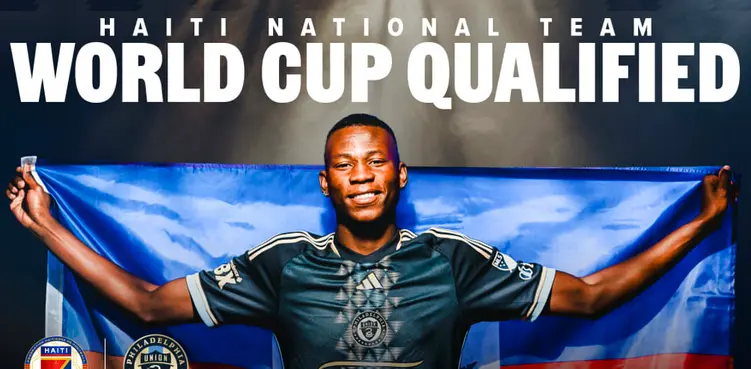
World Cup 2026. Haiti
Head coach Sebastien Migne has never visited Haiti. The Frenchman — who built his career coaching across Africa, in Cameroon, DR Congo, Togo, Oman, Kenya, Equatorial Guinea and the Republic of Congo — has only ever seen the country that employs him through a screen.
Haiti’s only previous World Cup was in 1974 in West Germany. That tournament produced two moments of history. Striker Emmanuel Sanon ended Dino Zoff’s world-record unbeaten run by scoring against Italy — the first goal Zoff had conceded in 19 consecutive matches. And the tournament’s first doping case involved a Haitian defender, caught using ephedrine and escorted home by a paramilitary group.
Fifty-two years later, the Grenadiers are back. In CONCACAF qualifying, they won their second-round group ahead of Honduras, beating Costa Rica along the way when Fratzsdi Pierre scored the goal that opened the door.
- Fratzsdi Pierre (30, AEK Athens) — the team’s primary scoring threat. Tall, powerful in the air and dangerous on the ground — if Haiti score at this tournament, he will almost certainly be the one responsible.
- Ruben Providence (24, Almere City) — the creative spark alongside Pierre in attack. Assisted the decisive goal against Costa Rica and has the ability to punish teams who give him space.
- Ricardo Ade (35, LDU Quito) — the veteran leader of the defence, playing in Ecuador’s top flight and running every minute as though he were a decade younger.
Who Advances from Group C
| Team | 1xBet |
|---|---|
| Brazil | 1.01 |
| Morocco | 1.11 |
| Scotland | 1.27 |
| Haiti | 8.00 |
Brazil at 1.01 is not a market — it is an actuarial certainty. No bookmaker in the world is pricing in a realistic scenario where the five-time champions fail to advance. Morocco (1.11) are treated with almost the same inevitability, and rightly so — their squad is superior to Scotland’s and vastly superior to Haiti’s. Scotland (1.27) are priced as comfortable qualifiers, reflecting their quality and the relative weakness of the group’s bottom half. Haiti (8.00) — the most generous odds in the group, for a team whose story defies conventional analysis.

Group C. World Cup 2026. Odds at 1xBet
Who Wins Group C
| Team | 1xBet |
|---|---|
| Brazil | 1.163 |
| Morocco | 7.10 |
| Scotland | 13.00 |
| Haiti | 100.00 |
Brazil (1.163) are overwhelming favourites to top the group, and with good reason. Ancelotti is not a manager who experiments in group stages — with this squad, he will expect to win all three games. Morocco (7.10) are the only realistic challengers for first place, and their head-to-head with Brazil will likely settle the matter. Scotland (13.00) — topping the group would require results that simply are not coming. Haiti (100.00) — only for those who believe in miracles and are willing to put their money where their heart is.
Our Predictions
Group C is the most straightforward in terms of the top two and the most compelling in terms of the subplot. Brazil and Morocco advance — that much is settled. The question is what Scotland do with their three games, and whether Haiti can produce one moment that will be replayed for generations.
The Tartan Army must beat Haiti and take points off Morocco to secure a place among the best third-placed teams. Their match against the Atlas Lions is the group’s defining fixture — a genuine contest between two quality sides with everything to play for. If Scotland win it, the entire conversation around this group changes. If they lose, they are playing for a ranking, not a guaranteed knockout spot.
Haiti will not go home without leaving a mark. One goal — against Scotland, against Morocco — and a country with no functioning football infrastructure will have reminded the world why this sport matters above everything else.
Other Groups WC-2026 at 1xBet
 Aiden Brooks
