



Group J at the 2026 World Cup
1xBet has Group J as the one every neutral wants. The reigning world champions, guided by the greatest player in football history on what will almost certainly be his final major tournament. North Africa’s most technically gifted side, arriving with a historical grievance that dates back to 1982 and a point to prove at their fifth World Cup. One of Europe’s most tactically compelling teams, back at a World Cup for the first time since 1998 under a coach who reinvented modern pressing football. And Jordan — the first Arab nation to qualify directly from Asian qualifying, with a squad built mostly from Gulf league players and a story that has quietly captivated their entire region. Three teams chasing second place. One team in a world of its own.
Group J Overview
Argentina arrive as defending champions with Messi’s final chapter as the central narrative. Algeria carry the memory of the Disgrace of Gijon and four decades of wanting to put it right. Austria return after 28 years away with Rangnick’s gegenpressing system refined to its most dangerous form. And Jordan have quietly done something no Arab nation had ever done before — qualified directly for the World Cup through the Asian route. Three spots available. One already taken.
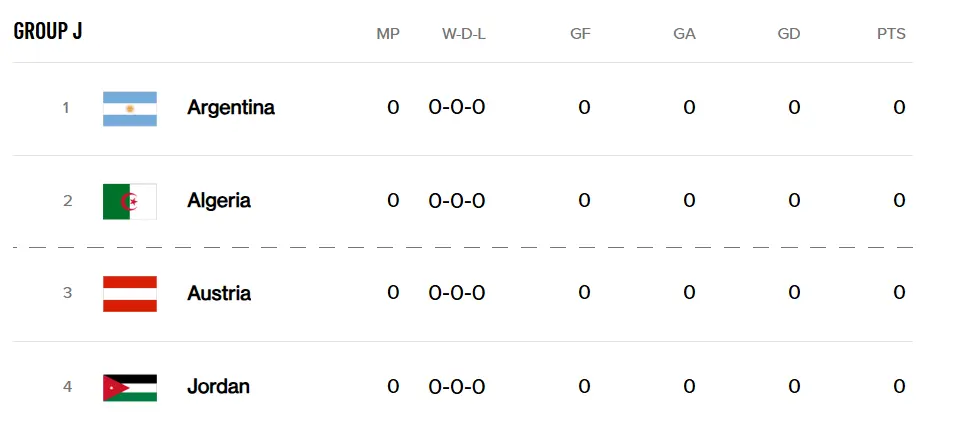
World Cup 2026 Group J
Argentina
Three-time champions with Messi’s last chapter
Argentina are the defending world champions. Their third title — won in Qatar in 2022 after one of the most dramatic finals in the tournament’s history, a 3-3 draw with France settled 4-2 on penalties — was the culmination of a generation that had come agonisingly close in 2014 (lost to Germany 0-1 in extra time) and been the talk of every World Cup since Messi’s senior debut.
Now, at 38, Lionel Messi arrives at what will almost certainly be his final tournament. Argentina have built their preparation around protecting and empowering him while developing the next generation around him. The squad contains a blend of 2022 champions and emerging talents who have since broken through.
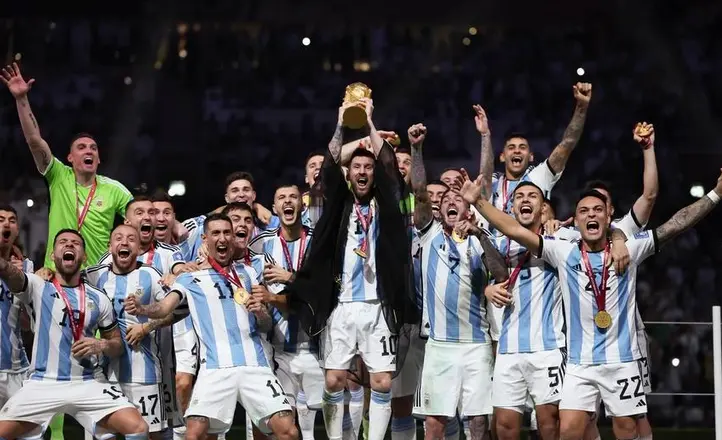
World Cup 2026. Argentina
South American qualifying — comfortable at the top
Argentina finished first in South American qualifying, well clear of the field. Their campaign included a defeat to Paraguay at home, which caused brief alarm, but consistent results against the stronger sides — Uruguay, Brazil, Colombia — confirmed their status as the continent’s leading force.
Playing style and key players
Lionel Scaloni has built a team that protects its defensive structure without sacrificing attacking quality. Argentina press in coordinated units, transition quickly and rely on the creative intelligence of their most gifted players to unlock organised defences. A 4-2-3-1 or 4-4-2 is used depending on the opponent, with significant flexibility in how the front players rotate.
- Lionel Messi — everything that needs to be said has already been said many times. What matters here is that he arrives as world champion, with the World Cup being the one trophy his generation can now defend rather than chase. His involvement will be managed carefully, but when he plays, everything Argentina do becomes simultaneously more dangerous and more coherent.
- Emiliano Martinez (Aston Villa) — the goalkeeper whose penalty-saving heroics in Qatar 2022 gave Argentina the title. His psychological dominance in shootouts has become something opponents genuinely fear.
- Julian Alvarez (Atletico Madrid) — the forward who outscored expectations in Qatar and has since become one of the most complete centre-forwards in European football. His pressing intensity, link play and finishing make him irreplaceable.
- Alexis Mac Allister (Liverpool) — the midfield engine who provides both defensive cover and forward thrust from deep. His consistency at Liverpool has made him one of the most reliable players in the squad.
- Enzo Fernandez (Chelsea) — the box-to-box midfielder whose range and dynamism give Argentina an additional creative dimension when Messi drops deeper.
- Franco Mastantuono — the youngest and most exciting member of the emerging generation, already drawing comparisons to Messi in his early career trajectory. This tournament will be his introduction to the world stage.
- Rodrigo De Paul — the relentless engine who does the defensive work that allows others to express themselves. His pressing intensity and ground-covering define how Argentina function without the ball.
- Cristian Romero (Tottenham) — the aggressive, dominant centre-back whose reading of the game and willingness to initiate from deep give Argentina a distinctive defensive identity.
- Lautaro Martinez (Inter Milan) — the versatile striker who can lead the line or play alongside Alvarez, bringing clinical finishing and intelligent movement.
Algeria
The Desert Foxes, born in political struggle
Algeria’s football history began not on a pitch but in resistance. Their early players left European clubs to form the FLN (National Liberation Front) team four years before the official national side existed, using football as an instrument of political independence. That history of defiance shaped everything that followed.
Their 1982 World Cup debut in Spain produced one of the tournament’s most famous results: a 2-1 victory over West Germany on June 16 in Gijon. Algeria beat Chile too, finished with six points — and did not advance. The reason: West Germany and Austria, playing their final group game after Algeria had completed their matches, produced a mutually convenient 1-0 result that sent both European teams through at Algeria’s expense. The Disgrace of Gijon led directly to the rule that final group games must be played simultaneously — a rule that exists to this day.
After three more World Cup appearances — 1986, 2010 and 2014, when they finally reached the round of 16 and took Germany to extra time — Algeria missed the 2018 and 2022 tournaments. A defeat to Cameroon on away goals in 2022 qualifying was particularly painful. The 2026 cycle was approached with maximum seriousness.
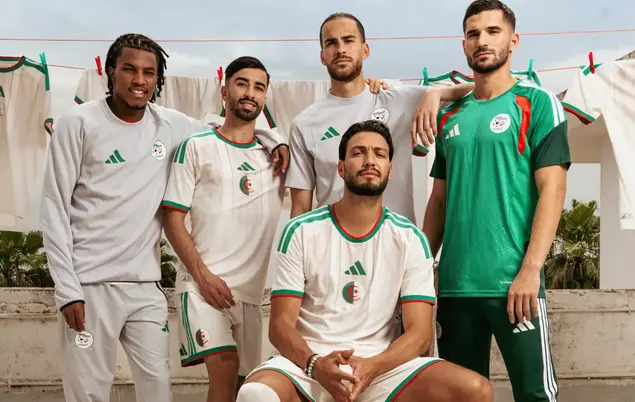
World Cup 2026. Algeria
Qualifying — near-perfect and dominant
Algeria’s group contained Mozambique, Uganda, Botswana, Guinea and Somalia. They won eight of ten games with the best defensive record in their section. The only stumbles were a goalless draw in Guinea and a surprising 1-2 defeat away. Everyone else was handled comfortably, with Mozambique (5-1), Somalia (3-0) and Botswana (3-1 twice) receiving the heaviest treatment. Direct qualification secured, fifth World Cup confirmed.
Playing style and key players
Coach Vladimir Petkovic — the Bosnian-Swiss specialist who guided Switzerland to knockout rounds at two World Cups and one European Championship — has built Algeria around attacking fluency and technical quality. This is not the archetypal defensive African side. Algeria press high, generate chances through wide play and rely on the individual quality of their stars in the final third.
- Riyad Mahrez (35, Al-Ahli) — the long-time captain and still the team’s most dangerous player. Multiple Premier League title winner, capable of deciding matches with a single action. Without Mahrez, Algeria’s threat diminishes significantly.
- Ryan Ait-Nuri (24, Manchester City) — the most technically sophisticated player in the squad after Mahrez. Attacks with pace and delivery from left-back, defends with discipline and reads the game intelligently. Rarely misses a minute of international football.
- Luca Zidane — the son of Zinedine Zidane, the greatest Algerian-heritage player in history, plays as Algeria’s first-choice goalkeeper. He has proven reliable in AFCON competition and will have his father’s support from the stands for every save.
- Ibrahim Maza (20, Bayer Leverkusen) — the youngest significant talent in the squad. Can play as a striker or attacking midfielder, already showing composure beyond his years. His AFCON showing confirmed his readiness for this stage.
- Rami Bensebaini (Borussia Dortmund) — the defensive anchor and an AFCON 2019 winner. Plays almost every minute at both club and international level, combining aerial dominance with the ability to initiate attacks from deep.
- Vladimir Petkovic — Swiss-Bosnian, connected to both the country that shaped his career and the continent where he was born. His record of consistently delivering knockout round appearances makes him one of the more underrated coaches at this tournament.
Austria
Back after 28 years, with football’s most intense pressing system
Austria were a major force in pre-war European football — their Wunderteam of the 1930s won famous victories over Scotland, Germany (6-0 in Berlin), Switzerland (8-1) and Hungary (8-2). They reached the semi-final of the 1934 World Cup and the bronze medal match of the 1954 edition. Then, across the next 60 years, they gradually faded. The last World Cup before 2026 was France 1998 — a tournament they left without a win.
The revival began with a youth development programme launched in 2002 and the emergence of the Red Bull pathway for Austrian players through Salzburg and Leipzig. By 2024, under Ralf Rangnick, they were one of Europe’s most exciting sides at Euro 2024. Now they are back at a World Cup.

World Cup 2026. Austria
Qualifying — efficient with character
Austria won European qualifying Group H, finishing two points clear of Romania. The campaign contained two losses: a 0-1 defeat away to Romania and a 1-1 draw at home to Bosnia in the final match. The decisive wins came in the head-to-head battles that mattered most — 2-1 at home to Romania and 2-1 away to Bosnia, with Konrad Laimer scoring the winner in Sarajevo.
Playing style and key players
Ralf Rangnick invented modern gegenpressing. His system demands that the ball is recovered within six to eight seconds of loss through coordinated pressure in the zones where possession was given away. Players overload areas, deny passing lanes and force errors. Once the ball is won, it moves quickly toward the opposition goal — typically in four or five passes. The system requires exceptional physical conditioning, which Austrian players possess.
- Konrad Laimer (28, Bayern Munich) — the most important player in the system, despite not being the most famous. Can play as a right-back or defensive midfielder, brings relentless energy and precise passing. His goal in Bosnia secured Austria’s direct World Cup qualification. Criminally underrated on the European stage.
- Marcel Sabitzer (32, Borussia Dortmund) — the primary goal threat from midfield. One goal away from entering the top ten all-time scorers for Austria and the team’s most consistent performer in important matches.
- David Alaba (33, Real Madrid) — the defensive leader, currently spending more time injured than playing at club level, but still the first name in Austria’s defensive setup. This is almost certainly his first and last World Cup. His left foot and reading of the game remain as sharp as ever when fit.
- Ralf Rangnick — one of the most influential football thinkers of the past 30 years. His pressing ideas shaped Klopp at Dortmund, Tuchel at Mainz and the entire Red Bull coaching philosophy. His Austria rebuild has been his career’s most satisfying chapter — at Euro 2024, he made his players fearless against superior opponents, and that fearlessness is the greatest thing he has given this squad.
Jordan
The first Arab country to qualify directly — with a squad from Gulf leagues
Jordan only became independent in 1946. They made their first World Cup qualifying attempt before the 1986 tournament. For most of the 21st century, they could not advance past the first round of Asian qualifying. Then, incrementally, the infrastructure improved, the coaching improved and the mentality transformed. A run to the Asian Cup final in Qatar 2023 — including a 2-0 victory over South Korea in the semi-finals — signalled that something had genuinely changed.
For the 2026 qualification, Jordan topped a second-round group that included Saudi Arabia, Tajikistan and Pakistan. In the third round, they finished second behind South Korea — holding the Koreans to a 1-1 draw, which proved decisive in their battle with Iraq for the second qualifying spot. They became the first Arab nation to qualify directly for a World Cup from the Asian route.
The squad is built almost entirely from players in Gulf leagues — Bahrain, UAE, Malaysia and Jordan itself. There is not a single player from a European first division. Their leading striker, Yazan Al-Naimat, tore his cruciate ligament in a cup quarter-final and will not be at the tournament.
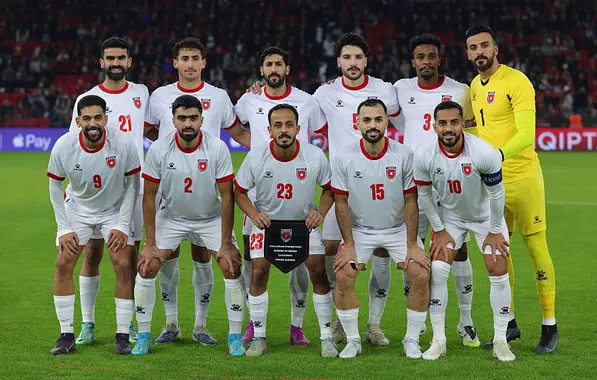
World Cup 2026. Jordan
Playing style and key players
Head coach Jamal Sellami — who won the 2018 Africa Cup of Nations as part of Morocco’s coaching staff and led Raja Casablanca to the Moroccan title — has built Jordan around defensive organisation and clinical finishing. They beat South Korea without the ball and won against Oman 4-0 with it. The team’s identity adapts to the opponent; collective organisation and team knowledge carry them further than individual quality.
- Ali Olwan (25, Al-Karma) — after the loss of Al-Naimat, Olwan carries the primary goalscoring burden. His hat-trick against Oman that sealed World Cup qualification is the defining moment of his international career. Can play wide or centrally.
- Mahmoud Al-Mardi (32, Dibba) — the captain, whose equaliser against South Korea in the crucial qualifying match demonstrated composure and quality in the biggest game Jordan had played in years.
- Yazid Abulayla — the experienced goalkeeper who has kept clean sheets against Saudi Arabia, made key saves against Oman in qualifying and earned a goalless draw against Russia in a friendly. The calm foundation on which Jordan’s defensive organisation is built.
- Jamal Sellami — the most decorated member of the coaching staff. His success at Raja Casablanca and his involvement with Morocco’s continental-winning team give him credibility that this squad’s relative inexperience cannot yet provide.
Who Advances from Group J
| Team | 1xBet |
|---|---|
| Argentina | 1.017 |
| Austria | 1.24 |
| Algeria | 1.35 |
| Jordan | 3.30 |
Argentina at 1.017 is simply a mathematical statement. Three-time world champions with Messi, Martinez, Alvarez and Romero do not exit in the group stage. The bookmakers are not offering a market here — they are acknowledging a truth. The gap between second and third — Austria (1.24) versus Algeria (1.35) — is genuinely interesting. The spread of prices across bookmakers on Austria suggests some uncertainty about evaluating a team returning to the World Cup after 28 years. Algeria’s price reflects a squad with more recognised European quality but less recent World Cup experience. Their direct head-to-head will likely decide second place. Jordan (3.30) — the odds acknowledge the possibility of advancement through the best third-placed teams route, but the gap in quality to Austria and Algeria is significant.

Group J. World Cup 2026. Odds at 1xBet
Who Wins Group J
| Team | 1xBet |
|---|---|
| Argentina | 1.333 |
| Austria | 5.55 |
| Algeria | 6.55 |
| Jordan | 43.00 |
Argentina (1.333) — one of the shorter prices for group victory in the entire tournament. Scaloni will want his team winning comfortably and entering the knockout phase in rhythm, particularly given how Messi’s minutes may be managed. Austria (5.55) — first place would require beating Argentina, which Rangnick’s pressing system is theoretically designed to threaten. The gegenpressing against Messi and Alvarez would be one of the tactical spectacles of the group stage. Algeria (6.55) — a wider price than their qualifying record suggests they deserve. Mahrez at 35 can still produce moments that decide games. If Algeria beat Austria in the direct confrontation, the second spot opens up entirely. Jordan (43.00) — first place would require beating Austria or Algeria and having Argentina lose elsewhere. Beautiful in theory.
Our Predictions
Group J is the tournament’s most narratively loaded quartet. Argentina will win it — that is near-certain. The second spot belongs to either Austria or Algeria, and their direct match is the group’s most important fixture.
Our assessment: Austria finish second. Rangnick’s pressing system is specifically designed to destabilise technically gifted teams by overwhelming them in transition. Algeria, for all their quality, are not a side that has been extensively tested against high-intensity European pressing at World Cup level. The 2014 match against Germany showed Algeria can compete at that level — but Austria’s system has been refined over four years, and this squad believes it can beat anyone.
Algeria advance as third — and depending on results in other groups, may still reach the round of 16 as one of the best third-placed sides. Jordan will earn respect, take one famous result from somewhere in the group and leave this tournament as something considerably more than they arrived as. The Al-Naimat absence is a significant blow — but Olwan’s hat-trick against Oman suggests the attack can still function.
Other Groups WC-2026 at 1xBet
 Aiden Brooks
