



Group K at the 2026 World Cup
1xBet has Group K as the tournament’s most geographically diverse quartet — four continents, four entirely different footballing cultures, four sharply contrasting histories. Portugal arrive as one of the genuine European contenders, armed with the deepest attacking squad they have ever assembled and a burning need to go further than the quarter-final that has become their ceiling. Colombia bring South America’s most entertaining team, a record-breaking unbeaten run and the creativity of Luiz Diaz combined with the waning but still commanding presence of James Rodriguez. DR Congo return to the World Cup for the first time since 1974 with a squad built from Premier League clubs and a story of resilience and extraordinary qualification drama. And Uzbekistan, making their debut, arrive under the coaching legend of Fabio Cannavaro with Khusanov from Manchester City at the back and Shomurodov looking to score at the biggest stage of his career.
Group K Overview
Four teams from four continents, each with something significant to prove. Portugal want to go further than the quarter-final that has defined their ceiling. Colombia want to show their 28-match unbeaten run was not a statistical anomaly. DR Congo want to rewrite a 52-year-old story that deserves a better ending. And Uzbekistan want to prove that their qualification was the beginning of something, not a lucky accident.
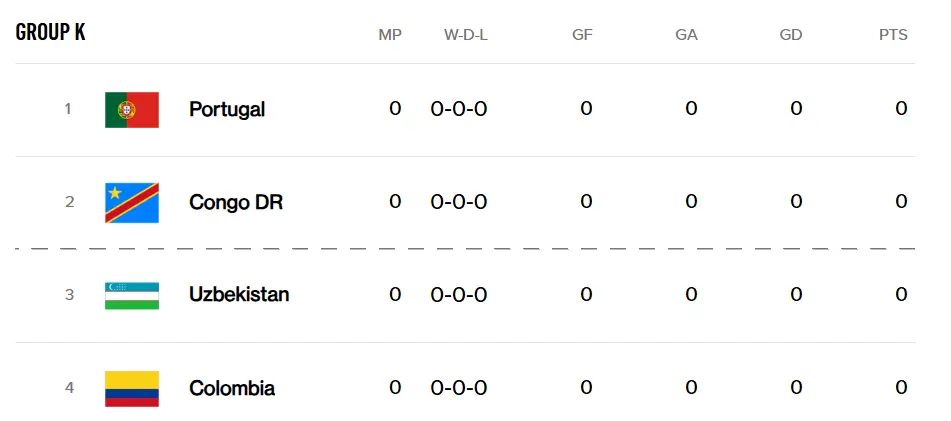
World Cup 2026 Group K
Portugal
Beyond Ronaldo — the generation waiting to be unleashed
Portugal’s World Cup history is a story of intermittent brilliance and persistent underachievement. Their finest hour came in 1966 in England, where Eusebio’s side reached the semi-final and finished third — a result that stood as their best for 40 years. The Ronaldo era brought consistency: fourth place in 2006, round of 16 in 2010 and 2018, group stage elimination in 2014, quarter-final in 2022. Extraordinary individual talent, always. A team capable of winning the whole thing, never quite.
The question heading into 2026 is simple: is this the year Portugal finally build a system that goes beyond Ronaldo rather than revolving around him? Because the squad they currently possess — beyond the captain — is genuinely exceptional in a way it has not been since the generation of Deco, Figo and Rui Costa.
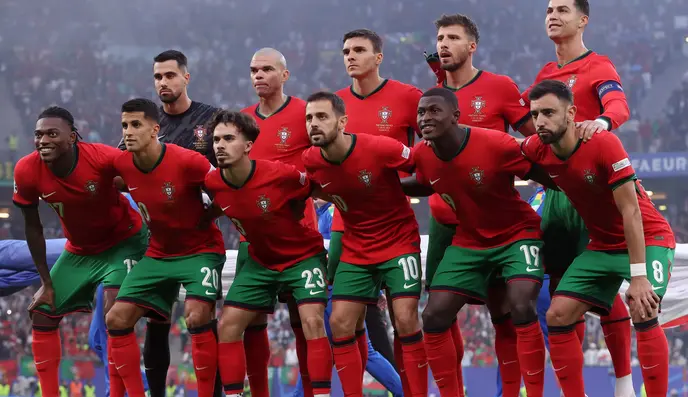
World Cup 2026. Portugal
Qualifying — dominant and stylish
Portugal won European qualifying Group F convincingly. The depth of talent available allowed Roberto Martinez to rotate freely without losing control of results. The squad list tells its own story: Diogo Costa in goal; Ruben Dias, Antonio Silva, Joao Cancelo, Nuno Mendes in defence; Bruno Fernandes, Ruben Neves, Joao Palhinha, Bernardo Silva, Joao Neves, Vitinha in midfield; Rafael Leao, Pedro Neto, Joao Felix, Goncalo Ramos, Francisco Conceicao in attack. That is not a squad — that is an embarrassment of riches.
Playing style and key players
Roberto Martinez has built Portugal around high-energy pressing, wide attacking play and the intelligent use of the half-space by their technically gifted midfielders. When it functions, it is one of the most attractive systems in European football.
- Cristiano Ronaldo — at 41, the debate about his exact role continues. He is still the captain, still the emotional leader, still capable of goals that defy his age. Whether Martinez will manage his minutes carefully or start him in every game is the tournament’s most-discussed selection question. What is certain: Ronaldo’s desire to succeed at a sixth World Cup is absolute.
- Bruno Fernandes — the creative engine and the player who makes everything move. His passing range, pressing intensity and ability to arrive late into scoring positions make him central to how Portugal function at their best.
- Ruben Dias (Manchester City) — the defensive leader who commands the backline with authority and composure. His ability to read the game and organise under pressure gives Portugal a security that unlocks attacking freedom for everyone else.
- Rafael Leao (AC Milan) — the most dangerous attacker in the squad when in form. Electric pace, directness and the confidence to take on any defender. This tournament could be his true coming-out moment.
- Bernardo Silva — the intelligent link between midfield and attack, always available, always moving, always choosing the right pass. His ability to find space between lines creates connections that allow Portugal’s wider players to receive in dangerous positions.
- Joao Neves — the young defensive midfielder whose maturity and positional intelligence have made him indispensable. He provides the foundation that allows Fernandes and Bernardo Silva to express themselves further forward.
- Goncalo Ramos — the clinical centre-forward who scored a hat-trick against Switzerland at the 2022 World Cup while Ronaldo sat on the bench. His movement and finishing make him a constant threat even in limited space.
Colombia
South America’s most entertaining team, back at a World Cup
Colombia’s footballing history has swung between sensational highs and bewildering lows with a frequency that no other major nation can match. They failed to qualify at all until 1962, then produced one of the greatest comebacks in World Cup history — trailing the USSR 0-4 at half-time, they recovered to draw 4-4. They then missed the next six tournaments. In 2014, they finally reached the quarter-final for the first time. Then they missed 2022 entirely, undone by eight draws in qualifying.
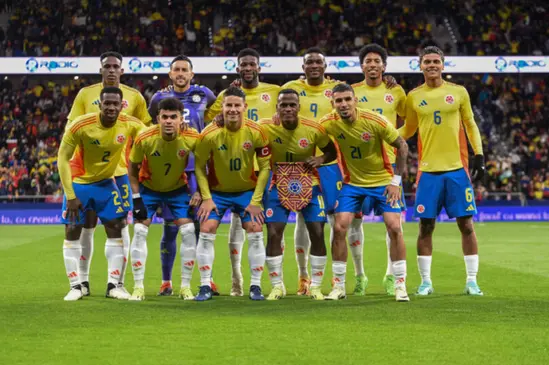
World Cup 2026. Colombia
A record-breaking cycle
Under Nestor Lorenzo, Colombia established a 28-match unbeaten run stretching from March 2023 through to the Copa America 2024 final, where they lost only to Lionel Messi’s Argentina. Along the way they finished runners-up in that continental competition — a tournament where James Rodriguez was the standout player, carrying the team with performances that recalled his 2014 World Cup brilliance. In South American qualifying, they finished third — ahead of Uruguay, Ecuador and Brazil — scoring more goals than any team except Argentina. Their 6-3 demolition of Venezuela in the final qualification rounds was a statement of attacking intent the rest of the world should take seriously.
Playing style and key players
Colombia play open, attacking football that can occasionally be reckless but is always watchable. They press high, use the full width of the pitch, have multiple goal threats from different positions and can score in large numbers. Lorenzo’s system demands courage and technical quality in equal measure — qualities this squad has in abundance.
- Luiz Diaz (Bayern Munich) — the most physically and technically complete player in South American football at this moment. His speed, directness, creativity and finishing ability from wide positions make him virtually uncontainable at his best. Against weaker opponents, he may be unplayable.
- James Rodriguez (35, captain) — the generation’s most gifted player and his final major tournament. His role has evolved from mercurial creator to experienced leader, but his quality has not disappeared. In Copa America 2024 he was the best player on the continent — threading passes no one else could conceive, reading the game three movements ahead. This World Cup represents his farewell; he will not waste it.
- Davinson Sanchez (Galatasaray) — the experienced centre-back who provides the defensive foundation Colombia’s attacking instincts require. Strong in the air, composed in build-up and capable of starting attacks from deep. His decade of international experience is invaluable in a squad with considerable attacking flair and occasional defensive vulnerability.
- John Cordoba — the physical centre-forward option who provides a different dimension to Colombia’s attack. His goals against Bolivia and Venezuela in qualifying showed he can deliver in important games. Well known to Russian football audiences from his career in the RPL.
- John Duran (Zenit St. Petersburg) — the 22-year-old has had an unconventional career path, but his ability to create from nothing and score in limited time makes him a dangerous option off the bench.
- Nestor Lorenzo — the Argentine who served as an assistant with Colombia at the 2018 World Cup before taking the top job. His record-breaking unbeaten run speaks for itself.
DR Congo
52 years away, and a return built on drama
The Democratic Republic of Congo’s only previous World Cup appearance was in 1974 — when they were still called Zaire. That tournament was shaped by everything except football: unpaid bonuses, political pressure from the Mobutu regime and a 0-9 defeat to Yugoslavia that remains the worst in their history. The one member of the squad who protested openly — deliberately attempting to get sent off against Brazil — has since passed into football folklore.
Fifty-two years later, a very different team makes the journey. This DR Congo squad features players from the Premier League, Bundesliga, La Liga and Serie A.
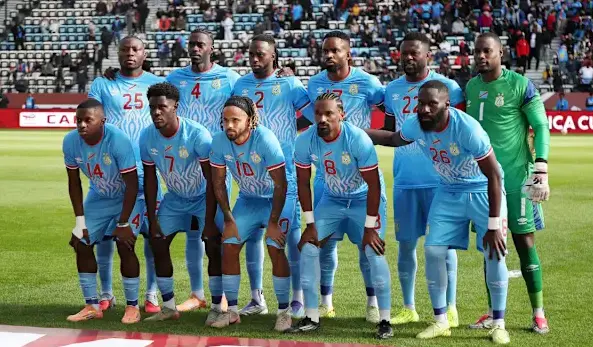
World Cup 2026. Congo DR
A qualification campaign that tested everything
DR Congo finished second in a qualifying group containing Senegal, Sudan, Togo, Mauritania and South Sudan — losing no points to Senegal and accumulating six wins in eight games. They then navigated the African play-offs: a late winner against Cameroon, a penalty shootout against Nigeria after coming back in the final minutes of normal time. Then intercontinental play-offs against Jamaica, where Axel Tuanzebe’s goal in the first period of extra time settled a tight, tense performance that generated 1.45 expected goals and conceded just one shot on target.
Playing style and key players
Head coach Sebastien Desabre — who led Uganda to their first AFCON knockout round in 40 years — has built DR Congo around a compact defensive structure that transitions quickly through athletic wide players. The approach ranges from a disciplined 4-4-2 against superior opposition to a more expansive 4-3-3 against weaker sides.
- Yoane Wissa (29, Newcastle United) — the most valuable player in the squad. Having made his name at Brentford, he moved to Newcastle before the 2025-26 season. At the World Cup he typically operates behind the main striker, carrying creative and goalscoring responsibilities. His versatility throughout qualifying demonstrated his quality.
- Aaron Wan-Bissaka (28, West Ham United) — known to every Premier League fan from his Manchester United years. His physical conditioning allows him to operate at top speed for 90 minutes, contributing in attack and recovering in defence. He made his international debut in September 2025 but has been a first-choice starter ever since.
- Cedric Bakambu (67 caps, 21 goals) — the experienced centre-forward who could have represented France but chose his country of heritage. At 34, still capable of playing 120 minutes at tournament intensity, as he demonstrated in the decisive Jamaica qualifier.
- Theo Bongonda (Spartak Moscow, RPL) — the right winger who has scored decisive goals throughout this qualification campaign, including the winner against Sudan and another against South Sudan. RPL followers will watch him with particular attention.
- Sebastien Desabre — the French coach who has spent almost his entire career on the African continent. The AFCON semi-final appearance in 2023 and this World Cup qualification represent his finest achievements.
Uzbekistan
The White Wolves arrive at their first World Cup
Uzbekistan have been one of Asian football’s most persistent underachievers in qualification — repeatedly falling agonisingly short. They qualified for the 2014 cycle’s third round only to lose to Jordan on penalties, and went out in the third round before 2018 and 2022 too. The 2026 expansion finally gave them the pathway their performances deserved.
Their qualifying campaign was methodical rather than spectacular: second in their group behind South Korea, holding Iran to two draws, beating the UAE twice and finishing with a 3-0 demolition of Qatar in the final round to secure their place five points clear of the third team.
Then, in an appointment that sent shockwaves through the football world, Fabio Cannavaro — the 2006 World Cup winning captain for Italy and Ballon d’Or winner — was named as head coach after the qualifying campaign concluded. Whether this partnership works or not may be one of the defining stories of the group stage.
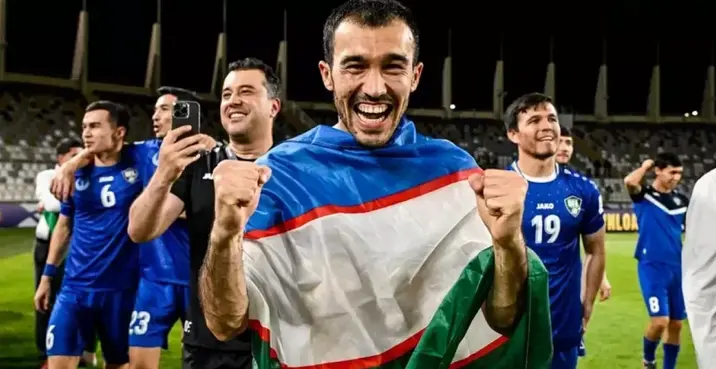
World Cup 2026. Uzbekistan
Playing style and key players
Uzbekistan play direct, organised football built around physical fitness, collective discipline and the individual quality of their three standout players. They are not seeking to outplay opponents with sustained possession — they seek to control spaces, defend compactly and exploit the counter-attack through Shomurodov’s movement and Fayzullayev’s pace.
- Abdukodir Khusanov (Manchester City) — the most prominent player in the squad and the defensive leader. He does not start regularly at City, but training alongside Rodri and Manuel Akanji has given him a tactical education he now transmits to the national team. His reading of the game and composure on the ball are significantly above what might be expected from an Uzbek international.
- Eldor Shomurodov — the all-time leading scorer and the team’s reference point in attack. Well known to Russian football audiences from his career in the RPL before moving to Turkey. His winter 2025-26 form at Basaksehir — two matches with 1+1 and two decisive contributions — suggests he arrives at the tournament in good shape.
- Abbosbek Fayzullayev — Shomurodov’s club partner, also at Basaksehir, and the squad’s most creative element. The former CSKA Moscow player operates on the left side, using his speed and dribbling to break pressure and create space for teammates.
- Fabio Cannavaro — a genuine icon of Italian and world football, a World Cup winner and Ballon d’Or holder. But his coaching career — Saudi Arabia, China, Guangzhou, Dinamo Zagreb — has been characterised by departures and underwhelming results. The concern is that his methods may disrupt a squad that had found real collective identity under the previous coach. The possibility that his ideas unlock something new is equally real.
Who Advances from Group K
| Team | 1xBet |
|---|---|
| Portugal | 1.02 |
| Colombia | 1.13 |
| DR Congo | 1.65 |
| Uzbekistan | 2.72 |
Portugal at 1.02 is as close to a certainty as the bookmakers offer. Ronaldo, Fernandes, Leao, Bernardo Silva and Ramos in a group with Colombia, DR Congo and Uzbekistan — the idea of Portugal failing to advance is not entertained by the market, and rightly so. Colombia (1.13) are treated as near-certainties for second place — an accurate reflection of their individual quality and collective momentum. They are significantly superior to both DR Congo and Uzbekistan in European club-level experience, and their direct match against Portugal will be the group’s defining fixture. DR Congo (1.65) are priced as moderate favourites to advance — roughly a 60% implied chance of progressing, which feels about right for a team returning after 52 years with a genuinely competitive squad. Uzbekistan (2.72) — the most significant outsiders in the group but not impossibly priced. A best third-placed finish is their most realistic route.

Group K. World Cup 2026. Odds at 1xBet
Who Wins Group K
| Team | 1xBet |
|---|---|
| Portugal | 1.41 |
| Colombia | 3.62 |
| DR Congo | 12.00 |
| Uzbekistan | 30.00 |
Portugal (1.41) — strong favourites to top the group, with good reason. Martinez will demand maximum points from the group stage as preparation for the knockout rounds, and this squad is more than capable of delivering them. Colombia (3.62) — the only realistic challengers for first place. If James Rodriguez produces his Copa America 2024 form and Luiz Diaz finds his best level, Colombia can beat Portugal. It would not be the first time a South American side has upset a European favourite at a World Cup. DR Congo (12.00) — the wide spread between bookmakers reflects genuine uncertainty about how this team will perform on the biggest stage for the first time in 52 years. Uzbekistan (30.00) — winning the group would mean beating both Colombia and Portugal, which at this stage of their footballing development seems beyond what this squad can deliver regardless of Cannavaro’s tactical input.
Our Predictions
Group K will confirm Portugal as one of the title contenders and set up one of the more intriguing round of 16 fixtures in the tournament. They win the group. The second spot belongs to Colombia — and the match between them is the group’s standout fixture, a game that will attract attention far beyond the immediate consequences for qualification.
DR Congo finish third — and depending on the third-place rankings across the tournament, may still advance. Their story alone makes them worth following: a team absent for 52 years, built through dramatic play-offs against Nigeria and Jamaica, with Spartak Moscow’s Bongonda coming off the bench to score decisive goals. The Leopards will not be passive participants.
Uzbekistan finish fourth, bow out gracefully and return home having answered the question of whether their qualification was a fluke with a resounding no. Khusanov will have caught the attention of European clubs. Shomurodov will have given his country something to remember. And somewhere in the stands, Cannavaro will be deciding whether there is a chapter two.
Other Groups WC-2026 at 1xBet
 Aiden Brooks
