



Coinflip
CoinFlip is one of the simplest gambling formats there is — call heads or tails, and if you’re right, you win. Players browsing the games on 1xBet will find CoinFlip listed as an instant-play title, and despite its simplicity, the mechanics behind the “Series” mode multiplier, the exact house edge, and the provably fair verification system reward a much closer look at the numbers than the interface lets on at first glance.
CoinFlip at a Glance
| Parameter | Value |
|---|---|
| Game type | Coin toss / instant win |
| RTP | 96% |
| House edge | 4% |
| Single-flip payout multiplier | 1.92x |
| Fairness mechanism | Provably Fair (Salt + Hash verification) |
| Min bet | $0.1 |
| Max bet | $150 |
| Max payout | $10,000 |
| Modes | Fixed payout, or "Series" (compounding multiplier) |

Coinflip Interface
How a Round Works
Placing a bet takes three steps: enter your stake, pick Heads or Tails, and the coin lands on one side or the other. Guess correctly and you win; guess wrong and the stake is lost outright, with no partial return. There’s no waiting on a climbing number like in a crash game — the outcome resolves the instant the coin lands.
Two toggle-based modes control how winnings behave:
- Series mode off (fixed payout): every toss is independent, with a fixed 1.92x multiplier and payout per correct guess, resetting to the same starting point each time regardless of the previous round’s outcome.
- Series mode on (compounding multiplier): each correct guess in a row increases the winning multiplier, but a wrong guess — or manually clicking Withdraw — ends the series and resets the multiplier back to the start.
RTP and the Math Behind the 1.92x Multiplier
CoinFlip carries a published RTP of 96%, meaning a 4% house edge. Since a coin toss has exactly two possible outcomes, a mathematically “fair” (zero-edge) payout for guessing correctly would be exactly 2.00x the stake. CoinFlip’s actual single-flip payout is 1.92x, which is precisely the fair 2.00x reduced by the 4% house edge:
2.00 × 0.96 = 1.92x
| Metric | Value |
|---|---|
| Fair (zero-edge) payout for a 50/50 bet | 2.00x |
| Actual CoinFlip payout | 1.92x |
| Gap (house edge as a multiplier reduction) | 0.08x, or 4% of the fair payout |
| Expected value on a $10 fixed-mode bet | (0.5 × $19.20) − $10 = −$0.40 (−4%) |
That −$0.40 figure on a $10 stake is worth sitting with: half the time you win $9.20 profit ($19.20 − $10), and half the time you lose the full $10. Averaged across those two equally likely outcomes: (0.5 × $9.20) + (0.5 × −$10) = $4.60 − $5.00 = −$0.40, confirming the 4% edge directly from the payout structure rather than just citing the published RTP.
How the Series Multiplier Actually Builds
The screenshot values for consecutive series wins — x1.92, x3.84, x7.68 — reveal the exact formula CoinFlip uses. Each step is precisely double the previous one:
- 1.92 × 2 = 3.84
- 3.84 × 2 = 7.68
That doubling comes directly from the coin having two equally likely outcomes: the fair multiplier for n consecutive correct guesses is 2ⁿ, and CoinFlip applies the same flat 4% edge to that compounding fair value:
Multiplier after n consecutive wins = 0.96 × 2ⁿ
Extended Series Table: Multiplier, Odds, and Payout to n = 15
| Wins in a row (n) | Fair multiplier (2ⁿ) | Actual multiplier (0.96 × 2ⁿ) | Probability | Odds expressed as "1 in X" | Payout on a $10 bet |
|---|---|---|---|---|---|
| 1 | 2.00x | 1.92x | 50% | 1 in 2 | $19.20 |
| 2 | 4.00x | 3.84x | 25% | 1 in 4 | $38.40 |
| 3 | 8.00x | 7.68x | 12.5% | 1 in 8 | $76.80 |
| 4 | 16.00x | 15.36x | 6.25% | 1 in 16 | $153.60 |
| 5 | 32.00x | 30.72x | 3.125% | 1 in 32 | $307.20 |
| 6 | 64.00x | 61.44x | 1.5625% | 1 in 64 | $614.40 |
| 7 | 128.00x | 122.88x | 0.78125% | 1 in 128 | $1,228.80 |
| 8 | 256.00x | 245.76x | 0.390625% | 1 in 256 | $2,457.60 |
| 9 | 512.00x | 491.52x | 0.1953% | 1 in 512 | $4,915.20 |
| 10 | 1,024.00x | 983.04x | 0.0977% | 1 in 1,024 | $9,830.40 |
| 11 | 2,048.00x | 1,966.08x | 0.0488% | 1 in 2,048 | $19,660.80 → capped at $10,000 |
| 13 | 8,192.00x | 7,864.32x | 0.0122% | 1 in 8,192 | $78,643.20 → capped at $10,000 |
| 15 | 32,768.00x | 31,457.28x | 0.00305% | 1 in 32,768 | $314,572.80 → capped at $10,000 |
Key takeaway on the cap: at a $10 stake, the $10,000 maximum payout kicks in between the 10th and 11th consecutive win — a 10-win streak pays $9,830.40 (still under the cap), but an 11-win streak’s raw multiplier would produce $19,660.80, so the payout is capped at $10,000, meaning the entire theoretical value beyond 10-11 wins in a row on this stake size is simply lost to the cap, not paid out.
Expected Value: Confirming the 4% Edge Holds at Every Streak Length
Just as with crash-style multiplier games, it’s worth being explicit: no streak length offers a better expected return than any other. The formula is:
EV = (probability of reaching n) × (payout at n) − stake
Running this at several points on a $10 stake:
| n | Probability | Payout | EV calculation | Result |
|---|---|---|---|---|
| 1 | 0.5 | $19.20 | (0.5 × $19.20) − $10 | −$0.40 (−4%) |
| 2 | 0.25 | $38.40 | (0.25 × $38.40) − $10 | −$0.40 (−4%) |
| 3 | 0.125 | $76.80 | (0.125 × $76.80) − $10 | −$0.40 (−4%) |
| 5 | 0.03125 | $307.20 | (0.03125 × $307.20) − $10 | −$0.40 (−4%) |
| 10 | 0.0009766 | $9,830.40 | (0.0009766 × $9,830.40) − $10 | −$0.40 (−4%) |
Every row lands at exactly −4% of the stake, because the 0.96 factor is baked into the multiplier at every single step — probability shrinks by half each round while the payout doubles, and the fixed 0.96 discount is the only thing that survives that cancellation. There is no streak length with better theoretical odds than another; the only thing that changes is variance.
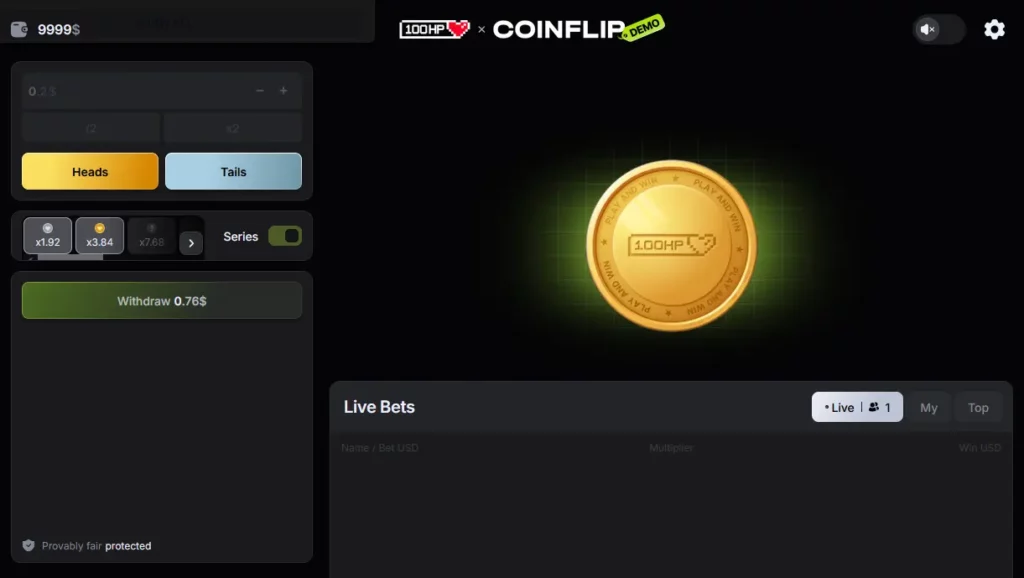
Coinflip Win
Expected Number of Attempts to Reach a Given Streak
A separate and practically useful question: if you keep starting new series after every loss, how many series, on average, would you need to attempt before landing one specific streak length? This follows directly from the “1 in X” column above — on average, it takes X attempts to see a streak of that length land once:
| Target streak | Average attempts needed to see it once |
|---|---|
| 3 wins in a row | ~8 attempts |
| 5 wins in a row | ~32 attempts |
| 7 wins in a row | ~128 attempts |
| 10 wins in a row | ~1,024 attempts |
Worked example: if you play Series mode and restart after every loss, aiming specifically for a 5-win streak (30.72x), you’d need to run through roughly 32 separate attempts on average before that streak shows up once — and most of those 32 attempts will end after just 1 or 2 flips, since the average run length before a loss (a basic property of a 50/50 geometric process) is just 1 win before a loss, calculated as p ÷ (1−p) = 0.5 ÷ 0.5 = 1.
Simulated Session Comparison: Fixed Mode vs. Series Mode Over 1,000 Flips
To make the practical difference concrete, consider two players each flipping $10 stakes 1,000 times.
Player A — Fixed mode, cashing out every single correct guess immediately:
- Expected wins: 1,000 × 0.5 = 500 wins
- Expected total returned: 500 × $19.20 = $9,600
- Expected total staked: 1,000 × $10 = $10,000
- Net result: −$400 (exactly −4%, matching the house edge precisely)
- This result is highly stable — with 500 independent 50/50 flips, the actual win count will almost always land close to 500 (standard deviation ≈ √(1000 × 0.5 × 0.5) ≈ 15.8 wins), so real sessions cluster tightly around the −$400 expectation.
Player B — Series mode, always pushing for exactly 4 wins in a row before manually withdrawing (15.36x), restarting immediately after any loss or successful withdrawal:
- Probability of completing a 4-win series: 6.25% per attempt
- Each successful series returns $10 × 15.36 = $153.60; every failed attempt loses $10 at the point of the miss
- Over roughly 1,000 flips, expect approximately 1,000 ÷ (average flips per attempt) attempts — since most series end quickly, this produces meaningfully more attempts than 1,000 ÷ 4
- The expected value per attempt still nets out to −4% of the amount risked per attempt, but the results cluster far less tightly: a real 1,000-flip session for Player B could show either a much larger loss than Player A (if streaks land below the 6.25% average) or a substantial profit (if several 4-win streaks land in a row)
The mathematical conclusion is identical to the crash-game comparison: both players face the same 4% edge on average, but Player A’s smoother, evenly-distributed 50/50 bets produce a session result that closely tracks the theoretical expectation, while Player B’s streak-chasing approach produces the same average outcome with dramatically wider swings around it.
Fixed Mode: Expected Loss by Bet Size
For players who prefer the flat 1.92x mode, here’s what the theoretical expected loss looks like scaled by stake size across a 500-flip session:
| Bet per flip | Total wagered (500 flips) | Expected loss (4% of total) |
|---|---|---|
| $0.10 (minimum) | $50.00 | $2.00 |
| $1.00 | $500.00 | $20.00 |
| $10.00 | $5,000.00 | $200.00 |
| $50.00 | $25,000.00 | $1,000.00 |
| $150.00 (maximum) | $75,000.00 | $3,000.00 |
Fixed Mode vs. Series Mode: Which Fits Your Style
Since both modes carry the identical 4% house edge, the choice between them is about risk profile, not expected value:
- Fixed mode suits players who want steady, low-variance action — each flip pays the same 1.92x regardless of what happened before, so results stay close to the theoretical −4% over any reasonably sized session.
- Series mode suits players chasing a bigger single payout — the multiplier compounds fast (doubling each win), but a single wrong guess wipes out the entire accumulated streak, resetting to zero rather than preserving any partial gain.
Practical tip: in Series mode, clicking Withdraw at any point locks in the current multiplier rather than risking the next flip — the built-in mechanism for converting an in-progress streak into an actual payout before a wrong guess erases it. Given that the average win streak before a loss is just 1 (per the geometric-distribution math above), withdrawing after 2-3 consecutive wins already captures a streak longer than what a purely average run would produce.
Provably Fair Verification: How to Actually Check a Result
CoinFlip’s fairness system goes beyond a general label — it gives a direct way to verify any individual round after it settles, using a Salt and Hash pairing:
- Before the round resolves, the outcome’s numerical value is generated on the game’s servers and immediately displayed as an encrypted Hash — locked in before the coin result is shown, so it can’t be altered retroactively based on how much was staked.
- After the round ends, the corresponding Salt (the cipher that unlocks that Hash) is saved to your round history.
- To verify a specific round, click the shield icon in your bet history or the leaderboard, copy the Salt, and paste it into the Fairness Check verification window (or any compatible third-party hash calculator).
- Running that check recomputes the original Hash from the Salt — if it matches the Hash published before the round resolved, that confirms the result wasn’t altered after bets were placed.
Game Limits and the Payout Cap in Context
| Limit | Value |
|---|---|
| Minimum bet | $0.1 |
| Maximum bet | $150 |
| Maximum payout | $10,000 |
At the maximum $150 bet, the payout cap arrives much sooner in a series than at smaller stakes. A single fixed-mode win at $150 pays $150 × 1.92 = $288 — nowhere near the cap. But in Series mode, the math scales up fast:
| Wins in a row at $150 stake | Raw payout | Hits the $10,000 cap? |
|---|---|---|
| 5 | $150 × 30.72 = $4,608 | No |
| 6 | $150 × 61.44 = $9,216 | No |
| 7 | $150 × 122.88 = $18,432 | Yes — capped at $10,000 |
So at the maximum bet size, the practical ceiling on Series mode is reached at just 7 consecutive correct guesses (a 0.78125% event, or roughly 1 in 128 attempts) — much sooner than the 10-11 win threshold calculated earlier for a $10 stake.
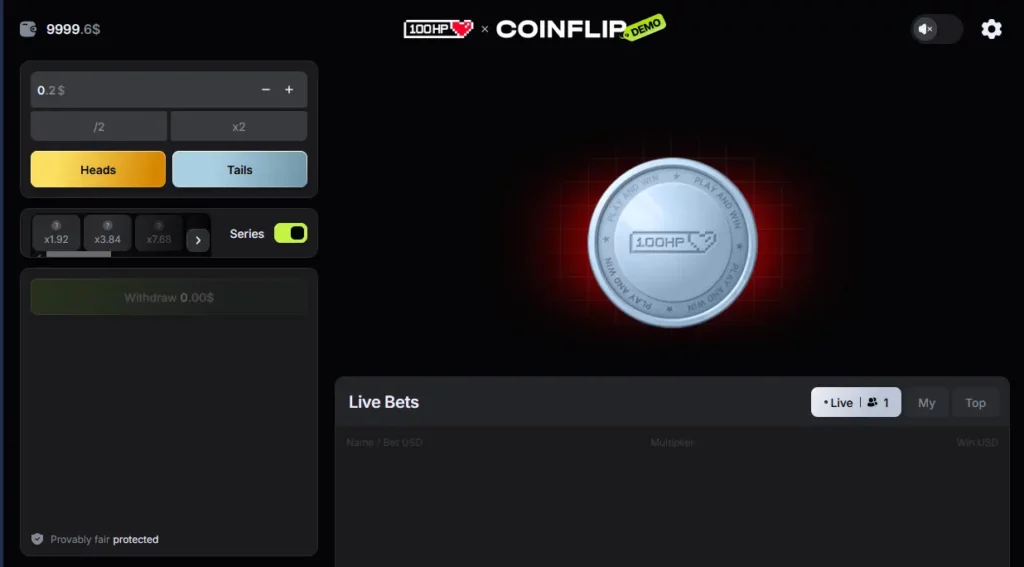
Coinflip End Game
Live, My, and Top Panels
- Live shows other players’ bets and outcomes in real time as rounds resolve.
- My holds personal betting history, including past withdrawals — also where the shield icon for provably fair verification lives.
- Top displays statistics on the largest winnings by amount and multiplier over different time windows — useful context, but no bearing on the odds of your next flip, since every round is an independent 50/50 event.
Malfunctions and Connection Issues
- Malfunction policy: if a technical malfunction affects the gaming software, all bets and payouts from the affected round are cancelled, and impacted players are reimbursed in full within 1 hour.
- Connection responsibility: the operator isn’t responsible for a lost bet caused by the player’s own internet connection dropping — a stable connection is recommended, particularly around the Series Withdraw click.
Getting started takes a standard registration, after which CoinFlip is available directly in the casino section alongside 1xBet’s other instant-win titles. The game is also fully playable through the Android app or the iOS app, with the same 1.92x base multiplier, Series mode mechanics, and provably fair verification as the desktop version.
Other Games at 1xBet
 Aiden Brooks
