



Rocket Queen
Rocket Queen is crash-style game, built on the same core mechanic as Aviator: a multiplier climbs from 1x while the round is live, and everyone who hasn’t cashed out before it crashes loses their stake. Players exploring the 1xBet game lobby will find Rocket Queen sitting alongside the other crash titles, and unlike most slots, this format lives or dies on a single number — the multiplier at which the round ends — so understanding the math behind that number matters more here than in almost any other casino game.
Rocket Queen at a Glance
| Parameter | Value |
|---|---|
| Release date | December 1, 2023 |
| Game type | Crash / multiplier game |
| RTP | 97% |
| Min bet | $0.1 |
| Max bet | $140 |
| Max win | Not publicly disclosed |
| Fairness mechanism | Provably Fair |
| Simultaneous bets | Up to 2 bet panels at once |
| Autobet / Auto Withdrawal | Both available |
| Live Chat | Yes, real-time with other players |
| Leaderboard | Daily, weekly, and all-time |
| Technology | JS, HTML5 |
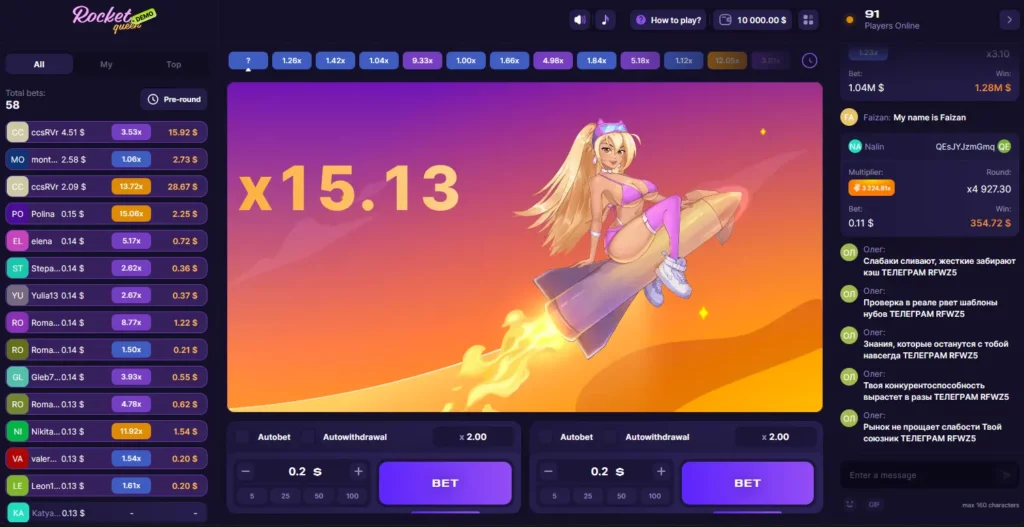
Rocket Queen Big Win
How the Round Actually Works, Step by Step
A new round starts once the previous one settles. Before the multiplier begins climbing, there’s a betting window during which every player places a stake. Once betting closes, the multiplier starts at 1.00x and climbs continuously — visually represented by the rocket carrying its rider higher — until, at an unpredictable point, the round crashes and the multiplier stops for good.
The entire outcome depends on one decision: press Withdraw before the crash, and your payout is your stake multiplied by whatever the multiplier displayed at that exact moment. Miss that window, and the full stake is lost — there’s no partial refund, no consolation multiplier, nothing recovered.
A full round breaks down into four stages:
- Betting window opens — players place their stake(s) on one or both available bet panels.
- Multiplier launch — the round begins at 1.00x and starts climbing in real time.
- Live decision window — every player with an active bet watches the multiplier rise and decides when (or whether) to cash out.
- Crash — the round ends at a point neither the operator nor the player controls in the moment; anyone still holding an uncashed bet loses it in full.
Two bets can run in parallel on separate panels — for example, cashing one out early as a safety net while letting the second ride for a higher multiplier. Both Auto Bet and Auto Withdrawal can be configured so the game plays a fixed stake and cashes out at a fixed multiplier automatically, without requiring you to click anything mid-round.
Provably Fair: What It Means and Why It Matters Here
Rocket Queen runs on a Provably Fair mechanism, a fairness model built specifically for games like this, where trust in the outcome can’t rely on “watching” a physical process the way you might trust a live-dealt card. The core idea:
- The result of each round is generated using a method that produces a value before betting even closes, but that value is cryptographically obscured until after the round ends.
- Once the round finishes, the underlying data becomes available, letting anyone independently recompute the crash point and confirm it matches what was actually displayed.
- Because the crash point can’t be altered retroactively based on how much was bet in a given round, this structurally rules out the operator adjusting outcomes in response to bet sizes after the fact.
This is different from trusting a slot’s RNG certification, which relies on third-party lab testing rather than something the player can verify round-by-round themselves. In a crash game specifically, provably fair verification matters more because the entire product is a single number (the crash multiplier), making it easy in principle to spot-check.
RTP and House Edge: What 97% Actually Means
Rocket Queen carries a published RTP of 97%, converting directly to a 3% house edge — the average share of every dollar wagered the game is designed to retain over a large number of rounds.
| Metric | Value |
|---|---|
| RTP | 97% |
| House edge | 3% |
| Expected loss per $100 wagered | $3.00 |
| Expected loss per $1,000 wagered | $30.00 |
| Expected loss per $10,000 wagered | $300.00 |
Worked example over a betting session: staking $10 per round across 200 rounds ($2,000 total wagered):
$2,000 × 0.03 = $60 expected loss
That’s the mathematical baseline — actual results in any real session will swing well above or below that figure, since a single well-timed high multiplier or a string of early crashes both push results far from the average. RTP only converges toward its stated value over a very large number of rounds, not within one session.
Why Your Cashout Target Doesn’t Change Your Edge
This is the single most important thing to understand about crash games, and it surprises a lot of players: the house edge applies equally no matter what multiplier you’re aiming to cash out at.
Provably fair crash games are typically built so that the probability of a round reaching any given multiplier M follows approximately:
P(reaching M) ≈ RTP ÷ M
This general structure is what makes a disclosed, stable RTP possible across a game where the crash point is otherwise unpredictable. Using that relationship, here’s what the odds and expected value look like at several common cashout targets on a $10 bet:
| Cashout target | Approx. probability of reaching it | Payout if reached | Net profit if reached | Expected value |
|---|---|---|---|---|
| 1.50x | 64.7% | $15.00 | +$5.00 | −$0.30 (−3%) |
| 2.00x | 48.5% | $20.00 | +$10.00 | −$0.30 (−3%) |
| 3.00x | 32.3% | $30.00 | +$20.00 | −$0.30 (−3%) |
| 5.00x | 19.4% | $50.00 | +$40.00 | −$0.30 (−3%) |
| 10.00x | 9.7% | $100.00 | +$90.00 | −$0.30 (−3%) |
| 25.00x | 3.88% | $250.00 | +$240.00 | −$0.30 (−3%) |
| 50.00x | 1.94% | $500.00 | +$490.00 | −$0.30 (−3%) |
| 100.00x | 0.97% | $1,000.00 | +$990.00 | −$0.30 (−3%) |
Notice the pattern: the expected value column is identical — exactly −3% of the stake — at every single cashout target, from a conservative 1.5x all the way to an ambitious 100x. That’s a direct mathematical consequence of the P ≈ RTP ÷ M relationship: probability and payout scale inversely, canceling out to the same fixed edge regardless of how aggressive or conservative your target is.
What this means practically: there is no “smarter” cashout multiplier that beats the house edge. Cashing out at 1.5x every round and cashing out at 20x every round carry the identical theoretical edge against you — the only thing that changes between those two approaches is variance, not expected return.
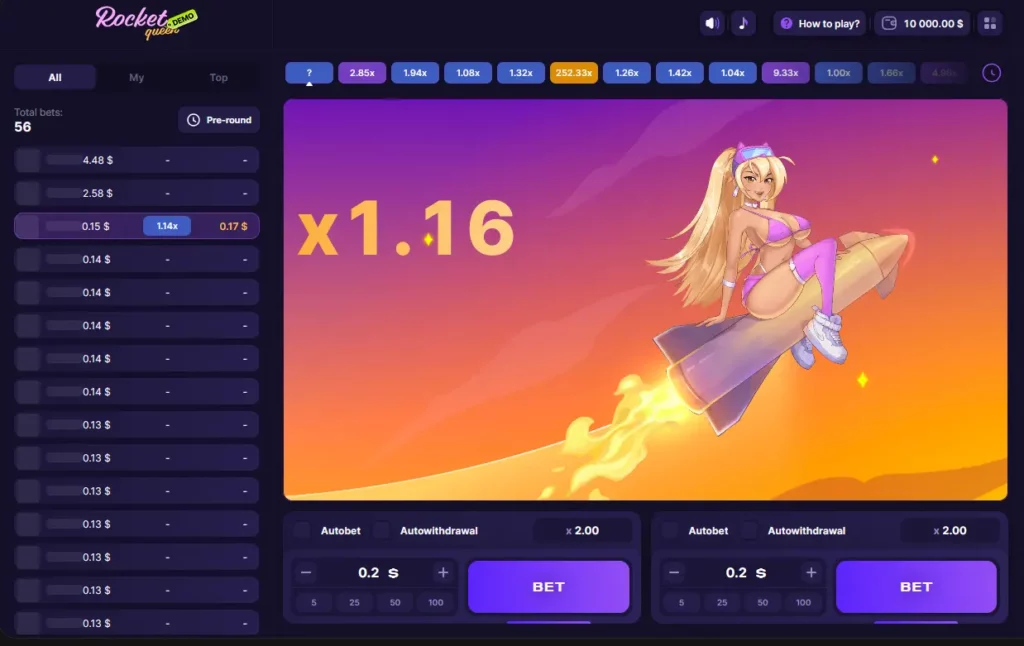
Rocket Queen Interface
Comparing Two Strategies Over 100 Rounds: A Variance Illustration
To make the variance difference concrete, consider two hypothetical players, each betting $10 per round for 100 rounds, using the approximate probabilities above.
Player A — conservative, targets 2.00x every round (≈48.5% hit rate):
- Expected number of wins: 100 × 0.485 ≈ 48–49 wins
- Each win returns $20 ($10 profit); each loss costs $10
- Expected total: (48.5 × $20) + (51.5 × $0) − $1,000 staked = $970 − $1,000 = ≈ −$30
- Session “feel”: frequent small wins, losses spread evenly, smoother balance curve
Player B — aggressive, targets 25.00x every round (≈3.88% hit rate):
- Expected number of wins: 100 × 0.0388 ≈ 3–4 wins
- Each win returns $250 ($240 profit); each loss costs $10
- Expected total: (3.88 × $250) − $1,000 staked = $970 − $1,000 = ≈ −$30
Both strategies land at the same expected loss of roughly $30 over 100 rounds — confirming the earlier math — but their actual session experiences look nothing alike. Player A will almost certainly see a result close to their expected value, since nearly half their rounds land. Player B has a real chance of hitting zero wins across all 100 rounds (a not-insignificant probability given a ~3.88% hit rate per round), finishing the session down the full $1,000 stake despite having the same theoretical edge as Player A. Conversely, Player B has a small chance of landing 6–8 hits instead of 3–4, producing a session that finishes strongly positive — a swing Player A’s strategy essentially can’t produce.
This is the practical meaning of “same EV, different variance”: neither approach is mathematically better, but they carry very different risk-of-ruin profiles over a finite number of rounds.
Bankroll Approach for a Fixed-Edge, High-Variance Format
Since no cashout target changes your edge, the only real levers you control are stake size and variance profile. A few concrete ways to apply that:
- Match your cashout strategy to your risk tolerance, not to a search for an edge. Since the EV is identical across targets, choose low multipliers for smoother, more frequent small wins, or high multipliers for rare but large ones — this is a personal variance preference, not a strategic advantage.
- Use the two-panel feature to split variance. Placing a smaller “safety” bet with an early auto-cashout (e.g., 1.5x) alongside a larger bet with no cashout set until a higher target lets you bank a modest return most rounds while still keeping exposure to a bigger multiplier.
- Set Auto Withdrawal before, not during, a round. Since the multiplier climbs in real time, deciding your cashout point in advance and configuring Auto Withdrawal removes the temptation to chase a round further than planned once it’s already climbing.
- Treat the $140 max bet as a session cap, not a target. At the maximum stake, a single lost round costs $140 outright; sizing bets as a small percentage of your total bankroll keeps a bad run from ending a session in a handful of rounds.
- Use the Leaderboard and Live panel as context, not a signal. The Top panel shows other players’ winnings by amount and multiplier over different time windows, and the Live panel shows real-time bets — useful for a sense of activity, but neither reflects anything predictive about the next round’s crash point, since each round is generated independently.
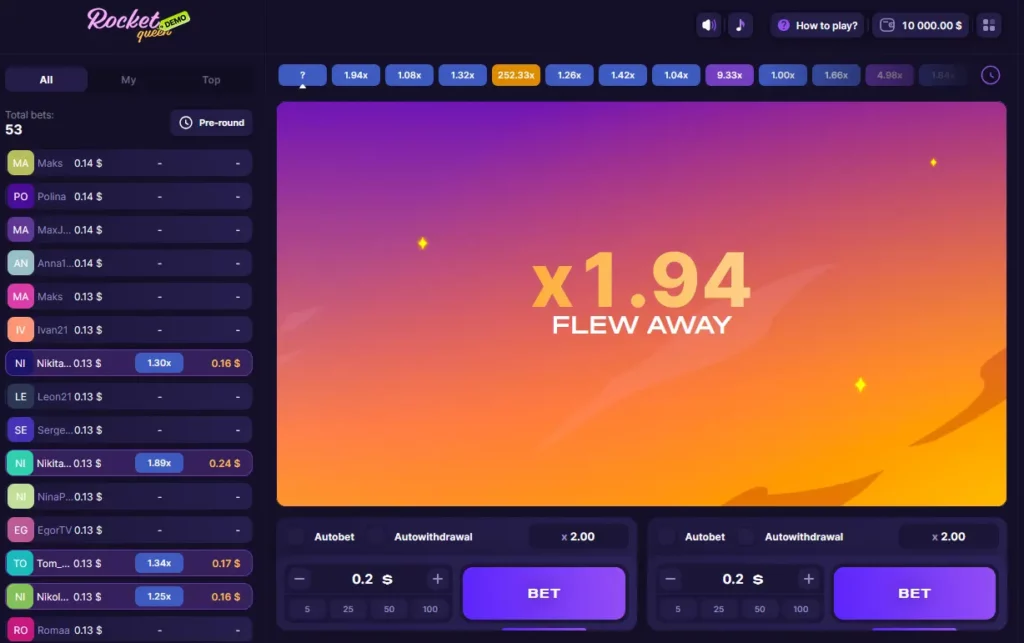
Rocket Queen End Game
Live Chat, Leaderboard, and Multi-Device Access
Beyond the core betting mechanic, Rocket Queen includes several social and accessibility features:
- Live Chat allows real-time interaction with other players during rounds. The chat prohibits advertising (external links, group/channel promotion), predictions about round outcomes, and using promotional text as a username — violations can result in a temporary or permanent ban from the chat.
- Leaderboard tracks top winnings by amount and multiplier across daily, weekly, and all-time windows, giving a reference point for how large multipliers have landed for other players recently, without implying anything about upcoming rounds.
- Multi-device support means the same game runs on desktop, laptop, tablet, and smartphone, built on lightweight JS/HTML5 technology (roughly 3.5 MB), so there’s no meaningful difference in features or fairness between playing on mobile versus desktop.
Malfunctions, Connection Issues, and Free Bet Terms
A few operational rules are worth knowing before playing for real money:
- Malfunction policy: if a technical malfunction affects the gaming software, all bets and payouts from the affected round are cancelled, and impacted players are reimbursed in full within 1 hour. If a technical error prevents a round’s result from being obtained at all, the win is credited at a flat 1.00x multiplier rather than being lost entirely.
- Connection issues: the operator isn’t responsible for a lost bet caused by the player’s own internet connection dropping mid-round, so a stable connection matters more here than in a standard slot, where a disconnect doesn’t cost you a live, ticking multiplier.
- Free bet terms are unusually detailed for a crash game:
- Winnings from a free bet are calculated as the free bet amount multiplied by the round’s payout multiplier, but the free bet stake itself is non-refundable unless stated otherwise.
- Switching to real-money play isn’t possible until all granted free bets are fully played — a batch of free bets needs to be used up before a standard cash wager can be placed again.
- Winnings accumulate across all free bets in a batch; if the batch isn’t fully played or it expires, accumulated winnings are lost.
- Total free bet winnings credit to the bonus balance, not directly to the withdrawable real-money balance, unless the specific promotion states otherwise.
- If a minimum withdrawal multiplier is set on a free bet, the Withdraw button stays locked until that threshold is reached; if a maximum payout limit is set, winnings are capped there regardless of how high the round’s multiplier climbs, and the system will auto-withdraw once that maximum multiplier is hit.
- Unused free bets expire after their stated validity period, and the provider can cancel free bets at its sole discretion at any time.
Registration and Getting Started
Getting into Rocket Queen for real money starts with a standard registration at 1xBet, which can be completed by entering personal details manually or signing up through a linked social account — typically name, location, age, contact details, and preferred currency. Identity verification (submitting ID, and in some cases proof of income) is standard practice across licensed operators and usually completes within 24 hours; once verified, the full game lobby, including Rocket Queen, becomes accessible.
It’s worth spending time in demo mode before betting real money — since the mechanic is entirely about timing a single cashout decision, practicing manual and automatic withdrawals with virtual funds first is the cheapest way to get comfortable with how quickly the multiplier can move before committing a real stake.
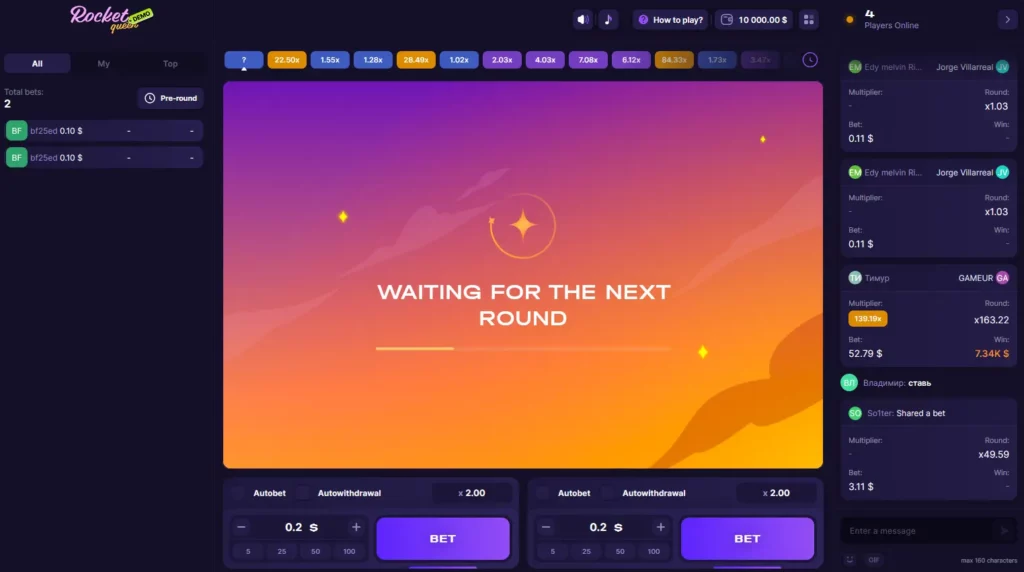
Rocket Queen Waiting for the next round
What’s Not Publicly Disclosed
Unlike most slots, where a max win figure and hit-frequency data are typically published alongside RTP, Rocket Queen’s official listing doesn’t disclose a maximum multiplier cap, a hit-frequency statistic, or a formal volatility rating. The 97% RTP is confirmed directly, but claims of multipliers reaching “hundreds or thousands of times” the stake — a description that circulates around this game — aren’t backed by an official published maximum, so it’s worth treating any specific max-multiplier figure you see elsewhere as unverified until 1xBetdiscloses one directly.
Getting started takes a standard registration, after which Rocket Queen is available directly in the game lobby alongside the rest of 1xBet’s crash titles. The game is also fully playable through the Android App or the iOS App, with the same Provably Fair mechanic, bet limits, and Auto Withdrawal settings as the desktop version. Players building a broader stake with the site’s Bonuses should keep the free bet wagering rule above in mind, since those funds need to be fully played before returning to standard cash bets.
Other slots at 1xBet
 Aiden Brooks
