



The Dog House Megaways
The Dog House Megaways is Pragmatic Play’s Megaways sequel to their 2019 hit The Dog House, swapping fixed paylines for up to 117,649 dynamic ways to win. Players browsing the slots on 1xBet will find this title listed under Pragmatic Play’s catalogue, and the numbers behind it deserve a closer look, since the RTP shown in the game itself can meaningfully differ from what’s quoted on generic slot-listing sites.
The Dog House Megaways at a Glance
| Parameter | Value |
|---|---|
| Developer | Pragmatic Play |
| Release date | 2020 |
| Reels | 6 (dynamic, 2–7 symbols per reel) |
| Ways to win | Up to 117,649 |
| RTP (as shown in 1xBet's game info panel) | 94.55% |
| Default/highest available RTP | 96.55% |
| Middle RTP configuration | 95.53% |
| Volatility | High (5/5) |
| Max win | 12,305x the bet |
| Min / Max bet | $0.20 / $240 |
| Free spins modes | Sticky Wilds, Raining Wilds |
| Bonus buy cost | 100x total bet |
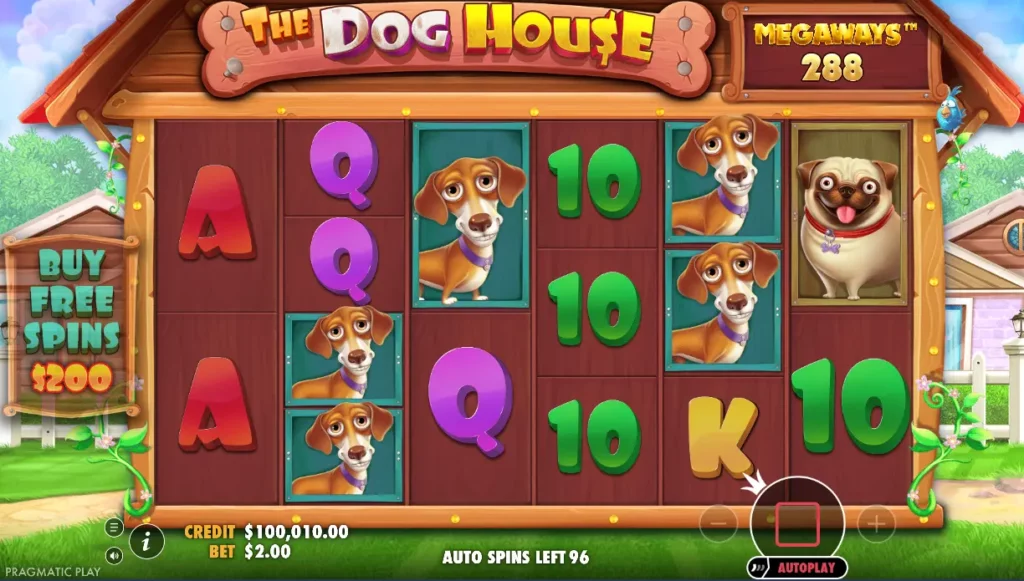
The Dog House Megaways Interface
Why the RTP You See Might Not Be 96.55% — The Math Behind the Gap
Most generic slot listings quote The Dog House Megaways at a 96.55% RTP, and that number is real — it’s the top of three certified configurations Pragmatic Play makes available to operators (96.55%, 95.53%, and 94.55%). Checking the actual in-game info panel on 1xBet shows the game running at 94.55% — the floor of that range, not the ceiling.
Here’s what that gap costs in concrete terms. House edge is simply 100% minus RTP:
| RTP setting | House edge | Expected loss per $100 wagered |
|---|---|---|
| 96.55% | 3.45% | $3.45 |
| 95.53% | 4.47% | $4.47 |
| 94.55% | 5.45% | $5.45 |
That’s a 58% larger house edge at 94.55% compared to 96.55% (5.45% ÷ 3.45% ≈ 1.58), even though the RTP difference looks small at just 2 percentage points.
Worked example at $2 per spin over a 500-spin session ($1,000 total wagered):
- At 96.55% RTP: expected return = $965.50 → expected loss of $34.50
- At 94.55% RTP: expected return = $945.50 → expected loss of $54.50
- Difference: $20 more lost over the same 500 spins, purely from the RTP configuration, before variance even enters the picture
Scale that to a 2,000-spin session at the same $2 stake ($4,000 wagered), and the gap widens to $80 in expected loss between the two settings. None of this is guaranteed on any single session — high volatility means actual results swing far from the theoretical average — but it sets the baseline you’re playing against.
Practical takeaway: open the game’s info panel (the “i” icon in the bottom corner) before committing real money. The RTP is printed directly on the rules pages rather than hidden — this applies to any Pragmatic Play Megaways title, not just this one, since the same three-tier structure is standard across their catalogue.
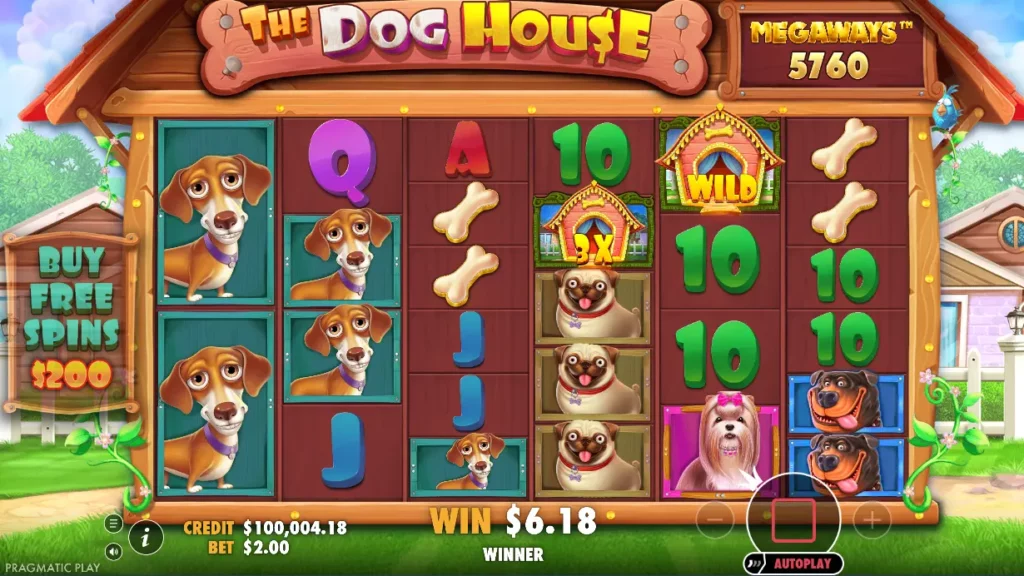
The Dog House Megaways Win
How the Reels and Ways to Win Work
The Dog House Megaways runs on a 6-reel grid where each reel independently displays between 2 and 7 symbols on every spin. That variability generates the changing ways-to-win count, from 64 on a minimal spin up to the full 117,649 when every reel maxes out at 7 symbols.
To put that range in perspective: going from the minimum to the maximum represents an 1,838x increase in the number of simultaneous ways a symbol combination can pay (117,649 ÷ 64 ≈ 1,838.3), which is why the “Megaways” counter displayed above the reels can look dramatically different from spin to spin — a screen showing mostly 2-symbol reels might carry only a few hundred ways, while a screen with several 6-or-7-symbol reels can carry tens of thousands.
Wins are read left to right on adjacent reels starting from reel 1 — a combination that skips a reel doesn’t count, even if the matching symbol reappears further along. Only the highest-paying combination is counted per unique symbol pattern, but wins from separate patterns on the same spin are added together into the total payout.
Full Paytable, With Worked Payout Examples
The premium symbols are four dog breeds, while the lower-value symbols are the standard 10 through Ace card ranks.
| Symbol | 3 symbols | 4 symbols | 5 symbols | 6 symbols |
|---|---|---|---|---|
| 10 | 0.05x | 0.1x | 0.2x | 0.5x |
| J | 0.05x | 0.1x | 0.2x | 0.5x |
| Q | 0.1x | 0.2x | 0.3x | 1x |
| K | 0.1x | 0.2x | 0.3x | 1x |
| A | 0.1x | 0.2x | 0.3x | 1x |
| Bone | 0.15x | 0.4x | 0.5x | 1.5x |
| Collar | 0.15x | 0.4x | 0.5x | 1.5x |
| Dachshund | 0.15x | 0.5x | 0.75x | 1.5x |
| Pug | 0.35x | 0.75x | 1x | 2x |
| Shih Tzu | 0.5x | 1x | 1.5x | 3x |
| Rottweiler | 0.75x | 2x | 3x | 7.5x |
Bold tip: the payout gap between the weakest and strongest regular symbols is steep. On a $2 bet:
- A 6-of-a-kind win on 10s or Js pays $1.00
- A 6-of-a-kind win on Rottweilers pays $15.00 — 15 times more for the same combination length
This gap is a direct driver of the game’s high volatility rating: most of the reel space is occupied by low-value card symbols, so a “typical” winning spin skews toward the smaller end of the paytable, while premium-symbol wins are comparatively rare but disproportionately larger.
The Dog House Wild and the Multiplier Math
The Dog House symbol is Wild and substitutes for every regular symbol except the Paw Print Scatter, appearing exclusively on reels 2, 3, 4, and 5. Whenever a Wild lands, it’s randomly assigned a multiplier of 2x or 3x, and multiple wilds in the same winning combination have their multipliers multiplied together, not added.
This compounding structure creates a wide gap between modest and extreme outcomes. Take a base combination win worth $10 before any multiplier is applied, and compare how the payout scales depending on how many wilds contribute and what multipliers they carry:
| Wilds in the combination | Multipliers rolled | Combined multiplier | Payout on a $10 base win |
|---|---|---|---|
| 1 wild | 2x | 2x | $20 |
| 1 wild | 3x | 3x | $30 |
| 2 wilds | 2x, 3x | 6x (2×3) | $60 |
| 2 wilds | 3x, 3x | 9x (3×3) | $90 |
| 3 wilds | 2x, 3x, 3x | 18x (2×3×3) | $180 |
| 3 wilds | 3x, 3x, 3x | 27x (3×3×3) | $270 |
Compare the last row to what an additive system (multipliers added rather than multiplied) would produce on the same three-wild combination: 2+3+3 = 8x, or 3+3+3 = 9x — a payout of $80 or $90, versus the $180–$270 the actual multiplicative rule delivers. That gap — roughly 2 to 3 times larger under multiplication once three wilds are involved — is exactly why landing multiple wilds on one combination during a Sticky Wilds round is the single biggest driver of the game’s headline 12,305x win potential, and it’s worth double-checking this rule in the info panel, since some third-party listings describe it incorrectly as additive.
Free Spins: Two Modes, One Choice
Landing 3 or more Paw Print Scatters anywhere on the reels triggers the bonus round, with a choice between two modes. Neither can be retriggered once chosen.
Sticky Wilds Free Spins:
| Scatters landed | Free spins awarded | Sticky wilds per reel |
|---|---|---|
| 3 | 7 | 2–7 |
| 4 | 12 | 2–7 |
| 5 | 15 | 2–7 |
| 6 | 20 | 3–7 |
Any wild that lands during the round carries a random 1x, 2x, or 3x multiplier and stays locked in place for the rest of the round, with each reel’s minimum size guaranteed to match however many sticky wilds sit on it. This means a 7-spin round triggered by 3 scatters can still end with a reel permanently holding 2–7 stacked wilds by its final spin, each with their own multiplier compounding on every subsequent win that includes them — a single locked 3x wild sitting on a reel for the remaining 6 spins effectively multiplies every winning combination it touches across that entire stretch.
Raining Wilds Free Spins:
| Scatters landed | Free spins awarded | Wilds per spin |
|---|---|---|
| 3 | 15 | Up to 6 |
| 4 | 18 | Up to 6 |
| 5 | 25 | Up to 6 |
| 6 | 30 | Up to 6 |
Here, up to 6 new Wild symbols with fresh 1x/2x/3x multipliers can drop into random positions on every single spin, without carrying over. Note the spin-count trade-off directly: for a 3-scatter trigger, Sticky Wilds gives you 7 spins while Raining Wilds gives you more than double that at 15 — the shorter Sticky Wilds round compensates with accumulation, while Raining Wilds compensates with sheer spin volume.
Choosing between them comes down to variance preference:
- Sticky Wilds rewards a round where wilds land early and often, since accumulation compounds toward the final spins — but a round with sparse wild landings can end with little built up.
- Raining Wilds spreads wild density evenly across roughly double the spins, trading the compounding ceiling for more consistent opportunities throughout a longer round.
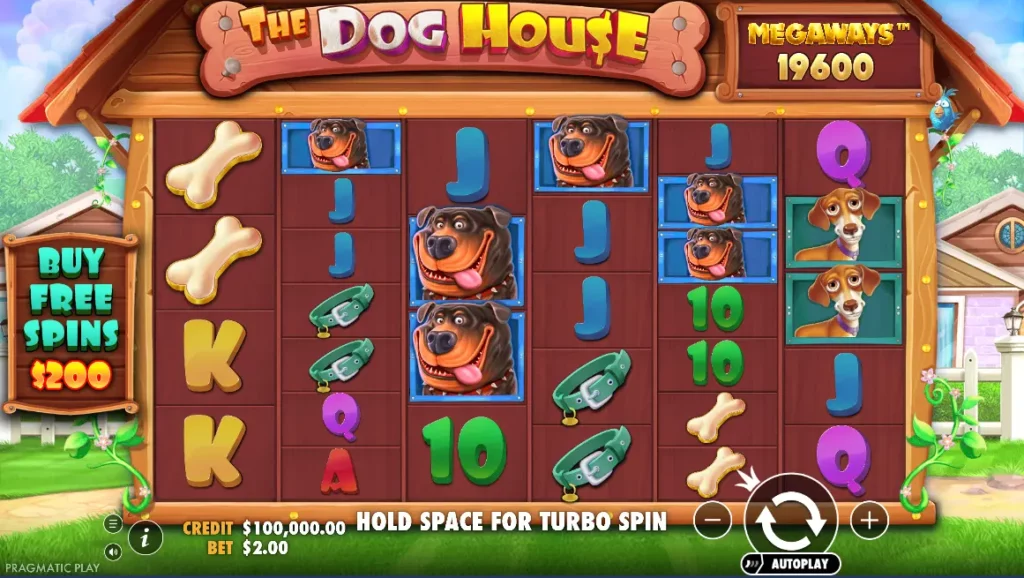
The Dog House Megaways at 1xBet
Buying the Bonus Round: The Real Cost
Rather than waiting for scatters to land naturally, Buy Free Spins triggers the bonus instantly for 100x your total bet. On a $2 bet, that’s a $200 upfront cost for guaranteed entry into a randomly determined 3–6 scatter outcome, with your free spins count and mode choice determined exactly as if you’d triggered it organically.
To evaluate whether that’s worth it, compare it against the theoretical RTP: if the bonus buy feature is priced fairly relative to the base RTP, the expected return from a $200 buy should sit somewhere in the neighborhood of $200 × 0.9455 = $189 at the 94.55% setting — meaning on average, you’re still paying for the convenience of skipping the wait, not gaining a mathematical edge. Some community-tracked data from live sessions suggests actual average bonus-buy returns can run below this theoretical baseline more often than above it, though that data isn’t officially published by Pragmatic Play and should be treated as anecdotal rather than certified. The buy feature’s real value is time savings and variance control, not a hidden edge over natural triggers.
Volatility, Hit Frequency, and What a Session Actually Feels Like
The Dog House Megaways carries the maximum volatility rating, 5 out of 5, which the in-game rules describe directly: high-volatility games pay out less often on average, with a higher chance of a big win in a short span. Independent community tracking (not an officially published Pragmatic Play statistic) has put the base-game hit frequency somewhere in the low-to-high 20% range depending on the sample, meaning a meaningful stretch of spins — often into the hundreds — can pass between free spins triggers.
That structure has a direct bankroll implication: at a $2 bet with, say, 300 dry spins before a bonus trigger, you’d be looking at roughly $600 in wagering with no bonus round factored in, purely from base-game variance. This is why bankroll sizing for this specific title should assume longer dry stretches than a medium-volatility slot, and why the free spins mode choice — not the base game — carries most of the game’s realistic upside.
A few adjustments make that volatility more manageable:
- Size your stake for triple-digit dry spells, not average outcomes. A 94.55%–96.55% theoretical RTP describes millions of spins, not a single session.
- Decide your free spins mode preference in advance. Sticky Wilds for accumulation potential, Raining Wilds for spin volume and steadier wild exposure.
- Treat Buy Free Spins as a time-saving tool, not a value play — the math above shows it’s priced close to the base RTP, not below it.
- Check the info panel RTP before your first real-money spin, given the 2-point spread between 94.55% and 96.55%.
Getting set up takes a standard registration, after which The Dog House Megaways is available directly in the casino section. The game is also fully playable through the Android app or the iOS app, with the same paytable, RTP setting, and bonus modes as the desktop version.
Other slots at 1xBet
 Aiden Brooks
