



Group H at the 2026 World Cup
1xBet has Group H built around one certainty and three genuine unknowns. Spain arrive as the world’s top-ranked side and will win this group — that much is settled. Everything else is genuinely uncertain: two-time world champions chasing a return to relevance under one of football’s most demanding coaches, a Gulf state with billion-dollar infrastructure but a squad of largely unknown locals, and a debut team from an island of half a million people whose goalkeeper is currently without a club. Spain will advance. Everything else is exactly what makes this group worth watching from the first minute.
Group H Overview
Four teams with four completely different relationships to this tournament. Spain arrive to prove that 2010 was the beginning of something rather than an isolated peak. Uruguay come with Bielsa’s philosophy, Valverde’s brilliance and a genuine question mark over goals. Saudi Arabia bring the memory of one iconic moment against Argentina and a new coach appointed weeks before the tournament. And Cape Verde arrive at their first-ever World Cup having overturned a 1-4 deficit against Cameroon to get here — a story that already deserves its own chapter.
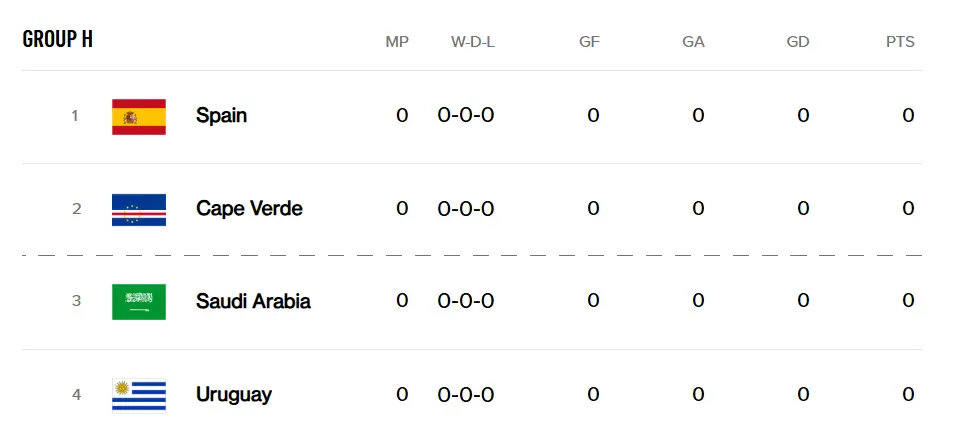
World Cup 2026 Group H
Spain
The world’s best team, back to prove 2010 wasn’t a one-off
Spain enter the 2026 World Cup ranked first in the world by FIFA — a position earned through consistent dominance at every level of international football over the past two years. Their only World Cup title came in 2010 in South Africa, where Andres Iniesta’s extra-time goal beat the Netherlands. Since then: a catastrophic group-stage exit as defending champions in 2014, a round-of-16 elimination by Russia on penalties in 2018, and a last-16 defeat to Morocco in Qatar 2022. Three consecutive disappointments that the current generation is desperate to correct.
The squad Luis de la Fuente has assembled around the La Masia conveyor belt of talent is arguably the deepest Spain has had since the tiki-taka era. They won Euro 2024 with a style that felt both faithful to their tradition and refreshingly direct — high press, quick transitions, relentless width. The question is not whether Spain will advance from this group. It is how far they can go once the knockout rounds begin.
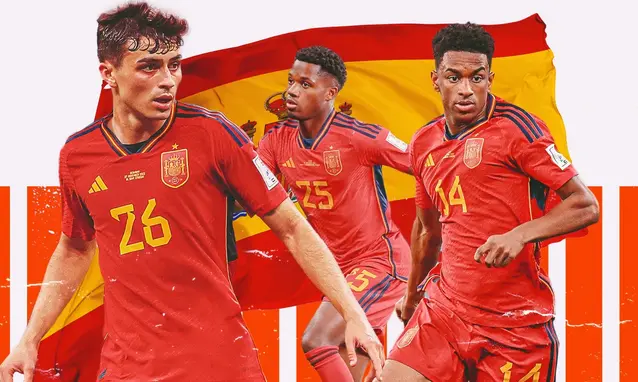
World Cup 2026. Spain
Qualifying — businesslike and dominant
Spain won European qualifying Group E without significant difficulty. The clearest statement came in a 6-0 victory over Turkey — a comprehensive demolition that underlined the gap between them and even quality opponents.
Playing style and key players
Luis de la Fuente’s Spain play a 4-3-3 built around positional fluidity, aggressive pressing and the creative exploitation of wide spaces. The fullbacks push high, the midfield rotates constantly and the front three press as a unit and combine instinctively in possession.
- Lamine Yamal — the teenager who won Euro 2024 with a goal that will be replayed for decades. Now the undisputed first name on the teamsheet, operating from the right wing with a freedom and directness that no defensive system has yet found a reliable answer to. His combination of dribbling, vision and composure in decisive moments is not supposed to exist in a player this young.
- Pedri (Barcelona) — the metronome in the centre. His ability to receive under pressure, find angles and drive forward with the ball makes him the architectural core of the Spanish midfield. When Pedri is playing well, Spain’s entire tempo changes.
- Rodri (Manchester City) — the Ballon d’Or holder and the player who makes the entire system function. His positioning, passing range and ability to read the game before it develops gives Spain a level of midfield control that most squads can only admire from a distance.
- Martin Zubimendi (Real Sociedad) — Rodri’s partner in defensive midfield, providing the screening and coverage that allows the more attacking players to press higher. Quiet, precise and massively underrated.
- Dani Olmo — creative, direct and capable of scoring from central midfield positions. His movement between lines creates constant discomfort for organised defences.
- Pau Cubarsi (Barcelona) — one of the most composed young centre-backs in European football, already commanding the Barcelona defensive line at club level.
- Alejandro Grimaldo (Bayer Leverkusen) — the left-back who combines defensive reliability with extraordinary attacking output. His delivery and late runs create a constant threat that opponents must track specifically.
- David Raya (Arsenal) — the first-choice goalkeeper whose distribution and sweeping make him integral to how Spain build from the back.
- Mikel Oyarzabal — the experienced centre-forward option, calm and clinical in front of goal. His goal in the Euro 2024 final reminded everyone that he produces in the moments that matter most.
Uruguay
The original champions, searching for a new era
Uruguay are the first world champions in history — winners in 1930 and 1950 — and one of the most storied names in the sport. The Charrua have also won the Copa America 15 times. No nation this small has achieved so much in football. The generation of Forlan, Suarez and Cavani reached the semi-final in 2010 and carried the country’s ambitions for over a decade. That generation is now gone. What remains is a transition squad guided by Marcelo Bielsa’s unmistakable philosophy.
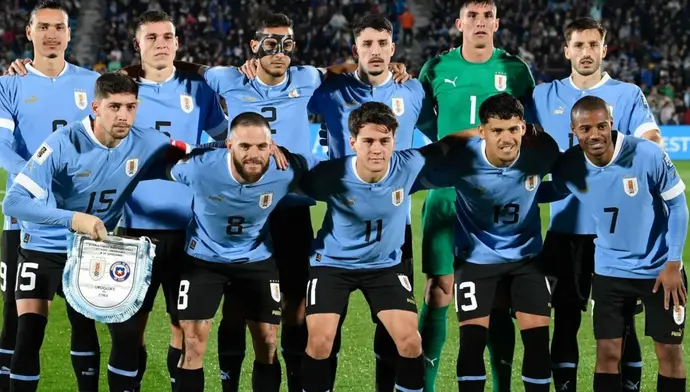
World Cup 2026. Uruguay
A qualifying campaign of gritty arithmetic
Uruguay finished fourth in South American qualifying — one of the six direct berths — after a campaign with two very distinct phases. The first six games brought four wins including victories over Chile (3-1), Argentina (2-0) and Brazil (2-0). The final twelve games brought only three wins and a series of goalless draws. Without the focal point of Suarez, goalscoring has become Uruguay’s fundamental challenge. Bielsa has built an exceptional defensive structure — 12 goals conceded in 18 games — but the attacking output relies heavily on individual moments of quality rather than sustained pressure.
Playing style and key players
Bielsa’s Uruguay are one of the most philosophically coherent teams at the tournament. The entire system is built on three interlocking principles: aggressive high pressing the moment possession is lost, constant movement and positional interchange across all lines, and individual responsibility for creating solutions within the collective structure. It is physically and mentally demanding football that rewards versatility and punishes those who cannot sustain intensity for 90 minutes.
- Federico Valverde (Real Madrid) — the most important player in the squad and one of the most complete midfielders in world football. His ability to press, carry, pass, shoot and defend makes him the perfect vehicle for Bielsa’s system. Without Valverde, Uruguay functionally become a different team.
- Ronald Araujo (Barcelona) — the athletic centre-back who pushes higher than any traditional defender in this system, contributing to pressing triggers and arriving late in attacking situations.
- Jose Maria Gimenez (Atletico Madrid) — the experienced anchor of the defensive unit, reading the game behind Araujo and covering the spaces created by Uruguay’s high defensive line. At 31, he compensates for a slight loss of pace with positioning and authority.
- Manuel Ugarte (Manchester United) — the defensive midfielder whose energy and work rate embodies everything Bielsa asks of his players. His ability to win the ball and immediately begin the next attack is central to Uruguay’s press-and-go identity.
- Darwin Nunez — the one genuine centre-forward in the squad, currently in an unusual personal situation having been excluded from his club setup. His movement off the ball creates space for Valverde and the midfielders — converting that space into goals is the one question mark hanging over Uruguay’s tournament.
- Marcelo Bielsa (70) — one of the most influential coaching minds in football history. His philosophy has shaped coaches from Guardiola to Pochettino. The 2026 tournament is his chance to finally win something on the biggest stage.
Saudi Arabia
Billions invested, a squad of unknowns and one goal against Argentina
Saudi Arabia are one of world football’s most contradictory propositions. The country hosts Cristiano Ronaldo, Karim Benzema, Neymar and dozens of other global stars in its domestic league. Stadiums are being built at extraordinary speed. The 2034 World Cup is coming to Riyadh. And yet the national team consists almost entirely of Saudi Pro League players, with barely a handful of Europeans in the squad, and their best-known moment in recent football history remains a single Saleh Al-Dawsari goal against Lionel Messi.
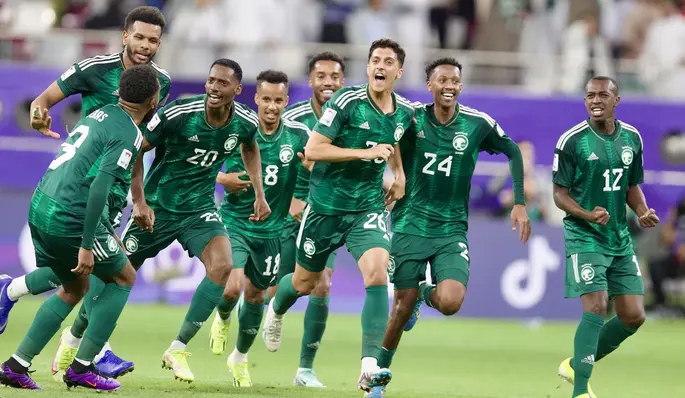
World Cup 2026. Saudi Arabia
A chaotic qualifying campaign with a scandalous finale
Saudi Arabia entered Asian qualifying in the second round and immediately showed the inconsistency that has defined the team. A shock home defeat to Jordan was the first warning. The third round brought defeats to both Japan and Australia, then a humiliating loss to Indonesia (1-2). The decisive qualifying phase descended into controversy — Saudi Arabia were accused by both Iraq and Indonesia of manipulating the schedule to maximise rest advantages. They beat Indonesia (3-2) and drew with Iraq (0-0), advancing on goal difference alone.
Then, weeks before the tournament, Herve Renard — the coach who masterminded the Argentina win in 2022 — departed. In came Giorgos Donis (56), a Greek coach who had previously managed Al-Hilal and spent years in the Saudi domestic system. His appointment was built on familiarity with the local mentality and an ability to deliver results with limited resources.
Playing style and key players
Renard had implemented a 4-2-3-1 with genuine tactical sophistication — high press, mobile wingers, rapid transitions. Donis inherits that structure and is expected to maintain it. The system’s effectiveness is entirely dependent on individual execution, which against Spain and Uruguay will be severely tested.
- Salem Al-Dawsari (34, Al-Hilal) — the only Saudi player most of the world could name. The man who scored the iconic goal against Argentina in Qatar 2022. Still the team’s most important creative figure despite advancing age and increasingly frequent injuries. He scores in the moments that matter — two crucial qualifying goals in tight matches.
- Mohammed Kanno (Al-Hilal) — the 190cm holding midfielder who has benefited from sharing a midfield with Milinkovic-Savic, Malcolm and Ruben Neves at club level. Physical, aggressive and impossible to drop.
- Firas Al-Buraikan (25, Al-Ahli) — the team’s most reliable scorer with 15 goals in 67 appearances. Scored the decisive brace against Indonesia in the crucial qualifying match and tends to produce his best football specifically for the national team.
- Giorgos Donis — took charge weeks before the tournament. His knowledge of Saudi football is genuine; his ability to prepare a team for Spain and Uruguay in limited time is the central uncertainty.
Cape Verde
From a 1-4 deficit to the World Cup
Cape Verde is an island nation of approximately 500,000 people off the west coast of Africa. Independent from Portugal only since 1975, with a football federation established in 1982, their squad is a global patchwork: a Portuguese-raised goalkeeper currently without a club, a defender who played in Hungary, midfielders from Sweden and Switzerland, and a forward born in the Netherlands. It looks less like a national team than a football version of an international assembly. It is also, genuinely, a World Cup squad.
Notable also: two players from the Russian league feature in the squad — Kevin Lenini from Krasnodar and Benchimol from Akron Togliatti — giving Russian football followers a specific reason to follow these games closely.
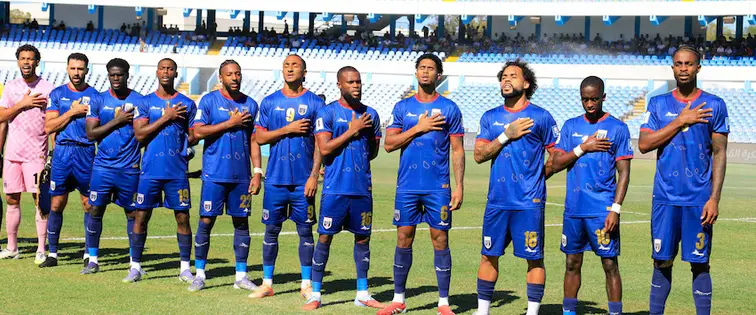
World Cup 2026. Cape Verde
The comeback against Cameroon that changed everything
Cape Verde’s qualifying group contained Eswatini, Mauritius, Angola, Libya and Cameroon. The campaign did not begin promisingly — a 1-4 defeat in the first leg against Cameroon appeared to end their realistic hopes early. What followed was one of the more extraordinary reversals in African qualifying history. In the return fixture, Cape Verde kept a clean sheet and won 1-0. That single result shifted the entire campaign — the Blue Sharks climbed to first place and held on until the final match, when a 3-0 win over Eswatini in front of their home supporters sealed a first-ever World Cup appearance.
Playing style and key players
Cape Verde do not attempt to control games. Their identity is built on fast counter-attacks exploiting wide areas, defensive compactness and extraordinary finishing efficiency — they scored 1.6 goals per game from an average of just 2.2 shots on target. That conversion rate belongs to a team that takes very few chances and makes almost all of them count.
- Ryan Mendes (35) — the captain and record appearance-maker. No longer the primary goal threat, he operates as the senior playmaker from whom younger attacking players receive the ball. The experience and composure he brings are irreplaceable.
- Dylon Livramento (24, on loan at Casa Pia) — the team’s main attacking hope. Scored the only goal in the decisive win over Cameroon. Fast, direct and improving rapidly. At home he is regarded as the country’s biggest footballing star.
- Steven Moreira (31, Columbus Crew) — the right-back with three MLS Cup titles. Ferociously competitive in one-on-one duels and quick enough to recover defensive positions against faster opponents.
- Kevin Lenini (Krasnodar, RPL) — the first-choice holding midfielder. Plays almost every minute for the national team and cited in the tactical setup as the player who kills opposition attacks in the central zone. Two goals and an assist in 28 appearances.
- Benchimol (Akron Togliatti, RPL) — the attacking option off the bench, typically receiving 10-25 minutes and making them count. Five goals and three assists in 20 national team appearances — defined by impact rather than volume.
- Bubista — the head coach whose winding journey through eight different roles over 15 years brought him to the Cape Verde job in 2020. He has now delivered their most extraordinary result. First-time World Cup stories often begin with coaches nobody has heard of yet.
Who Advances from Group H
| Team | 1xBet |
|---|---|
| Spain | 1.01 |
| Uruguay | 1.15 |
| Saudi Arabia | 1.79 |
| Cape Verde | 2.58 |
Spain at 1.01 is simply a statement that no alternative universe exists in which La Furia Roja fail to reach the knockout rounds. The world’s top-ranked team, the deepest squad in the group by enormous distance, and opponents that are not France, Germany or Brazil. Uruguay (1.15) are treated as near-certainties too, and rightly — Bielsa’s defensive structure conceded only 12 goals in 18 South American qualifiers, and Saudi Arabia and Cape Verde are not going to dismantle it. Saudi Arabia (1.79) sit third in the market — the bookmakers are genuinely uncertain whether the Green Falcons can beat Cape Verde and take points off Uruguay. Cape Verde (2.58) — advancing would require beating Saudi Arabia and picking up something against Uruguay. The counter-attacking efficiency they showed in qualifying is a genuine weapon, but the gap in individual quality is significant.

Group H. World Cup 2026. Odds at 1xBet
Who Wins Group H
| Team | 1xBet |
|---|---|
| Spain | 1.21 |
| Uruguay | 5.00 |
| Saudi Arabia | 17.00 |
| Cape Verde | 55.00 |
Spain (1.21) are almost as short to top the group as they are to simply advance — which accurately reflects the reality that no team here is expected to beat them. The only scenario in which Spain don’t finish first involves an unexplained collective failure of form. Uruguay (5.00) are the only realistic challengers for first place — their direct game against Spain is the group’s defining fixture. Bielsa’s high press could make the Spanish midfield uncomfortable, but whether that translates into goals against Rodri and Zubimendi is a different question entirely. Saudi Arabia (17.00) — first place would require beating both Uruguay and Spain, which demands performances that would make the Al-Dawsari goal against Argentina look like an ordinary afternoon. Cape Verde (55.00) — first place for the World Cup debutants from an island of 500,000 people would be the most extraordinary story in the history of the group stage.
Our Predictions
Group H will confirm Spain’s position as one of the three or four genuine contenders for the title. They will win every game, accumulate near-maximum points and enter the knockout phase in the most dangerous possible form.
Second place belongs to Uruguay. Bielsa’s defensive organisation and Valverde’s individual quality are too much for Saudi Arabia and Cape Verde. The Charrua will be compact, difficult to play through and clinical enough in transition to collect six points from their two winnable fixtures.
The third and fourth positions are where the real interest lies. Saudi Arabia will beat Cape Verde — the gap in individual quality is too large to ignore — but Cape Verde will push them closer than anyone expects. The Blue Sharks’ counter-attacking efficiency means they will create chances even from limited possession. Livramento will score at this World Cup. Their debut will not be entirely without reward. It never is for teams who refuse to behave like the tournament’s obvious victims.
Other Groups WC-2026 at 1xBet
 Aiden Brooks
